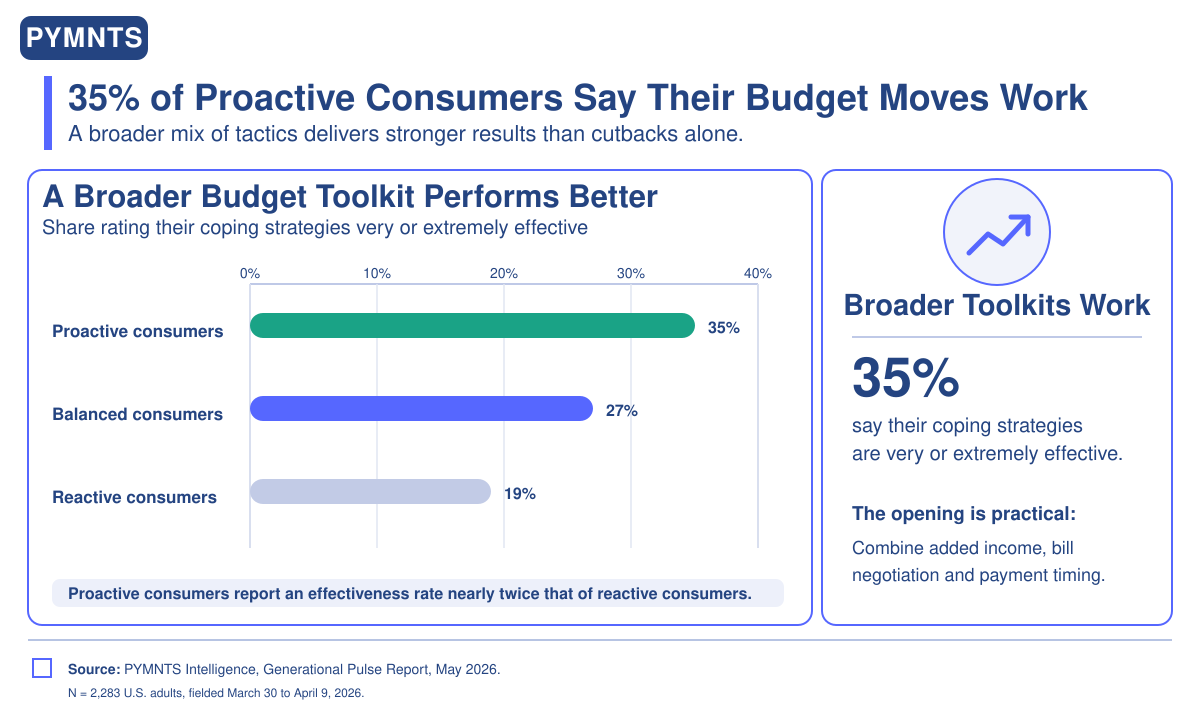
Households squeezed by higher prices are getting better results when they treat budgeting like a toolbox, not a single pair of scissors.
A new PYMNTS Intelligence data book, “Five Ways Consumers Make Tight Budgets Work Harder,” finds that consumers are combining small changes to protect essential spending. They’re trimming selected extras, buying store brands, checking prices from store aisles and moving more grocery spending to retailers associated with value. Some are also adding income, negotiating bills and adjusting payment timing. The most encouraging result is that consumers who use several tactics report more success than those who rely mainly on spending cuts.
- A broader toolkit produces stronger results. Thirty-five percent of proactive consumers rated their coping strategies as very or extremely effective. That compares with 27% of balanced consumers and 19% of reactive consumers. Proactive households are more likely to combine added income, bill negotiations and payment timing. The approach doesn’t erase higher costs, but it can give families more control over when money arrives and leaves.
- Consumers are cutting selectively. Among paycheck-to-paycheck consumers who struggle to pay bills, 53% spent less on nonessential purchases such as dining out, entertainment and travel during the past year. That rate was nearly double the 27% recorded among consumers who don’t live paycheck to paycheck. Another 24% of financially strained consumers kept nonessential spending about the same, while 23% spent more. The figures suggest many households are protecting room for some discretionary purchases instead of abandoning them altogether.
- Everyday shopping tools are doing more work. Nearly half of Labor Economy consumers, or 49%, bought store-brand or private-label products in the past year. Store brands edged out coupons and promotional codes, which 46% used. Smartphones also helped at the shelf: 35% of consumers who used mobile assistance while shopping in stores searched for coupons and discounts, while 26% compared prices at other merchants.
Where consumers shop also reflects financial pressure. Among online grocery shoppers with high financial stress, 56% made their most recent purchase from Walmart, compared with 50% of those reporting low stress. The in-store gap was wider, at 37% versus 26%.
These shifts won’t remove the strain caused by higher prices. Still, the findings show consumers have more levers to pull than cutting expenses alone. Small moves can reinforce one another. By combining savings, shopping and cash-flow tactics, households can create a little more breathing room while keeping essential bills on track.
At PYMNTS Intelligence, we work with businesses to uncover insights that fuel intelligent, data-driven discussions on changing customer expectations, a more connected economy and the strategic shifts necessary to achieve outcomes. With rigorous research methodologies and unwavering commitment to objective quality, we offer trusted data to grow your business. As our partner, you’ll have access to our diverse team of PhDs, researchers, data analysts, number crunchers, subject matter veterans and editorial experts.