The latest data on spending shows it continues to outrun income growth as higher prices absorb more of the household budget. June offered another example: The Personal Consumption Expenditures reading for that month indicated that consumers increased their spending 0.3% from May while personal income, disposable income and wages each rose 0.2%, as reported by the Bureau of Economic Analysis (BEA).
More revealing was what consumers received for that additional spending. After adjusting for prices, consumption increased only 0.1%. In other words, households spent more, but much of the additional money went toward paying higher prices rather than buying substantially more “volume” of goods and services.
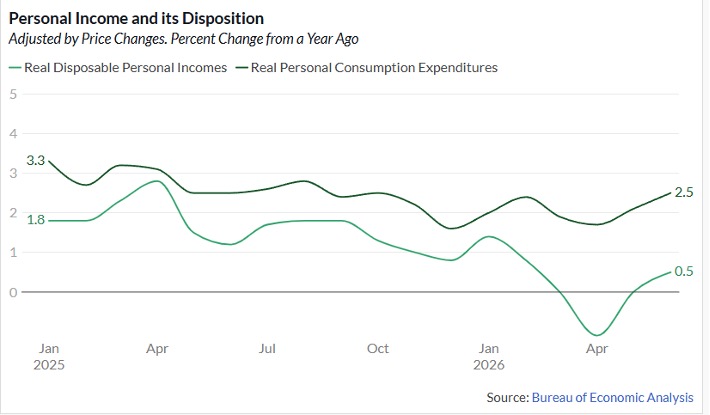
The latest government numbers from Thursday (July 30) fit with PYMNTS Intelligence has been finding at the household level: Consumer spending is positive even as the financial capacity supporting it becomes more constrained.
The issue for banks, merchants and payments companies is therefore bigger than whether spending is rising or falling. It is how consumers are keeping spending going, what gets cut first when budgets tighten, and which payment methods become more important when the paycheck provides less room.
Prices are central to that equation. The PCE price index increased 0.3% in June. Services spending rose 0.4%, including increases in transportation and recreation, while spending on motor vehicles and parts increased 2.3%. The increases have pushed nominal spending higher even when household purchasing power is making considerably less progress.
The Spending Number Doesn’t Show the Whole Consumer
The July PYMNTS Consumer Expectations Index (PCEI) adds a layer of insight into the psychology behind what might be termed the “propensity to spend” in the future.
Consumers became more confident about the broader economy in July, pushing the PCEI to 55.6. But their view of their own financial position did not improve nearly as much.
The PCEI found that consumers’ three-year outlook for the national economy improved by 4.1 points in July, while their outlook for their own household finances increased just 0.8 points. The report also found weakening confidence in job security, particularly among financially constrained households.
Separately, PYMNTS’ Wage to Wallet Index shows what that looks like closer to checkout.
PYMNTS Intelligence’s data show that the Labor Economy, roughly 60 million workers earning no more than $25 an hour and generally less than $50,000 annually, accounts for more than one-third of employed adults.
Forty-six percent said they had reduced nonessential spending during the previous year, and 40% eliminated at least one “want” category entirely. Their nonessential spending averaged $452 a month, 43% below the $787 reported by higher earners.
That matters to retailers because aggregate consumer spending can look relatively healthy while the mix underneath it shifts toward necessities.
Credit Can Extend the Paycheck, but Not for Everyone
The gap between income and spending naturally raises the question of credit.
Credit can provide households with additional cash-flow flexibility when spending runs ahead of current income. But the Wage to Wallet data shows why it would be misleading to assume consumers simply put the difference on their cards.
Debit is the most-used payment method for 43% of Labor Economy consumers, compared with just 16% for credit cards. One in five had not used a credit card at all during the previous year.
Installments provide another route. Labor Economy consumers use BNPL at roughly the same rate as higher earners, 22% versus 23%. More important is why they use financing: 45% of Labor Economy consumers who used installments said they did so because they could not cover the full purchase price at once.
The PYMNTS Intelligence data indicates that the government’s June spending numbers are more consequential than a 0.3% increase might suggest.
Consumers are still spending. But wages grew more slowly, prices consumed much of the increase, and PYMNTS Intelligence shows financially constrained households already making choices about what to cut, what to put on debit and when to spread a purchase across payments.