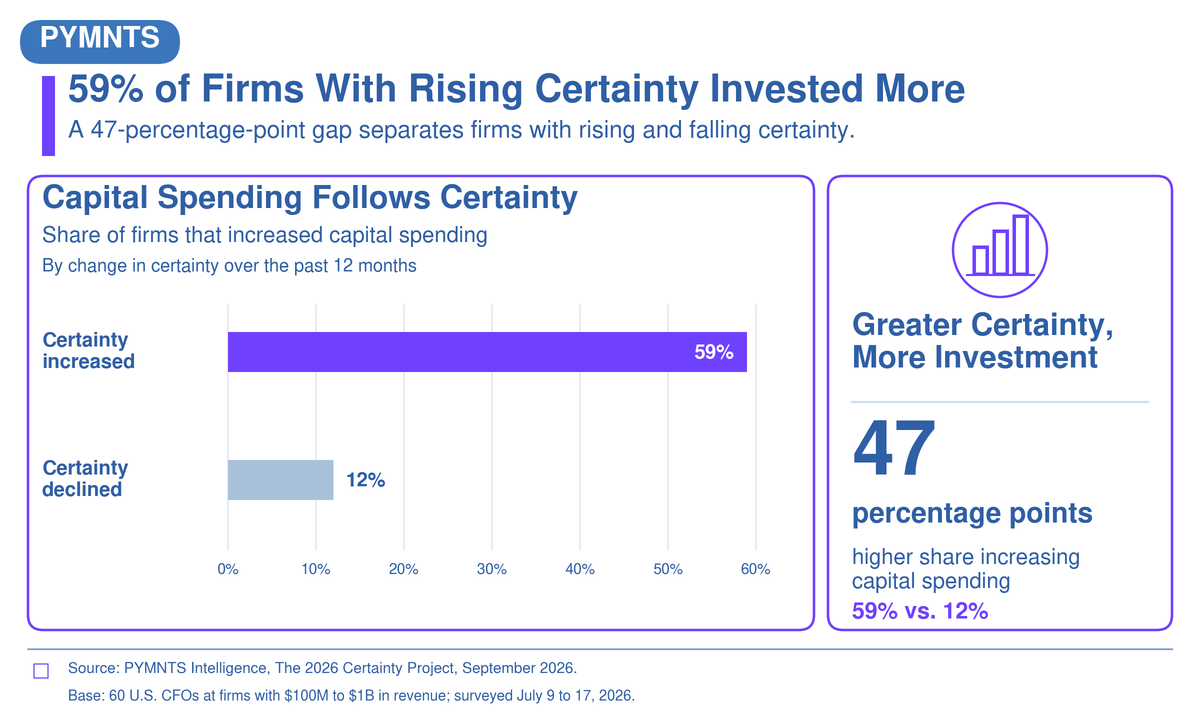
For middle market companies, greater certainty and higher investment often go together: 59% of firms with rising certainty increased capital spending.
That connection runs through “The Cost of Caution: Why CFOs Put Growth Plans on Hold,” the latest report in the PYMNTS Intelligence 2026 Certainty Project. Based on a July survey of 60 chief financial officers at U.S. companies with annual revenue of $100 million to $1 billion, the report found that certainty helps guide spending and hiring decisions. Companies want a clear view of conditions before expanding, although their plans show they don’t need a completely predictable economy to pursue growth.
Certainty works like visibility on a highway: Drivers can move ahead more comfortably when they can see farther down the road.
- Greater certainty accompanies more investment. Among firms whose certainty increased over the past 12 months, 59% raised capital spending, compared with 12% of firms whose certainty declined. That’s a 47-percentage-point difference in the share investing more. Only 5% of firms with improving certainty reduced capital spending, while half of those with declining certainty cut it. The comparison shows how closely a company’s reading of business conditions aligns with its willingness to commit money to longer-term plans.
- CFOs can change spending plans within months. Some 57% of firms adjust capital spending within three months of a shift in certainty, and 90% do so within six months. More than half require high certainty before committing to expansion. Yet 91% say a small or modest decline would prompt a defensive stance. Companies already pursuing expansion tend to wait longer before adjusting investment, suggesting they’re more willing to absorb a short-term change in conditions.
- Businesses protect the spending that keeps them running. When uncertainty rises, 58% of CFOs say they’d cut or postpone capital expenditures, while only 7% would trim maintenance spending. Hiring and marketing also face early cuts. Customer demand and financing costs deserve particular attention: 27% identify demand as the single biggest source of uncertainty affecting investment decisions, followed by 22% who cite interest rates and financing costs. Those concerns help explain why clearer sales expectations and borrowing costs can support planning.
The outlook still includes substantial room for expansion. Across the sample, 47% of firms plan to increase capital spending over the next 12 months and 42% intend to add employees. More than 60% of companies with moderate uncertainty plan to invest more, compared with 25% of those facing high uncertainty. Among firms with low uncertainty, 56% expect to increase headcount. Those plans suggest businesses can keep growing while some uncertainty remains, provided executives feel confident enough to commit.
At PYMNTS Intelligence, we work with businesses to uncover insights that fuel intelligent, data-driven discussions on changing customer expectations, a more connected economy and the strategic shifts necessary to achieve outcomes. With rigorous research methodologies and unwavering commitment to objective quality, we offer trusted data to grow your business. As our partner, you’ll have access to our diverse team of PhDs, researchers, data analysts, number crunchers, subject matter veterans and editorial experts.