Buy now, pay later was supposed to take business away from credit cards. Instead, credit cards appear to be taking a page from BNPL.
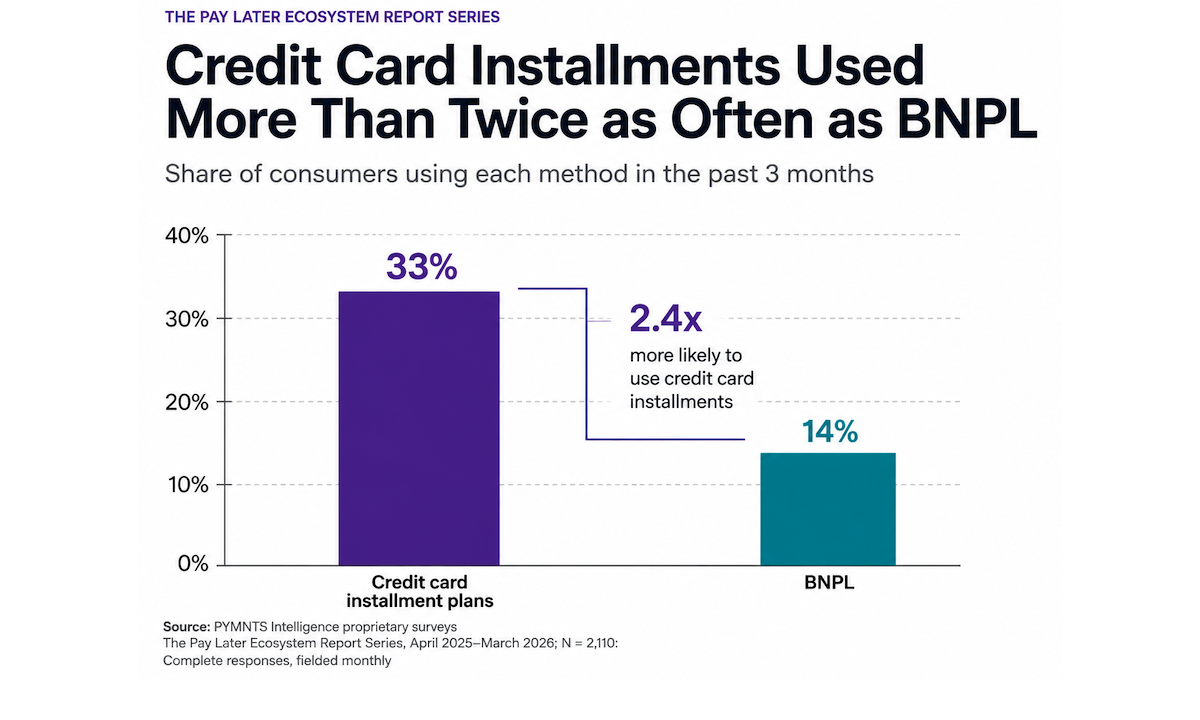
PYMNTS Intelligence research from the “Pay Later Ecosystem Report” finds consumers are increasingly choosing installment plans attached to their credit cards, giving issuers a built-in advantage in a market BNPL providers helped create. Across eight surveys, consumers used credit card installment plans at more than twice the rate of BNPL.
The trend is less about consumers abandoning Pay Later than about where they want to get it. Card issuers can put installment options inside accounts and payment relationships consumers already use, allowing them to offer the flexibility of Pay Later without requiring customers to adopt another provider.
The data shows that advantage widening:
- 33% of consumers used credit card installment plans by March 2026, up from 23% in April 2025, while BNPL slipped from 15% to 14%.
- 47% of Gen Z consumers used credit card installments in March, more than twice the 23% who used BNPL.
- 20% of consumers earning at least $150,000 used BNPL in March, twice the 10% rate among consumers earning less than $50,000.
The generational numbers are particularly striking. Pay Later is frequently associated with younger consumers, but those shoppers are not necessarily choosing standalone BNPL providers. Gen Z credit card installment use rose from 31% in April 2025 to 47% in March 2026, while BNPL use moved only from 21% to 23%. Millennials and bridge millennials followed the same broad pattern.
Income produces another wrinkle. BNPL use consistently ran higher among consumers earning at least $150,000 than among those earning less than $50,000. In November, for example, the respective rates were 22% and 7%. By March, they stood at 20% and 10%.
That makes Pay Later look less like a financial safety net and more like another way consumers manage purchases and cash flow.
For banks, card networks and FinTechs, the numbers point toward Pay Later becoming a feature of broader financial relationships rather than a standalone payment category. BNPL established consumer demand for breaking purchases into predictable payments. Card issuers increasingly appear to be capturing that demand from inside the accounts consumers already carry.
The findings are based on PYMNTS Intelligence surveys of approximately 2,500 U.S. adults.