
Antitrust Chronicle® 2021

December 2021 - I
Retail Grocery Sector Few sectors are as vital to modern life as the grocery industry. Napoleon famously derided the United Kingdom as a “nation of shopkeepers.” But in today’s urbanized, industrialized world, shopkeepers provide the link between nourishment and the people who require it.

November 2021 - I
Antitrust Chronicle - Corporate Compliance Compliance programs are, by definition, the first line of defense against antitrust violations. Yet compliance programs raise inherent conflicts of interest. To what extent can one expect the hunter to be the groundskeeper? This is the inherent dilemma to the treatment by regulators and courts of compliance programs in enforcement, fining guidelines, and countless other contexts.

October 2021 - II
Antitrust Chronicle – Robinson’s Imperfect Competition Sometimes perfection can be the enemy of the good. Most economists idealize the notion of “perfect competition,” whereby any profit-maximizing producer faces a market price equal to its marginal cost. An exception, however is the work of British economist, Joan Robinson, who noted that sometimes imperfect competition can be more welfare-maximizing than the Platonic ideal. Indeed, in reality, outside economics textbooks, idealized conditions are rarely reproduced. Nonetheless, the theory underlying “perfect competition” informs much competition law and economics. Resolving the dilemma surrounding what constitutes perfect competition, acceptable competition and a non-competitive market represents the subliminal undercurrent of enforcement policy. The pieces in this CPI Chronicle address this dilemma from various angles, taking into account enforcement and practice experience from the jurisdictions in which the authors have worked. They represent a valuable contribution to this discussion, which will be perennial for as long as antitrust rules are enforced.

October 2021 - I
Antitrust Chronicle – Robinson's Imperfect Competition Sometimes perfection can be the enemy of the good. Most economists idealize the notion of “perfect competition,” whereby any profit-maximizing producer faces a market price equal to its marginal cost. An exception, however is the work of British economist, Joan Robinson, who noted that sometimes imperfect competition can be more welfare-maximizing than the Platonic ideal.
September 2021 - II
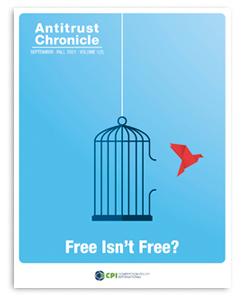
Antitrust Chronicle – Free Isn’t Free? What is a “free” service? Intuitively, and historically, a “free” service would be defined, simply, as one that merely does not require payment at the point of sale. Yet, new business models, facilitated by the Internet, have upended the notion of “free.” In particular, with regard to user-facing services such as online search, social networking, image and video hosting (along with countless others), users are not obliged to pay for the service in monetary terms.

September 2021 - I
Antitrust Chronicle - Bundling & Tying Bundling and tying are classic antitrust abuses. Leveraging market power to force customers of “Product A” to purchase “Product B” is an archetypal competition law infringement. Like most antitrust abuses, tying can take many forms. Aside from the standard paradigm of forcing a customer to purchase a product additional to the one in which the incumbent possesses market power, there can be more nuanced scenarios.
August 2021 - II
Antitrust Chronicle – State Attorneys General In this Chronicle we feature contributions from the offices of State Attorneys General from across the U.S. The Attorneys General of the 50 States and the District of Columbia play a vital – and occasionally overlooked – role in the enforcement of both Federal and State antitrust laws.

August 2021 - I
Antitrust Chronicle – EAB Antipasto As per tradition, this August 2021 Antipasto edition of the Antitrust Chronicle features articles from members of the CPI Editorial Advisory Board. This set of articles covers a variety of jurisdictions and a diversity of antitrust topics including, among other things, the treatment of innovation in merger analysis, consumer patterns in online markets, controlling market power in online ecosystems, the effectiveness of remedies in recent U.S. merger clearances, and failure to file under the Chinese merger control regime. Antitrust Chronicle – EAB Antipasto, Summer 2021, Volume 2, Number 1
July 2021 - II
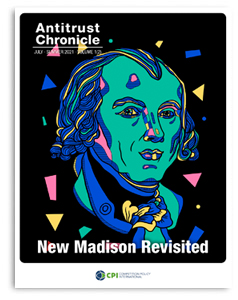
Antitrust Chronicle – New Madison Revisited James Madison, the fourth U.S. president and a principal drafter of the U.S. Constitution, is credited with including Article I, Section 8, Clause 8 – the Patent and Copyright Clause. This provides the basis for Congress to enact rules protecting intellectual property (“IP”) rights in the U.S. constitutional order, a unique development at its time. The evolution of antitrust law has, over time, come into conflict with the intellectual property rights created on the basis of this article, and has caused some actors, most recently former AAG Makan Delrahim of the U.S. Department of Justice, to call for a rebalancing of the interaction between IP and antitrust rules, in favor of rights holders, notably in the case of disputes over matters such as so-called fair, reasonable and non-discriminatory (“FRAND”) licensing terms. Antitrust Chronicle – New Madison Revisited. Summer 2021.
July 2021 - I
Antitrust Chronicle – Foreign Direct Investment Competition rules inevitably interact and come into conflict with other domains of economic regulation. This is very clear in the case of rules concerning government (and, in particular, foreign) subsidies. Both concern distortions of competition, but the former focuses on the conduct of private companies, whereas the latter constrains the actions of governments.

June 2021 - II
Antitrust Chronicle – Buyer Cartels The pieces in this Chronicle place the treatment of buyer cartels in its historical context, and apply the lessons of the past to current-day challenges. Each author brings a unique perspective from their particular jurisdiction, and discusses the latest salient developments in the context of the ever-evolving dialogue surrounding the correct manner in which to regulate market power.

June 2021 - I
Antitrust Chronicle – Interoperability Interoperability has long been a controversial issue in antitrust law and related regulatory disciplines. The concept refers, essentially, to the ability for systems controlled by different operators to be compatible, and in particular to share information and function in conjunction with each other. Interoperability can take many forms. For example, telephone systems operating on the basis of one standard must interoperate with other standards in order to allow cross-network telephone calls. Interoperable file formats allow documents made in one computer program to be opened and edited in a competing program without loss of data. Cross-border rail networks are based on the interoperability of trains due to common rail gauge standards.

May 2021 - II
Antitrust Chronicle – Section 230 An originally obscure provision of the Communications Decency Act (“CDA”) of 1996, Section 230 provides that “no provider or user of an interactive computer service shall be treated as the publisher or speaker of any information provided by another information content provider.” From its originally obscure origins, Section 230 of the CDA has come to be viewed as a touchstone of freedom of expression online, and is considered by many to have been a key liberty allowing for the massive growth of online platforms in the decades since its original adoption.

May 2021 - I
Antitrust Chronicle – Healthcare Since 2020, more than ever, healthcare has risen to near the top of the political agenda. Inevitably, the topics that define politics attract enhanced antitrust scrutiny, and healthcare is no exception. Even before the COVID-19 pandemic, antitrust debates have raged in various aspects of the healthcare industry, from the provision of medical services, to patent-related practices in the pharmaceuticals industry. Practices in healthcare vary considerably throughout the world. The contributions to this Chronicle reflect the diversity of practices in healthcare provision in various jurisdictions, ranging from the concerns raised in more socialized healthcare systems, to concerns relating to vertical integration in more privatized systems. Despite the diversity of systems throughout the world, practitioners and commentators across jurisdictions have much to learn from each other. The contributions to this Chronicle form a vital contribution to the cross-pollination of information and practices concerning enforcement in healthcare as it continues to develop over the months and years to come. Spring 2021, Volume 2, Number 1 Antitrust Chronicle – Healthcare
April 2021 - II
Antitrust Chronicle – Inclusive Competition The latest CPI Chronicle comes at a time when the COVID-19 pandemic continues to disproportionately impact women and minorities around the globe and erects yet another roadblock to the economic and societal advancement of these groups. With this societal and economic backdrop, this edition of the Chronicle fittingly focuses upon the concept of Inclusive Antitrust and the debate about whether and how antitrust policy and enforcement could be a better tool in the fight for equality.
April 2021 - I
Antitrust Chronicle – Open Banking In this Chronicle, we examine the issue of Open Banking. Interoperability has long been an antitrust preoccupation. Traditionally, interoperability concerns have arisen with respect to the tech sector, as reflected in cases involving the so-called tech giants of the given day, dating back decades, to the very inception of antitrust rules. In those contexts, antitrust enforcement resulted in remedies, such as the imposition of rules requiring dominant companies to provide for mechanisms for customers to easily export their data from one platform to another, or to provide for dominant companies to make available APIs allowing their competitors to interact with their offerings on an equal footing.

March 2021 - II
Antitrust Chronicle – Year of the Ox Antitrust Enforcement in China We are delighted to release our CPI Antitrust Chronicle issue for March 2021, Year of the Ox – Antitrust Enforcement in China and present a selection of articles from enforcement authorities, law and economics experts, and practitioners in China. 2020 was an unprecedented year. Under the challenge of a global pandemic, the competition community in greater China area has set up a new norm. The central government of China set up its “dual circulation,” strategy which involves relying on a robust cycle of domestic demand and innovation as the main driver of China’s economy, and maintaining international markets and investors as another engine of growth. This strategy will require vigorous enforcement of competition policy in different industries, especially in the platform economy. In 2020, we witnessed new challenges in both mainland China and Hong Kong, as well as in the judicial system, with the emergence of new business models, along with new competition issues.
March 2021 - I
Antitrust Chronicle – 2021 Antitrust Horizons 2020 was a year of great turbulence. Society and the world economy were shocked by the COVID-19 pandemic; Brexit came to fruition; and political change occurred across the globe. Specifically, with relation to antitrust, legislators and policymakers began to come to grips with the calls for change reflected in reports such as the EU Crémer report, the UK Furman Report, and the U.S. House of Representatives Judiciary Committee Report. Moreover, authorities modified guidelines and rules to account for the new world brought about by COVID-19.
February 2021 - II
Antitrust Chronicle – Music & Technology Music is the playground of the soul. And the music industry is the playground of the law. The music industry has almost inevitably found itself at the vanguard of technology. From Edison’s invention of the mere notion of recorded media, to today’s streaming platforms, music is perennially at the forefront of legal drama.
February 2021 - I
Antitrust Chronicle – Gatekeepers What is a gatekeeper? More than other terms of art that have gained currency in recent years, the notion of a “gatekeeper” holds particular potency in today’s environment. In essence, the term “gatekeeper” seeks to capture the notion of a company or platform that mediates the public’s access to information and commerce. Obvious examples include the prominent search, social media and online commerce platforms that have gained significant economic power in recent decades.

January 2021 - II
Antitrust Chronicle - Telecommunications Telecoms markets have long formed the vanguard of antitrust enforcement. From the formative days of the antitrust treatment of the Bell System in the U.S. in the 1960s, to seminal cases such as Verizon v. Trinko in the U.S. and cases such as Wanadoo in the EU, telecoms issues have long defined the contours of antitrust doctrines. This dynamic continues to this day, with, for example seminal merger judgments on both sides of the Atlantic in telecommunications markets. Telecommunications, as a network industry, also has many lessons for upcoming debates on the regulation of digital markets. Questions of ex ante v. ex post regulation, in particular, have echoes of past debates in telecommunications regulation and are therefore of great salience today.
January 2021 - I
Privacy Matters: GDPR & CCPA Data protection has emerged as one of the key issues of the 21st Century. Two key pieces of legislation: the EU General Data Protection Regulation (“GDPR”), and the California Consumer Privacy Act (“CCPA”) are the keystones in the legislative response to the concerns raised by Big Data, in the so-called digital economy.