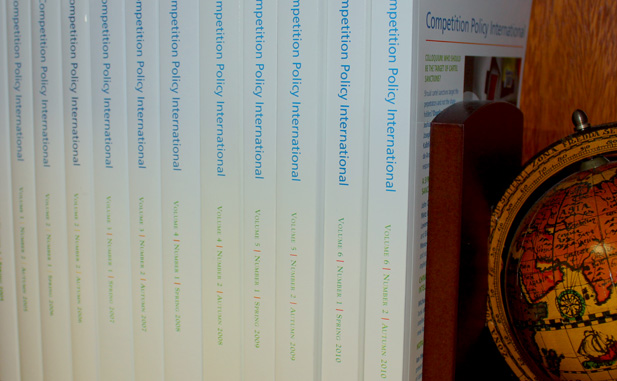
In our Autumn 2013 Journal, we present a Symposium on Antitrust and Intellectual Property, explore Current Cases in Anglo/Lafarge and feature this edition’s Classic, Appropriating the Returns from INdustrial Research and Development. Click here to order a physical copy of our Autumn 2013 Journal.
-
Letter from the Editor
Dec 20, 2013
The CPI Autumn 2013 issue features contributions with a divergence of views (David S. Evans, Antonio Bavasso)
-
A Symposium on Antitrust and IP
Sir Robin Jacob, Dec 20, 2013
The danger to innovation is all too obvious for those who can see: it pays to be a grasshopper rather than an ant better to be a copyist than an innovator. Sir Robin Jacob (University of College London)
Tim Wu, Dec 20, 2013
Competition law and Intellectual Property have divergent intellectual cultures the former more pragmatic and experimentalist; the latter influenced by natural law and vested rights. Tim Wu (US Federal Trade Commission)
Douglas Ginsburg, Joshua Wright, Dec 20, 2013
In modern antitrust law, intellectual property rights (IPRs) are treated like all other forms of property. Joshua D. Wright (US Federal Trade Commission) & Douglas H. Ginsburg (US Court of Appeals, DC Circuit)
Herbert Hovenkamp, Dec 20, 2013
Whether antitrust policy should pursue a goal of general welfare or consumer welfare has been debated for decades. The academic debate is much more varied than the case law, however, which has consistently adopted consumer welfare as a goal.
Richard Epstein, David J. Kappos, Dec 20, 2013
At present, the traditional informal mechanisms for setting FRAND rates for SEPs have come under extensive attack by the Federal Trade Commission and elsewhere, from those who believe more limited damages and less frequent injunctions o!er the best path to resolving disputes over Standard Essential Patents. In this article we take issue with those conclusions. Richard A. Epstein (New York University School of Law) & David J. Kappos (Cravath, Swaine & Moore LLP)
Eliana Garces, Dec 20, 2013
This piece argues that the way antitrust intervention is being framed allows regulators to restrict the behavior of the patent holder staying away from the issue of FRAND determination. (Eliana Garces Tolon, EC)
Kai-Uwe Kuhn, Dec 20, 2013
The economic justification for any regulatory intervention in patent litigation, especially those for standard essential patents, comes from the view that hold-up of users of patents is endemic to some industries, especially ICT. The paper reviews these reasons why hold-up is more likely in ICT industries and discusses the type of evidence that is available. (Kai-Uwe Kuhn, University of Michigan).
Pierre Regibeau, Dec 20, 2013
Antitrust concerns about pay-for-delay patent settlements are based on two theories of harms, one that stresses the need for courts to review the validity of patents and one that emphasizes the probabilistic nature of patent rights. Pierre Regibeau (CRA and Imperial College).
Fiona Scott Morton, Dec 20, 2013
This article lays out the economics of competition between branded and generic pharmaceuticals and its welfare consequences. I explain the logic behind so-called pay-for-delay or reverse payments in the context of the current IP environment where weak (probabilistic) patents are frequently granted by the PTO. Fiona Scott Morton (Yale University).
-
Current Cases and Issues
Julie Bon, Pietro Crocioni, Francesca Sala, Dec 20, 2013
This article explores the UK Competition Commission’s Anglo/Lafarge merger decision (2012) focusing on the reasoning for a finding of coordinated effects in cement. Julie Bon (UK Competition Commission), Pietro Crocioni (UK Office of Communications) & Francesca Sala (UK Competition Commission).
-
The Classics
David Evans, Dec 20, 2013
An introduction to Appropriating the Returns from Industrial Research and Development, the classic that describes the results of an inquiry into appropriability conditions in more than one hundred manufacturing industries, and includes informed opinions about an industry’s technological and economic environment rather than quantitative measures of inputs and outputs. David S. Evans (University of Chicago Law).
Dec 20, 2013
The classic that describes the results of an inquiry into appropriability conditions in more than one hundred manufacturing industries, and includes informed opinions about an industry’s technological and economic environment rather than quantitative measures of inputs and outputs. Richard C. Levin (Yale University), Alvin K. Klevorick (Yale University), Richard R. Nelson (Columbia University), Sidney G. Winter (Yale University).
-
eBook
Jan 20, 2014
View, download, and print the CPI Autumn 2013 eBook (PDF).