The next major digital asset product offered by a bank may not be a wallet, stablecoin or tokenized deposit. It may be an explanation.
Cryptocurrency’s categorical vocabulary has expanded faster than the public’s understanding of its products and infrastructure. Bitcoin and other crypto assets, stablecoins, tokenized bank deposits, tokenized securities and central bank digital currencies (CBDCs) are routinely grouped under the loose heading of digital assets, despite representing different claims, risks and use cases. Some are speculative assets. Some are payment instruments. Some are conventional financial products recorded on new infrastructure, while still others remain government research projects rather than products consumers can actually hold.
That confusion was manageable when crypto existed largely outside mainstream banking. It becomes more consequential as regulated financial institutions gain greater latitude to provide custody, stablecoin and blockchain-related services. As digital assets move closer to the financial perimeter, banks and credit unions may inherit a responsibility that has little to do with issuing or holding them. They will have to help customers understand what, exactly, they are being offered.
Read also: Stablecoins Are Just Wildcat Banking With Better Wi-Fi
Why Smaller Institutions Have a Crypto Education Advantage
The term digital asset is useful partly because it is so broad. It is also dangerous for the same reason. Large banks and technology companies can build broader digital asset product menus. Community banks, regional banks and credit unions may be better positioned to make those products intelligible.
Small institutions have long taught customers distinctions that the financial industry takes for granted, like checking versus savings, debit versus credit, fixed versus variable rates, insured deposits versus investments. They frequently operate through relationship managers, branch employees and call center staff who know why a customer is moving money, not merely where it is going.
A customer who mistakes a stablecoin for an insured deposit may take risks the institution never intended to encourage. A small business that assumes a tokenized payment is irreversible, anonymous or legally equivalent to cash may make faulty decisions about fraud, refunds and recordkeeping. A consumer who believes every blockchain transaction carries the protections of a card payment may discover otherwise only after money disappears.
Even the word “stable” can create false confidence. Stablecoins are designed to maintain a reference value, but their resilience depends on reserve quality, redemption arrangements, liquidity and governance. Those distinctions determine nearly everything that matters to a customer, including who owes the money, what backs it, whether its value can move, what protections apply, where it can be used and what happens if the provider fails.
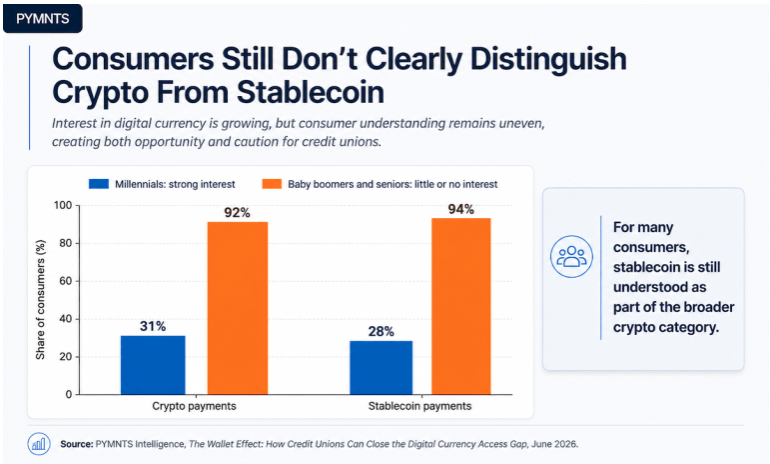
The June installment of PYMNTS Intelligence’s Credit Union Tracker Series, “The Wallet Effect: How Credit Unions Can Close the Digital Currency Access Gap,” a collaboration with Velera, revealed that stablecoin awareness falls short for 70% of credit union members.
A retiree considering a tokenized Treasury fund needs a different explanation from a manufacturer using stablecoins to pay an overseas supplier. A customer asking how to purchase bitcoin is making a different decision from one asking whether a digital dollar payment can settle over a weekend. The institution’s job is not to persuade all three customers to adopt the technology. It is to help each understand the financial claim, operational process and risk involved.
See also: Crypto Stopped Fighting Banks and Started Copying Them
Trust Needs to Scale Before Blockchain Financial Products Do
Banks are entering a market whose infrastructure is developing faster than its shared vocabulary. Stablecoins are expanding, tokenization is moving into payments and capital markets, and regulators are establishing clearer pathways for financial institutions to participate. The Federal Reserve has warned that stablecoin adoption could alter bank deposits, funding structures and the distribution of credit, making these instruments strategically relevant even to banks that never issue one themselves.
“Today, stablecoins are like a drug trying to treat 20 different problems,” Nium Founder and CEO Prajit Nanu told PYMNTS in an interview this week.
“Where we see a significant amount of opportunity is stablecoin not as a payments value, but as a settlement value,” he added. “Where we think stablecoin has the biggest value as, is a treasury layer across all the entities, where I can move money instantly among my entities.”
Customers will need to understand why a tokenized deposit is not simply another cryptocurrency, why a stablecoin is not necessarily the same as a dollar in a checking account, and why a tokenized security remains a security even when it moves on a blockchain.
For community banks and credit unions, that is not a secondary role. It may be their most defensible digital asset strategy. Become the trusted translator before confusion hardens into mistrust, regulatory exposure or fraud.
For all PYMNTS digital transformation coverage, subscribe to the daily Digital Transformation Newsletter.