Retail, since the category’s inception, has embraced the maxim that population density equals sales destiny. That calculus has largely held steady in the age of eCommerce and shifting customer expectations, too.
After all, the economics of last-mile delivery improve when more customers can be packed onto the same route. A driver making 100 stops across a few square miles is an asset. A driver covering long distances between scattered households is a cost problem.
Amazon’s announcement this month that its drone delivery service, Prime Air, plans to expand to nearly 500 U.S. cities and towns by the end of 2026, however, underscores how autonomous delivery could start inverting the age-old retail equation that the farther customers live from one another, the more expensive they are to serve.
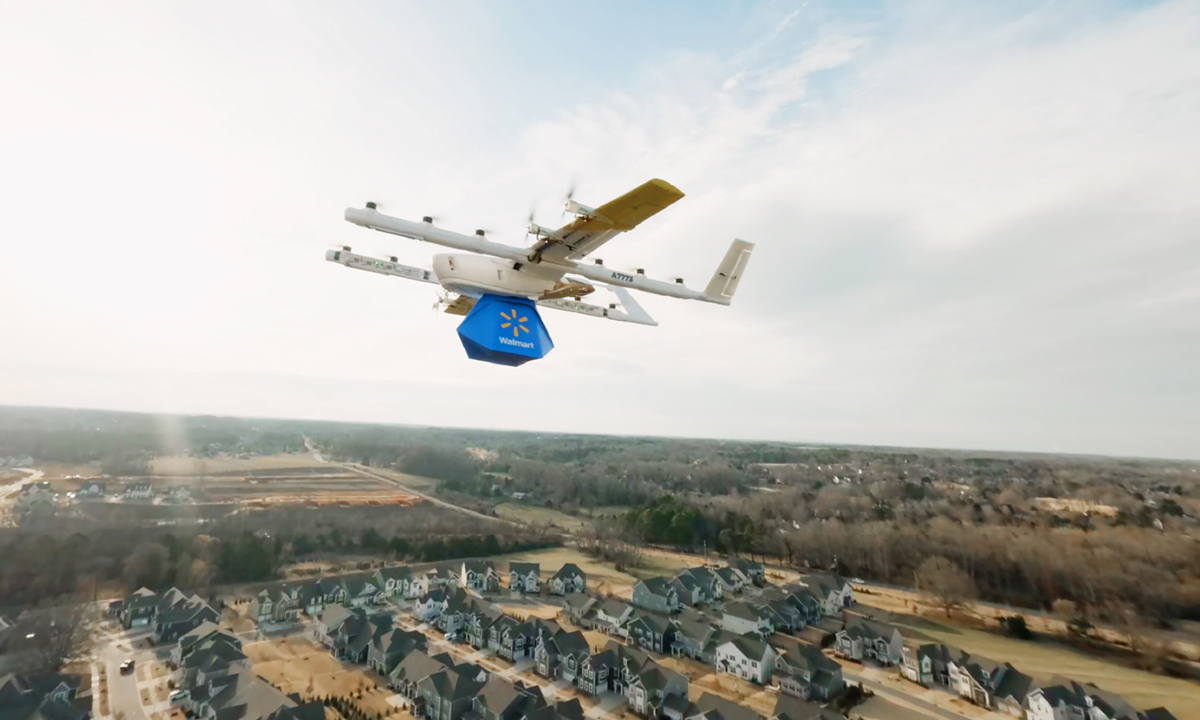
Meanwhile, Walmart is attacking the same problem from the opposite direction through a drone infrastructure partnership with Alphabet’s Wing.
The emerging retail battleground, as defined by the week’s headlines, show that low-density commerce is becoming a hotbed of competition. Amazon and Walmart are using technology to win over shoppers in the suburbs, exurbs, smaller cities and, eventually, rural communities where they live relatively close to inventory but where conventional last-mile delivery remains inefficient.
See more: Amazon and Walmart Want to Beat the Consumer to Their Next Purchase
Drones Are Making the Traditional Delivery Route Disappear
Traditional last-mile logistics is fundamentally a route-optimization business. That creates a structural disadvantage as density falls. But a drone operates according to a different logic.
A drone doesn’t need 100 households along a profitable route. It needs an eligible package, a reachable household and a viable flight. Amazon said its recent expansion represents a roughly sixfold increase in its footprint and will bring drone delivery to communities representing tens of millions of customers. Each current Prime Air site covers approximately 175 square miles, while eligible orders can include millions of grocery, electronics, cosmetics, medication and household items delivered in as little as 30 minutes.
Amazon’s Prime Air is already operating around markets including Waco, Baton Rouge, Omaha and Kansas City, with Syracuse and Boise among upcoming markets. These aren’t necessarily rural drone networks yet. But they point toward a more interesting geographic frontier than Manhattan or downtown San Francisco.
See more: Walmart and Amazon Rewrite the Price War
Walmart’s Stores Are Starting to Look Like Drone Runways
For decades, Walmart’s stores were primarily places consumers drove to, then eCommerce turned them into fulfillment centers. Now, drone delivery could turn them into launch infrastructure.
Walmart’s thousands of stores sit close to the communities they serve. That proximity means merchandise can already be positioned near the end consumer without building an entirely separate network of specialized fulfillment facilities. Put a drone operation beside that inventory and the supercenter becomes something considerably more powerful: store, warehouse, pickup point, conventional delivery hub and autonomous fulfillment node simultaneously.
Walmart describes drone delivery around everyday moments: forgotten ingredients, printer ink or medicine needed quickly. The company says customers have progressed from ordering novelty items to using the service repeatedly for immediate needs.
See more: Why the Mall of the Future Won’t Have a Parking Lot
That’s the strategic asymmetry in the Walmart-Amazon competition. Amazon has spent decades building perhaps the world’s most sophisticated eCommerce fulfillment system and is increasingly pushing fast-delivery inventory closer to consumers. Walmart starts with thousands of stores already embedded in American communities and is trying to make those assets behave more like eCommerce infrastructure.
The contest isn’t simply whether Walmart can become more like Amazon. It’s whether Amazon can make its fulfillment infrastructure behave like Walmart’s store network before Walmart makes its store network behave like Amazon’s fulfillment network.
For more than a century, retailers have asked how close they need to put a store to the customer. Then eCommerce changed the question to how close inventory needs to be. Autonomous delivery introduces another one: How much does it matter how far apart the customers are?
For all PYMNTS digital transformation and B2B coverage, subscribe to the daily Digital Transformation and B2B Newsletters.