Why the ‘Person’ of the Year in 2025 Should Be the Chatbot
It was sort of an accident. In 1927, Time magazine was chasing an interview with Charles Lindbergh shortly after his successful, first-ever solo transatlantic flight from New York to Paris in May of that year. (It took 33.5 hours, BTW.) The interview kept getting pushed until finally a date was set later than originally hoped. In the spirit of making lemonade out of lemons, Time turned the delay into a publication feature. Lindbergh was named Man of the Year, and that issue featured his picture on the cover.
Ever since, the second week in December is when Time names its Person of the Year.
This recognition honors the person who most shaped the year’s narrative, for better or worse. Those whose pictures grace the publication’s cover run the gamut from pop stars to presidents and everyone in between.
For 2025, Time named “The Architects of AI.” For 2024, it was President-elect Donald Trump. The year before that, it was Taylor Swift.
Here at PYMNTS, we’ve been watching a different phenomenon unfold. And if we were in the business of naming a Person of the Year, we believe there’s only one choice that makes sense for 2025.
The Chatbot.
Not the technology. Not the platforms. Not even the architects who built them. But the chatbot itself. That conversational interface people have named, personalized and invited into nearly every corner of their daily lives.
Been There, Almost Done That
We’ve been here before. Sort of.
Apple introduced Siri in 2011. Amazon launched Alexa in 2014. Google rolled out “Hey Google” in 2016. These were supposed to be our digital assistants, those always-on helpers that would make our lives easier, our homes smarter, our commerce more frictionless.
The pitch was compelling. Just speak like you would to a person, but into your phone, an app on your phone or a piece of hardware sitting on your kitchen counter. These assistants would understand what you needed, anticipate what you wanted, learn your preferences over time. They’d be that personal assistant, helpful in the same way a human assistant would be. They even had human names, so the experience could feel like you were talking to a person.
It didn’t really work that way.
Instead of a smart assistant, we got a keyword-responsive piece of software that required precise phrasing to get anything done. They were pretty good at doing things that didn’t require a conversation like setting timers, playing music, getting the weather or yesterday’s sports scores, telling corny jokes, opening and closing the garage door and turning lights on and off. They could order pizza, but only if you knew exactly how to phrase the request and didn’t mind a frustrating back-and-forth that often ended with “I don’t understand.”
According to PYMNTS Intelligence research from 2023, barely one in ten consumers thought these assistants were capable of being their smart, everyday sidekick. However, they saw the potential. Nearly half of U.S. consumers said they believed that in five years, a smart voice-activated assistant would be effective at managing their lives. Nearly six in 10 millennials said they’d pay more than $25/month to have access to one.
But that belief came with a massive asterisk: not with the current technology.
Turns out, they wouldn’t have to wait five years.
The Chatbot That Started a Worldwide Conversation
It was November 30, 2022, when OpenAI released ChatGPT to the public. Within five days, it had a million users. Within two months, 100 million. As has been written hundreds of times, it was the fastest adoption of any consumer technology in history. Faster than the internet, faster than mobile phones, faster than social media. I charted the adoption curve of Generative AI a couple of months back. And the momentum created by OpenAI with ChatGPT shows an adoption curve that’s more like a straight line, up and to the right.
Interestingly, that same 2023 consumer study, which PYMNTS fielded three months after OpenAI’s launch, cited ChatGPT as one of the contenders for that personal assistant mantle. Consumers can often see around the corners before the rest of us.
So, why the about-face from consumers now? What’s different?
Even without the voice-activated interface, ChatGPT was able to deliver what Alexa, Siri, and Google Assistant had promised but couldn’t provide.
A conversation.
The ability to understand context, remember what you’d asked three exchanges ago, infer what you actually meant from an imperfectly phrased question replete with typos, and provide genuinely helpful responses.
This wasn’t a voice interface responding to wake words and keywords. This was the assistant people had been asking about (and hoping for) for years. One that could help draft an email, debug code, explain complex topics, create content, analyze data, and do it all in a way that felt remarkably human. Like a person sitting beside you at the prompt helping you out. Delivering outcomes rich with context.
In seconds.
Claude, Gemini, Grok, and others followed. Each brought their own capabilities and personalities. And consumers, once disappointed by the limitations of first-generation digital assistants, came back. Tentatively at first, then with increasing enthusiasm as they discovered these assistants actually worked. Especially as their capabilities improved rapidly over time.
Today, this technology and these platforms aren’t just available. They’re accessible. To anyone with a mobile phone and/or a desktop computer. Some versions are free. They’re conversational. They have memory, reasoning, and the ability to handle complexity.
And consumers are showing up at their prompts every day by the tens of millions.
The Rise of the Chatbot
Every week, nearly 900 million people show up to talk to ChatGPT. That’s nearly three times the entire U.S. population, every single week, typing things into the prompt looking for answers and assistance.
These users drive 2.5 billion queries a day. In just three years.
It took Google 13 years to reach that volume.
Add in Claude (19M a month), Gemini (650M a month) and Grok (64M a month) and the growing constellation of dedicated AI platforms like Perplexity (45M a month) get us to nearly 1.8 billion people every month, worldwide, who’ve said “yes” to making conversations with chatbots part of their everyday routine.
But here’s why we think chatbots deserve our “Person of the Year” nod.
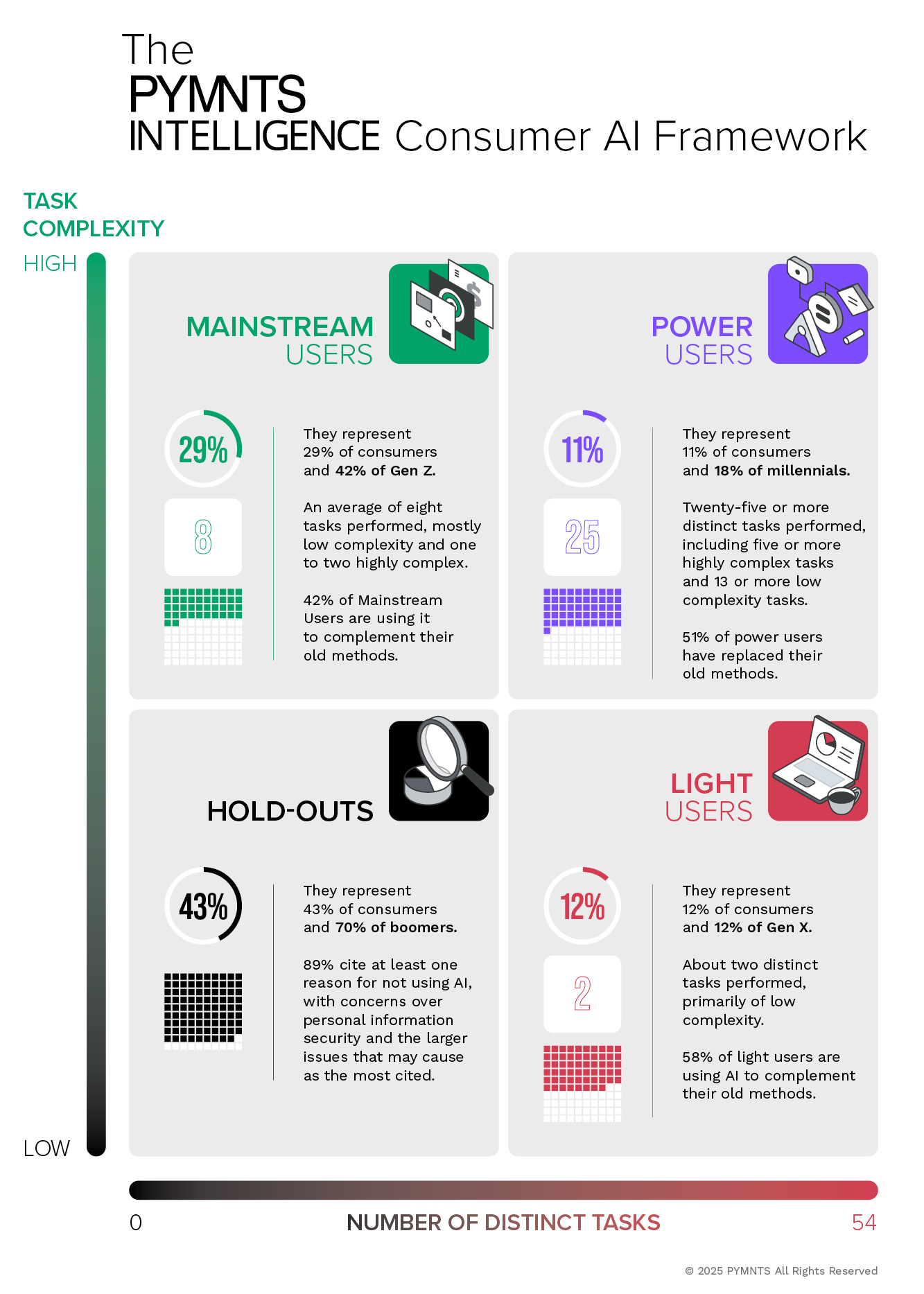
According to recently released PYMNTS Intelligence data, more than half the U.S. population now uses these platforms for something more than just a better alternative to discovery with search. They are using them to manage the real tasks across what I coined as the pillars of the connected economy back in January of 2020.
The activities that are the infrastructure of everyday modern life. How people shop, pay, live, work, eat, stay well, have fun, travel, communicate, and bank.
Then there are the 30 million power users — that’s more than one in ten U.S. consumers — who have already gone all in. More or less. These aren’t people testing the chatbot waters with their pinky toes. They’re using their chatbot for 25 or more of the 54 activities that represent these connected economy pillars.
More than 8 in 10 of these power users deploy AI for shopping discovery, daily planning, learning, and even health and wellness.
In just three short years, more likely in just the last 12 months, they’ve rewired their entire digital footprint around these conversational interfaces.
Chatbots and the Connected Economy
I’ve been writing about the connected economy since early 2020. The core idea then wasn’t just that consumers were becoming more digital, but that digital life was fragmenting across dozens of apps, activities, and decision points. I argued the 2020s would move us beyond that fragmentation toward connected digital ecosystems spanning commerce, finance, health, travel, shopping, and daily life. And create new consumer starting points with new workflows and business models to support it.
The open question then was who — or what — would orchestrate that complexity.
Five years later, the answer may be becoming clearer. Gen AI, agents and the chatbot.
The chatbot is quickly becoming the digital front door for consumers. How they discover products, research purchases, manage money, plan travel, navigate healthcare and organize daily life. The PYMNTS Intelligence Consumer AI Framework maps this shift every month across 54 discrete activities across nine connected economy domains. Activities that are weighted by activity complexity, risk and data sensitivity.
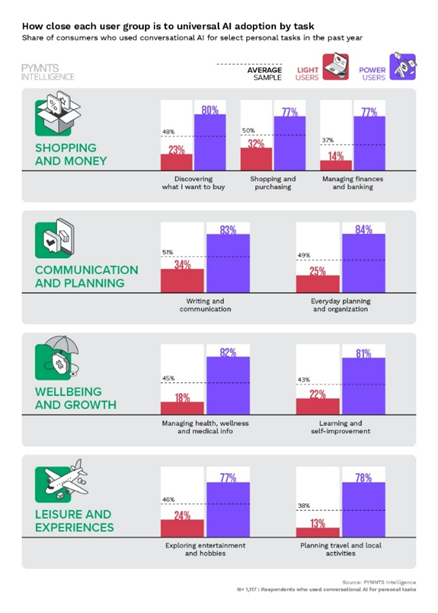
The latest study (November 2025 data) finds that power users deploy GenAI across all nine connected pillars we track, spanning the 25 or more of the 54 activities I mentioned earlier. They’re not dabbling. They report using chatbots to re-architect how they live. For these consumers, the chatbot has evolved from a utility that helps them do a few things faster to the everyday personal assistant they’ve been dreaming of for more than a decade.
More than 80% use it for shopping. Eighty-three percent for writing and communication. Eighty-four percent for daily planning. Eighty-one percent for learning. This usage pattern isn’t a collection of random use cases. It’s a decisive shift away from the time-consuming app-hopping on phone screens or browsers toward a single interface that can connect every pillar of the connected economy at the prompt.
With a conversation.
Daily planning is becoming the power user’s central thesis. Integration across the pillars of the connected economy is their killer app. Instead of juggling calendars, reminders, and apps, GenAI and chatbots synthesize priorities across work, life, travel, and spending. Power users rely on GenAI to interpret medical symptoms, demystify medical bills, set household budgets, and get advice on investment and credit/debt strategies.
For these users, the value isn’t so much simplifying search, it’s contextualizing the outcome. Chatbots explain, compare, advise. And simplify.
This feels like more than consumers with a preference for a cleaner user interface for search and discovery. It feels more like an ecosystem shift. When commerce is becoming a conversation. The chatbot their shopping researcher, recommender, and checkout layer. Their tutor and financial advisor. Their dog trainer, healthcare navigator. Their daily planner. Relationship advisor.
At the prompt where they can stop and start in the same place.
Power users are showing the rest of us how the connected economy is becoming a coordinated ecosystem, with their user-directed chatbots at the helm. Consumers stop managing connections themselves and delegate coordination to an assistant that understands intent, remembers context and acts across apps and use cases.
With a chatbot that touches every node of the connected economy. Not by owning those nodes, but by orchestrating activities across them. Like Uber with Alexa+. And OpenAI with Instacart.
The Rewiring of Commerce
The economic impact is starting to feel real. PYMNTS Intelligence finds that consumers who primarily use dedicated AI platforms with their chatbots say they are 27% more likely to use search engines less, compared to those who first rely on search engine generated AI summaries. Forty-two percent cite using Google less now.
That’s a big deal.
Search has been the front door to the internet for more than a quarter of a century. It’s how consumers got (or used to get) answers, shopped, found out what restaurants have five-star ratings and why their seven-month-old border collie is so suddenly so rambunctious.
Now there’s a meaningful cohort of consumers, growing every month, for whom that front door has moved. Who have said that they’re not complementing search with their chatbots. They’re replacing it.
More than half of power users, and at least one-third of Millennials and Gen Z, say chatbots have already replaced how they used to manage many of their personal tasks.
Two-thirds of those 30 million power users even say they’d let an AI agent autonomously handle everyday planning and organization.
But even those who are just getting their feet wet with chatbots are starting to shift. They’re 66% more likely in November than just a month ago to say they’ve replaced their old methods for finding product information. And 37% more likely to use their favorite chatbot for writing and communication.
These aren’t the power users who are often the first to try new things and willing to suffer through the oft friction-filled learning curve of new technology. These are everyday consumers who say they find real value in how chatbots can simplify their everyday lives.
The commerce implications are just starting to come into focus.
According to PYMNTS research, more than half of chatbot users would prefer to make purchases directly on the dedicated AI platform rather than being redirected to a merchant site. The bridge from discovery to transaction that has defined eCommerce since the beginning is starting to get creaky.
Trust But Verify
Not surprisingly, it’s not all smooth sailing.
One in four power users and three in ten light users report challenges when using AI. Privacy concerns top the list, followed by their chatbot not fully understanding what they meant. These aren’t trivial issues since they ultimately decide whether and how much consumers will trust these platforms with increasingly important decisions and transactions.
But here’s the paradox. Despite these concerns, adoption keeps accelerating. Usage deepens month over month. Consumers keep coming back, keep expanding the tasks they’re willing to delegate to their chatbots, keep integrating these tools more deeply into their routines.
As they do that, their trust grows. With more trust comes more usage. And before you know it, the shift becomes second nature.
The Wisdom of the Prompt
Eight hundred million people a week, and nearly two billion people a month, show us that something new from three years ago has moved from novelty to necessity. They’ve voted with their time, their trust, and increasingly, their wallets. That kind of adoption doesn’t signal playing around with the shiny new tool du jour. It implies a durable behavioral shift.
With it, we see the collapse of old digital muscle memory across the nine pillars that define our day-to-day. The searching, scrolling, comparing, clicking, and deciding has been compressed into a single conversation. The chatbot isn’t just making the process faster, it is redefining the journey.
In many ways, the chatbot is becoming the interface layer of the economy itself, no longer adjacent to commerce or to the pillars of the connected economy. It is embedded inside it.
The place where intent is expressed, shaped and fulfilled.
With that shift comes power. Power over discovery. Power over which choices are surfaced, which brands are considered, which outcomes feel best. How discovery across all of the pillars of the connected economy happens and is monetized. And, it’s happening in kitchens, cars, offices and checkout flows right now, at global scale.
So yes, Time was right to recognize the architects who built the AI platforms. But history will mark this year with something else, too. The moment when nearly two billion people (and counting) decided that the most natural way to navigate the digital and physical economy wasn’t through apps, search bars or screens. But through conversation.
In 2025, that conversation belongs to the chatbot.
And before long, you won’t just type to it.
You’ll talk to it. And finally get the smart personal assistant you were promised more than a decade ago.
That’s why the chatbot is our “Person” of the Year. The conversational intermediary that has become the most influential presence in the connected economy in just three short years.
The chatbot that’s changing how we relate to the digital economy itself.
One question at a time.
And chances are, before today is over, I’ll bet you’ll ask yours something too.
Until NEXT time.
Join the 19,000 subscribers who’ve already said yes to what’s NEXT.
PYMNTS CEO Karen Webster is one of the world’s leading experts in payments innovation and the digital economy, advising multinational companies and sitting on boards of emerging AI, healthtech and real-time payments firms, including a non-executive director on the Sezzle board, a publicly traded BNPL provider.
She founded PYMNTS.com in 2009, a top media platform covering innovation in payments, commerce and the digital economy. Webster is also the author of the NEXT newsletter and a co-founder of Market Platform Dynamics, specializing in driving and monetizing innovation across industries.
Latest News on
ACI Worldwide Considers Putting Billing Division Up For Sale
July 19, 2026, 8:58pm

Medical AI Startup OpenEvidence Weighs $200 Million Funding Round
July 19, 2026, 8:28pm

AI Chip Startup Etched Eyes $20 Billion Valuation
July 19, 2026, 8:00pm