I. Traditional Regulation and the Current Approach to Technology Platforms
As the evolution of markets and the consolidation of traditional antitrust tools has continued over the decades, competition law has had to adapt to new economic and technological realities. Concerns that were previously concentrated in traditional industrial structures have increasingly had to incorporate issues related to the use and accumulation of data, business models based on intermediation, and the architecture of digital ecosystems.
The expansion of digital technologies into broader economic activities and the advent of digital platforms operated by large companies gave rise to a broad debate on their impact on competition and on the usefulness of existing legal and institutional tools to avoid distortions in the markets. Various reports prepared by experts and academics have analyzed the phenomenon and made public policy recommendations, many of them aimed at incorporating ex ante regulations for the conduct of large digital platforms and concerning the market’s structure and failures (Furman et al., 2019; Stigler Center, 2019; Crémer et al., 2019).
These debates, which resulted in ex ante regulations such as the European Digital Markets Act (DMA), have followed an inverse process to the traditional examples in the economic theory of regulation reflected in the reforms and privatizations that were implemented in infrastructure and utilities. Historically, natural monopolies, characterized by non-replicable infrastructures were regulated. As innovation and technological changes reduced barriers to entry many of these sectors were subsequently deregulated.
On the contrary, today we are witnessing a process that involves a movement from competition to regulation of digital platforms, where the activities, goods and services that emerged through innovation and competition are becoming subject to increasing regulatory intervention in some countries, particularly in Europe. While technological innovation reduced costs and expanded the demand for services that ceased to be natural monopolies (eg. telecommunications and energy services), with digital platforms, born from innovation, an opposite effect is now being argued.
Governments in Latin America have been closely watching the international debate and some are receptive to European regulatory initiatives, a phenomenon often referred to as the “Brussels effect”.
Today, Brazil is the only country in the region moving towards an ex ante regulation regime for digital platforms, with similarities to the one proposed by the European DMA. This regulation already is, in its implementation, giving rise to claims from both potential beneficiaries and regulated companies. For example, a large proportion of users claim disadvantages in the quality of their services compared to users from countries that are not under the DMA umbrella. In addition, evidence suggests a heavy administrative burden for companies and regulators, with uncertain outcomes and risks.
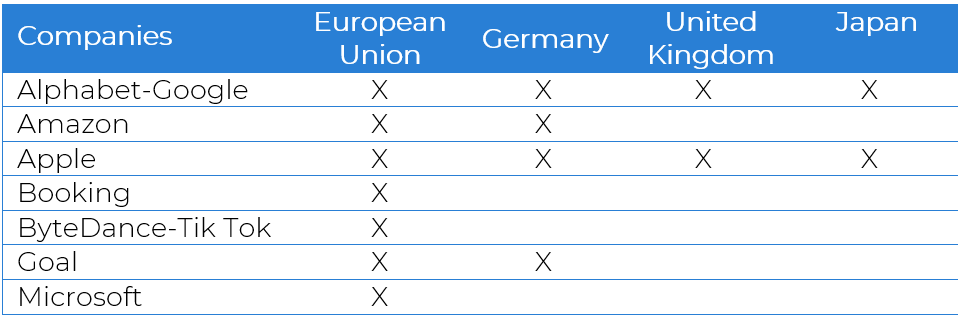
As a consequence of the DMA, the European Commission has designated 7 gatekeepers across 8 categories of core platform services. This contrasts with other international regulations such as those in Japan and the United Kingdom, in which only Apple and Google have been made subject to similar regulation. In Japan, the regulation applies only to mobile digital environments. In the UK, the CMA has consistently found Apple and Google as having Strategic Market Status for their mobile platforms (Table 1).
Table 1. Regulated companies in the comparative international experience
Source: authors’ own.
The choices made by Japan and the United Kingdom are explained by some unique features of mobile operating systems that make them more difficult to challenge than other services. In particular, mobile operating systems involve an expensive infrastructure (mobile devices) that limits multihoming on the user side, in contrast to social networks and e-commerce, where multihoming is common.
II. Absence of International Convergence
This comparative outlook is relevant if we are to contextualize the recent debate in Latin America, where Brazil stands as the only country in the region moving towards an ex ante regulation regime for digital platforms, through Bill No. 4,675/2025.[2]
Europe is leading a regulatory approach (the DMA) that arises as an evolution of previous antitrust cases. However, the United States and LATAM countries have resolved antitrust cases differently than Europe has. Consequently, a DMA-style regulatory approach does not appear to be the next step in the region.
Recent antitrust cases in Brazil and across the region show that competition law enforcement is firmly in place, and that competition agencies have the tools to address the challenges of the digital economy. It is therefore argued that the need for a new law on ex ante regulation is not obvious and that, consistently, the absence of international convergence shows that ex ante regulation is not inevitable.
III. Business Dynamism and Creative Destruction Driven by the Digital Economy
The typical trade-off between static efficiency and dynamic efficiency arises in the context of new ex ante regulation: promoting incremental innovation (or competition in services) versus promoting disruptive innovation (or competition in infrastructure).
Business dynamism and creative destruction are positively correlated with the growth rate of the economy. The entry of new companies into the market forces established companies to lower prices, but it also motivates them to increase productivity and innovation.
Business dynamism and the entry of new companies with the potential to challenge established players is observed in some sectors of the digital economy, mainly Fintech and e-commerce, but also in others such as HealthTech or Agtech. A regulation that discourages investment and financing in these sectors would have a negative impact in terms of potential growth for the region.
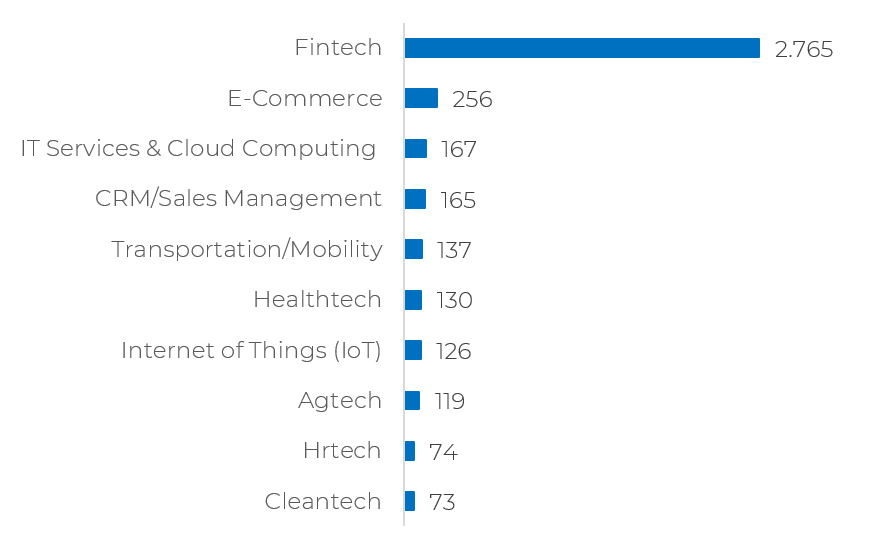
In Latin America and the Caribbean, venture capital has increased significantly between 2016, when nearly 197 companies were financed for USD 0.5 billion (LAVCA, 2024), and 2024, with 751 companies for USD 4.5 billion (LAVCA, 2025). In this regard, the 10 sectors that led the value financed by venture capital in 2024 are: Fintech (61%), E-Commerce (5.6%), IT Services & Cloud Computing (3.7%), CRM/Sales Management (3.6%), Transportation/Mobility (3%), Healthtech (2.9%), Internet of Things (IoT) (2.8%), Agtech (2.6%), Hrtech (1.6%), Cleantech (1.6%), all sectors linked to the digital economy and new technologies (Graph 1).[3]
Graph. 1. The 10 sectors with the highest venture capital investment in Latin America. USD million (2024)
Source: LAVCA (2025)
In Latin America, technology and digital companies lead business dynamism, which is key to sustained growth. Competition agencies have a fundamental role in preventing barriers to the entry and expansion of competitors and resistance on the part of incumbent companies to curb innovation with anticompetitive strategies. In this sense, an ex ante regulation of digital platforms could become a protection of established traditional actors that such platforms are defying.
IV. The Opportunities of Artificial Intelligence Should Not Be Wasted by Regulations with the Risk of Obsolescence
AI, in particular foundational models and AI-based agents, is having a significant impact on market structures and the competitive development of various digital players. This calls into question the technological and economic assumptions on which the ex ante regulation of digital platforms was built, rendering such regulation increasingly obsolete. Any current discussion of economic regulation for digital platforms must consider this phenomenon.
These considerations are especially relevant for developing economies such as those in Latin America, where technology and digital companies lead the business dynamism that is essential for sustained growth.
The competitive dynamics of regional digital ecosystems are conditioned by the economic and institutional context, characterized by strong traditional incumbent actors. Likewise, digital startups are drivers of business dynamics, innovation and economic growth. Any initiative to regulate digital platforms requires taking into account the impact of artificial intelligence , since most of ex ante regulations of digital platforms were born before the widespread adoption of AI.
The economic fundamentals that motivated regulatory initiatives need to be reviewed in light of the disruptive technological development of artificial intelligence solutions. In particular, AI could represent new opportunities for Latin American countries that should not be put at risk with static regulations. These risks are particularly relevant for the region, where the adoption of regulatory models inspired by the DMA could replicate dynamics of fragmentation, reduction of incentives for innovation and loss of efficiency in digital markets still in consolidation.
In this context, an ex ante regulation of digital platforms in the region could become a protection mechanism for established traditional actors that such platforms are defying.[4] Likewise, Aghion et al. (2021) highlight the importance of competition agencies in the face of the new technological wave that AI could mean, which would also be a general-purpose technology, as some authors have already discussed (Calvino, Haerle & Liu, 2025).
V. Conclusions
The analysis leads to the conclusion that new regulations are far from being a priority for Brazil, in the face of much more obvious and indisputable needs, such as providing competition agencies with the necessary resources to have qualified professionals and legal and technological tools according to their function.
Experience also shows that there are good practices for coordination between antitrust agencies and other bodies with competences over the digital ecosystem.
Ex ante regulation poses high costs and risks with non-obvious benefits. A decision to regulate must be based on the impossibility of “competition between networks (digital infrastructure)” and the existence of a bottleneck for third party access to essential infrastructure in the strict sense.
Importing a model such as the DMA to Latin America could have significant negative consequences and seems unnecessary in light of the possibility of effective responses through the coordinated and sophisticated application of legal instruments already available.
VI. References
Aghion, P., Bergeaud, A. & Bunel, S. (2021), The Power of Creative Destruction, Autonomous City of Buenos Aires: Ariel.
Bick, A., Blandin, A. & Deming, D.J. (2025), The Rapid Adoption of Generative AI, Federal Reserve Bank of St. Louis Working Paper 2024-027.
Calvino, F. Haerle, D. & Liu, S. (2025), Is generative AI a general-purpose technology? Implications for productivity and policy, OECD Artificial Intelligence Papers.
Crémer, J., de Montjoye, Y.A., & Schweitzer, H. (2019), Competition Policy for the Digital Era. European Commission
Furman, J, D Coyle, Fletcher, A., McAuley, D. & Marsden, P. (2019), Unlocking digital competition, Report for the UK Government.
Greco, E. & Keefer, P. (2025), Competition Policy for Free Markets, in Alviarez, V., Busso, M., Keefer, P., Santos, C. & Stucchi, R. eds., Markets for Development: Improving Lives through Competition, Ch. 10, Inter-American Development Bank.
LAVCA (2025), 2025 LAVCA Trends in Tech, Insights on the Venture Capital Industry in Latin America.
Stigler Committee on Digital Platforms (2019), Final Report. Stigler Center, University of Chicago.
Click here for a PDF version of the article
[1] This article summarizes the work of the authors “Defense of competition and ex ante regulation of digital platforms in Latin America“, soon to be published by Centro Competencia. Funding was received from Mercado Libre to carry out the research.
[2] The project has as its antecedent the Public Consultation (Taken from Subsidies) No. 1/2024, carried out by the Secretariat of Economic Reforms of the Ministry of Finance (SRE/MF), whose objective was to collect comments and suggestions on the regulation of the economic and concurrence aspects of digital platforms. The SRE/FM consulted society about the need for possible modifications to the Law on the Defense of Competition and/or the adoption of a new specific regulatory framework, as well as about the material areas that should be subject to intervention and the most appropriate institutional coordination mechanisms (There were 72 contributions, of which 59 were considered). See Ministry of Finance. Secretariat of Economic Reforms. Public Consultation No. 1, 2024. Public consultation on the regulation of the economic and competitive aspects of digital platforms. Brasilia, DF: Ministry of Finance, 2024.
[3] The sectors that lead the ranking in number of operations financed by venture capital are: Fintech (230), E-Commerce (46), Healthtech (40), Agtech (37), AI & Machine Learning (36), Logistics Tech (35), CRM/Sales Management (32), Proptech (29), Cleantech (28), Biotech & Medical Devices (27).
[4] Another relevant example in which digital actors can open markets and generate competitive pressures is the online marketing of medicines with a potential for a significant impact on consumer well-being and access to health for populations far from urban centers (Greco, 2026).