By: Cecilia de Mendoza & Marcos M. Orteu[1]
I. Introduction
Access to formal financial services has historically been constrained by structural barriers, leaving significant portions of the population excluded from the formal financial system. The rise of fintech firms, leveraging digital connectivity and mobile technology, has provided agile, low-cost, and accessible solutions that directly address these long-standing deficits, allowing millions of individuals and small businesses to enter the formal financial system.
Beyond inclusion, fintech expansion has reshaped competition across core financial markets by unbundling financial services — with firms specializing in payments, credit, digital accounts, or remittances, segments that have historically been underserved by traditional banks.
In Argentina, the country’s financial system has failed to provide accessible investment solutions for the general population, particularly in inflationary contexts that have long characterized the country. This gap is precisely where fintech innovation has made one of its most significant contributions.
Drawing on unique market and private data, as well as an analysis of the evolving regulatory landscape, this paper focuses on a specific and pivotal innovation within the Argentine market: the possibility of directly investing deposited funds through a payments account[2], pioneered by Mercado Pago (MP): Investment through MP. By seamlessly integrating a money market mutual fund into a highly accessible digital payment account, this solution offered an unprecedented value proposition: users could earn daily, competitive returns on their instantly available cash balances.
This report is structured as follows: Section 2 focuses on the development of Investment through MP in Argentina and its profound impact on consumers by providing access to returns that mitigate inflation. Section 3 discusses the competitive impact -as a headwind or tailwind- of regulation in financial services, and finally, Section 4 offers some final conclusions.
II. Investment Through Mercado Pago
In 2018, Mercado Pago introduced the money market fund “Mercado Fondo”, which combined with the new Mercado Pago payment accounts created the product “Investment through MP”.[3] This feature allowed account holders to automatically and instantly invest their balances in Mercado Fondo, earning daily returns on their cash holdings. Participation was optional, but once enrolled users’ balances were continuously invested and could be withdrawn at any time for payments or transfers without delay.
Figure 1 – Asking for consent to start investing through Mercado Pago in Argentina
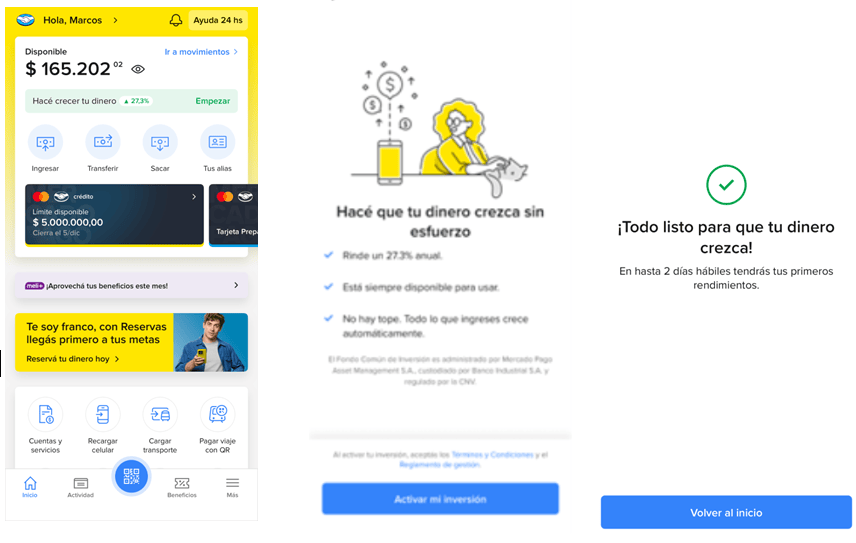
Investment through MP was a major innovation in Argentina’s financial ecosystem because it allowed Mercado Pago users to, among other benefits, protect themselves against the country´s very high inflation rates in a simple, expeditious, and secure manner.
III. The Importance of Investment through MP as an Innovation in Argentina
The importance of Investment through MP’s simple use and return on cash holdings contrasts with the lack of return of traditional banking products in Argentina. Saving and checking accounts have historically had nominal interest rates at or near zero, implying a negative real interest rate in a high-inflation regime.
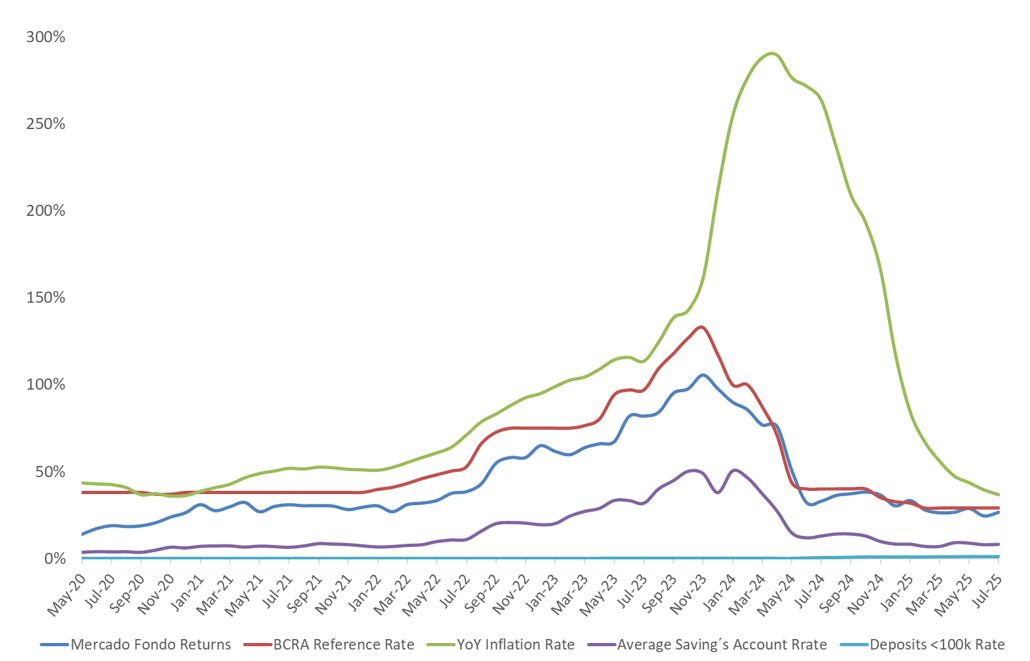
Figure 2 compares Argentina’s year-over-year inflation with four key interest rates—the Central Bank’s policy rate, the average deposit rate offered by commercial banks for deposits above ARS 100,000[4], the corresponding rate for smaller deposits, and the yield paid by Investment through MP—over a period of nearly five years.
Across the period, commercial banks’ deposit rates[5] remain notably below the policy rate and far below inflation, reflecting the limited ability of traditional banking products to offer account holders meaningful protection against inflation.[6] In contrast, the yield offered by Investment through MP shows a more dynamic adjustment, aligning more closely with the policy rate and consistently surpassing bank deposit rates.
Figure 2 – YoY inflation vs. annual nominal interest rates: BCRA monetary reference rate, savings account average rate, and Mercado Fondo return. May 2020 – Jul 2025.
Source: Own calculations based on INDEC, BCRA, and Mercado Pago data.
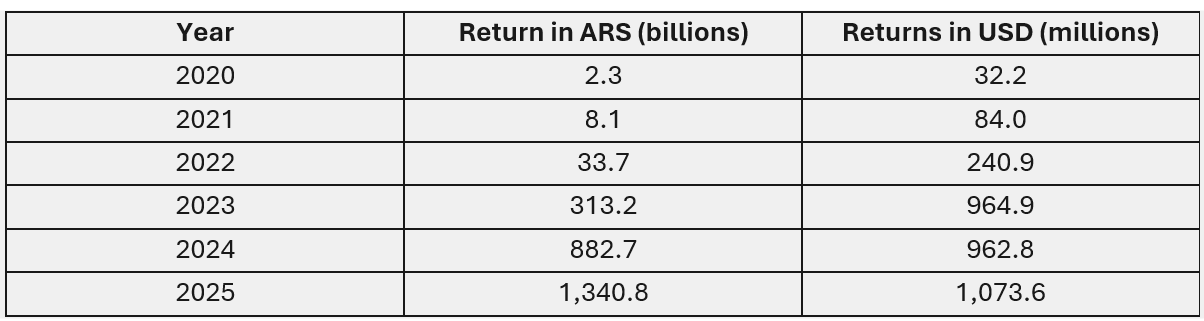
More broadly, this data indicates that in Argentina, traditional deposit products deliver deeply negative real returns, whereas fintech-enabled solutions—particularly Investment through MP—have offered depositors an alternative that allows them to earn a return on their balances, helping households partially offset the inflation tax on their cash holdings. Since its launch, Investment through MP has paid more than USD 2.3 billion in returns to users (see table 1)—income they would not have received, or would have received at much lower values, through traditional savings or checking accounts.
Table 1 – Mercado Fondo yearly returns on invested deposits to consumers in Argentina
Source: Mercado Pago.
IV. Access to New Savings and Investing Tools
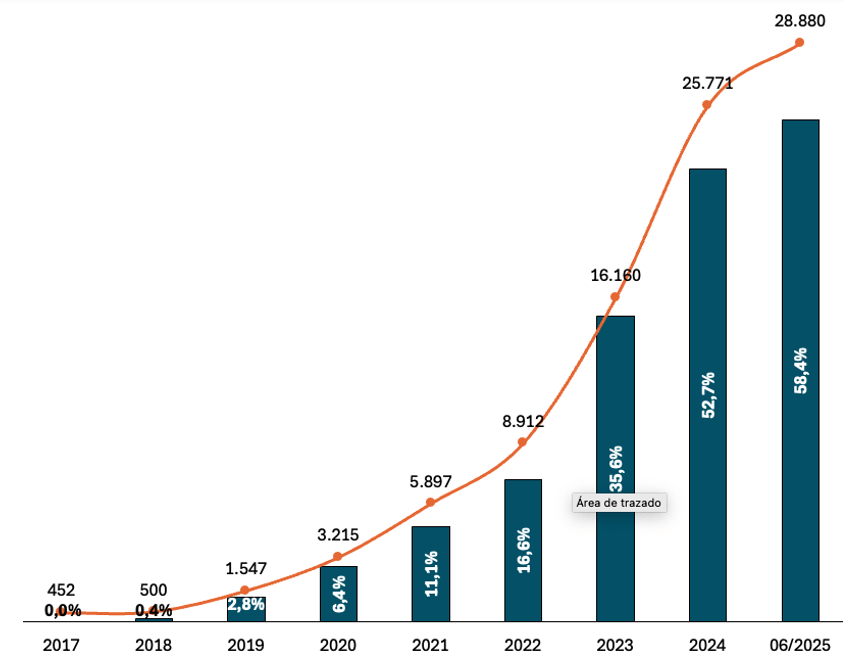
Since the launch of Investments through MP, the number of investment accounts has grown exponentially, surpassing 20 million through Mercado Pago alone in 2024 (reaching more than half of the adult population), alongside more than 8 million additional accounts offered by banks and other fintechs, many of which replicated the model. As shown in Figure 3, the share of Argentine adults investing through Mercado Pago has expanded sharply since its launch in 2018, reaching almost 60% of Argentina’s adult population by 2025.
Figure 3 – Total investment accounts in Argentina (in thousands) and Investment through MP penetration rate (in %) among adults in Argentina (+18)
Source: Own calculations based on BCRA, World Bank, CAFCI, and Mercado Pago data.
Before Investment through MP, most citizens had no access to investment alternatives within the financial system. Penetration was extremely low, as traditional financial institutions and brokerage firms largely targeted higher-income segments and offered limited, inaccessible options for the broader population.
In 2017, Argentina had only 452,118 investment accounts—just 1,4% of adults. Following the launch of Investment through MP in 2018, the landscape changed dramatically: by the end of 2019—less than two years after launch—60% of Argentina’s investment accounts had been opened by Mercado Pago users, a share that increased to 70% as of June 2025.
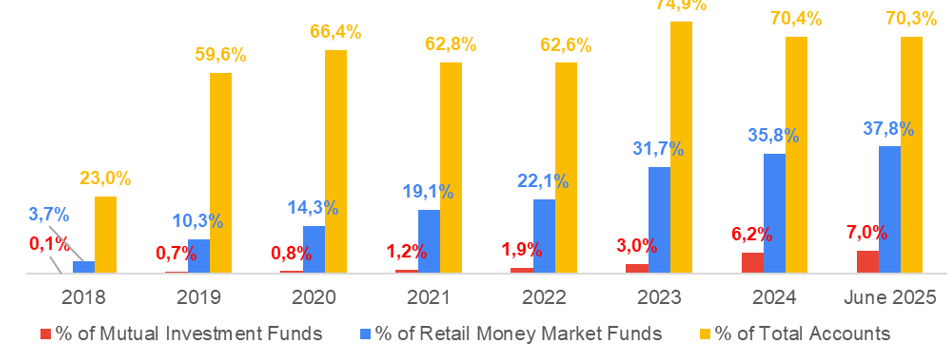
However, Investment through MP accounted for only 7% of total investments in money market funds and 37.8% of investments in “Clase A” money market funds (retail investors). Mercado Pago has a large number of investment accounts, given its democratization of investment tools, but it still holds a low share of total investment funds, as it is primarily a savings-and-investment vehicle for retail depositors (see Figure 4).
Figure 4 – Penetration of Investment through MP in Mutual Investment Funds. June 2025
Source: Mercado Pago and CAFCI.
Although fintechs account for only 6.1% of total private-sector deposits (excluding public-sector deposits), their penetration is both broad and deep. As of June 2025, 71.4% of the population held at least one payment account, while 4.8% relied exclusively on them, without any traditional bank account.[7] This reach extends across all socioeconomic segments: 61.5% of Mercado Pago users in Argentina earn an estimated 1.25 million pesos or less per month (~USD 900)[8], and 10% are minors aged 10–17[9], reflecting meaningful early-stage financial inclusion.[10]
V. Investment through MP Procompetitive Dynamics
Mercado Pago’s success with Investment through MP led several fintechs to quickly replicate the combined model of a payments and investment account (see Figure 5), offering daily returns on deposits with immediate withdrawals.
Notably, incumbent banks and fintechs have begun easing requirements for opening investment accounts and simplifying the process of investing in and withdrawing from money market funds. For instance, Banco Galicia began allowing 24-hour withdrawals from its funds and direct transfers from the money market to other accounts. Similar offerings were deployed by Banco Santander Rio, Banco ICBC, and Cocos Capital, among others.
Additionally, banks began paying competitive interest rates on deposits in savings and checking accounts. In September of 2024, Ualá —which started as a fintech but became a bank after it acquired the digital neobank Wilobank in 2022—[11] began paying competitive daily interest rates on deposits without them being invested in a money market fund.[12] Another Argentinian bank, Supervielle, followed suit in April of 2025, becoming the first traditional bank to offer daily interest rate payments on deposits.[13]
Figure 5 – Competitive response by selected Fintechs and Banks to Investment through MP
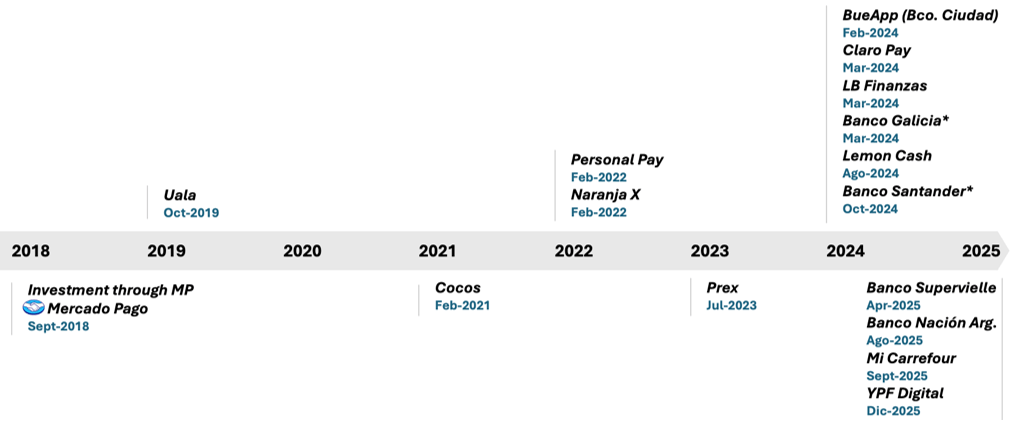
Note: Banco Santander and Banco Galicia introduced new functionalities and UX changes to their money market funds to replicate the Investment through MP service.
Source: Own elaboration based on multiple sources.
VI. Regulation and Competition in Financial Services
In financial services, regulation can operate as either a barrier to entry or a facilitator of competition and innovation. In this context, the role of Argentina’s financial sector regulators, primarily the Central Bank of Argentina (BCRA) and the National Securities Commission (CNV), is pivotal in shaping the competitive structure and evolution of the country’s financial services market.
A. Risk-Associated Regulation for Banks and Fintechs
Fintech companies’ business model tends to focus on specific services, such as payments, digital wallets, loans funded with their own capital, or the channeling of investments through specific vehicles (for example, money market mutual funds). In contrast with the banking business model, they do not engage in financial intermediation. Consequently, the regulatory framework applied to them is different: it relies less on prudential requirements and more on activity-based principles, such as transparency, segregation and custody of funds, interoperability, and consumer protection.
The origin of risk-associated regulation is not accidental; it directly reflects the difference in the risks assumed. Both banks and fintechs assume operational, technological, fraud-related, and other similar risks, but the financial intermediation carried on by banks presents additional systemic risks that require specific regulations.
Requiring the same prudential framework for fintechs and banks from the outset would create substantial artificial barriers to entry. This effect is known in competition literature as raising rivals’ costs: regulations designed to protect financial stability end up consolidating incumbent players’ positions, who already possess the capital, compliance teams, and experience to absorb high regulatory burdens.
B. Regulation as “Tailwind” for Competition
A clear illustration of how regulatory barriers can constrain competition is the payment of direct government assistance through programs administered by the National Social Security Administration (ANSES). Until April 2024, beneficiaries of the Asignación Universal por Hijo, Tarjeta Alimentar, and Becas Progresar programs were required to receive their transfers through savings or checking accounts at traditional banks, effectively excluding fintech providers and their digital payment accounts.[14] Since that rule was changed, beneficiaries have been free to choose where to deposit their funds. As a result, Mercado Pago has rapidly emerged as a competitive alternative to incumbent banks.
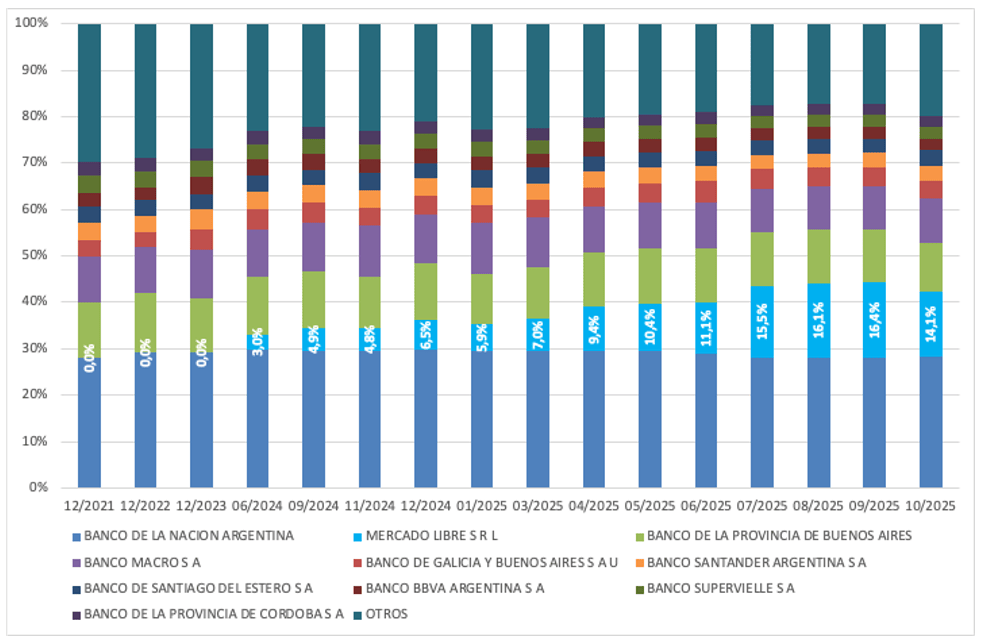
Nearly 1.8 million beneficiaries—representing 14.1% of the approximately 13 million total beneficiaries—have chosen Mercado Pago as their preferred institution to receive social benefits over less than two years, positioning it as the second-largest recipient institution after Banco de la Nación Argentina (see Figure 6). Notably, according to Mercado Pago, within just six months of the program’s launch, more than 85% of these beneficiaries reported earning returns through their digital accounts.
Figure 6 – Chosen “ANSES Payment Agents” (ANSES Agentes Pagadores) by government assistant beneficiaries
Source: Own elaboration based on ANSES “Agentes Pagadores” data.
C. Regulation as a Barrier (or “Headwind”) for Competition
Although Argentina has adopted a regulatory proportionality framework intended to facilitate fintech development, several regulatory constraints continue to limit its ability to compete with traditional banks. One of the most consequential restrictions concerns salary accreditation. Article 124 of the Law No. 20,744 on Employment Contracts (1976) and Law 26,704 on Salary Accounts (2011) require wages to be deposited into a free bank account at a regulated financial institution, thereby excluding fintech payment accounts from participating in a central segment of the financial services market: the disbursement of primary income.
Similar restrictions have strong implications for pensions. While fintech payment accounts—most notably Mercado Pago—have been widely adopted for receiving government social assistance, this option is not available for pension payments, even though both transfers are administered by the same public authority (ANSES). ANSES disburses more than 8.2 million pensions each month; however, the BCRA’s regulatory interpretation prevents any of these payments from being credited to fintech accounts (see Figure 7).
Figure 7 – Ranking of ANSES paying agents (official report, screen capture)
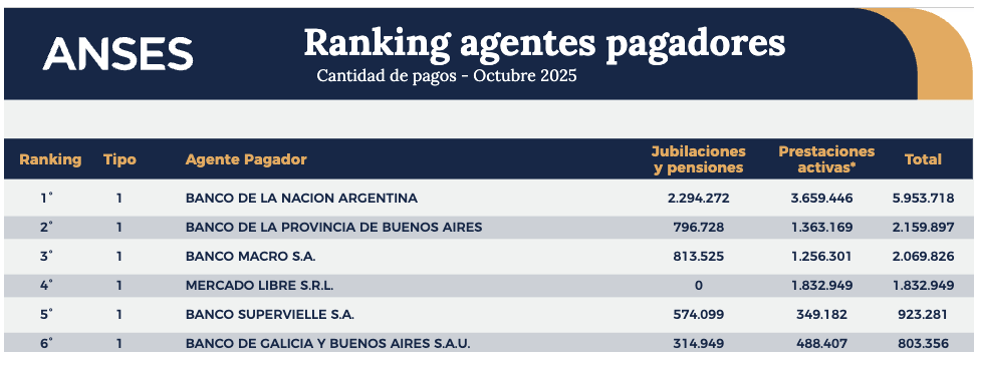
Source: “Ranking de Agentes Pagadores ANSES”, ANSES, October 2025.
The restriction on receiving salaries and pensions through digital accounts constitutes a regulatory distortion of the competitive landscape that confers a significant advantage to incumbent banks. Once individuals receive their primary income through a given account, a strong anchoring effect emerges, shaping subsequent financial behavior, usage intensity, and provider choice across other financial products and services. As a result, banks benefit from a regulatory mechanism that systematically reinforces account primacy, irrespective of differences in service quality or user experience.
VII. Final Remarks
Investment through MP represents a pivotal innovation that structurally transformed the Argentinian financial ecosystem, acting as a powerful engine for both financial inclusion and competition. By seamlessly embedding a money market mutual fund into a digital payment account, this product dramatically lowered the barriers to investment, enabling millions of previously excluded people to earn daily, competitive returns on their instantly available cash balances.
This innovation was particularly critical in Argentina’s high-inflation environment, offering households, especially those with lower incomes, an accessible and necessary defense against the inflation rate. Its success intensified competition in the historically stagnant banking deposit market, prompting both traditional incumbent banks and rival fintechs to reconsider their value propositions and integrate interest-bearing features into their product offerings.
The evolution of Investment through MP highlights the role of regulation in both enabling and constraining competition. However, persistent arbitrary regulatory asymmetries, such as restrictions on depositing salaries and pensions into fintech payment accounts, continue to act as barriers to competition, creating regulatory distortions that protect incumbents and limit the market’s full competitive potential.
Click here for a PDF version of the article
[1] Cecilia de Mendoza, Mercado Libre; Marcos M. Orteu, Universidad Torcuato Di Tella. The authors thank Álvaro Espinosa, Ana Ruival and Lucas Greco for their helpful comments and the research assistance from Federico Amtmann. Disclaimer: This paper has received financial and organizational support from Mercado Libre.
[2] A payment account, also referred to as a digital account, is a financial instrument offered by fintech companies that allows users to receive, hold, and use funds electronically to carry out basic payment and transfer operations, without the need for a traditional bank account.
[3] Mercado Libre, de cabeza al mundo financiero: ofrece pagos QR y una herramienta de ahorro para “Doña Rosa” – Infobae (Infobae, May 2018); Mercado Pago: 100.000 personas ya invierten a través de la billetera (RoadShow, December 2018). high-inflation context, a return on cash balances allows savers to minimize the negative effects
[4] Approximately equivalent to USD 80 as of July 2025.
[5] BCRA data on deposits offers the average interest rate paid per checking and savings account, and the interest rate paid per range of deposits. In particular, BCRA data shows the average interest rate in accounts with deposits from $0 to $99.999, from $100.000 to 499.999, from $500.000 to $999.999, and from $1.000.000 onwards. See BCRA, “Cuadros estandarizados de series estadísticas. TASAS DE INTERES POR DEPOSITOS”, file pashis.xls. Link: https://www.bcra.gob.ar/archivos/Pdfs/PublicacionesEstadisticas/pashis.xls
[6] Banks typically offered higher rates through term deposits (“plazos fijos”), but these products restricted access to funds for the entire contractual period. In contrast, Investment through MP enabled savers to earn a return on their cash balances while retaining full and immediate liquidity.
[7] https://www.bcra.gob.ar/indicadores-inclusion-financiera/
[8] As a reference, INDEC estimates the national household poverty line at a monthly income of AR$1.065.691 in the first semester of 2025. INDEC, “Incidencia de la po breza y la indigencia en 31 aglomerados urbanos. Primer semestre de 2025”, September 2025. Link: https://www.indec.gob.ar/uploads/informesdeprensa/eph_pobreza_09_25D162CC7BFB.pdf
[9] Underage users can open an account starting at age 10, and can invest their funds starting at age 13, in both cases with parental authorization. https://www.mercadopago.com.ar/ayuda/32939
[10] We are excluding ussers designated as Sellers in Mercado Libre marketplace, both firms and individuals, from the sample, given that they have different behaviour that individual/personal users.
[11] Autorizan la compra de Wilobank por parte de Ualá, que tendrá a Eurnekian como socio – LA NACION.
[12] Ualá aumenta la tasa de su cuenta remunerada: cuánto gano si invierto $500.000.
[13] Un banco tradicional lanza por primera vez una cuenta remunerada en pesos y en dólares: cómo funciona – Infobae.
[14] Although ANSES allowed this in 2019, it was not implemented until April of 2024. RESOLUCIÓN 39 / 2019 – ADMINISTRACION NACIONAL DE LA SEGURIDAD SOCIAL | Argentina.gob.ar