I. Introduction
Interim measures are preventive and corrective tools that competition authorities can adopt during investigations into possible infringements of competition law, particularly in cases of alleged abuse of a dominant position. In Latin America and the Caribbean, most competition regimes contemplate the use of interim measures in their legal frameworks (Burnier da Silveira & Berbert-Born, 2025; OECD, 2024).
However, competition authorities do not frequently resort to such interim measures, reserving their use for cases in which the plausibility of the law and the risk associated with the delay are sufficiently demonstrated.
This article describes an atypical situation for the region: over a period of two years, six competition agencies issued injunctions against the same companies in similar cases. The setting for this event was the payment methods and Fintech sector.
II. Injunctions Against Payment Card Brands
The actions of competition agencies in the payment methods sector are not new, as important interventions have been reported over the last several years, either regarding investigations for abuse of dominant position, market studies, or competition advocacy actions.[2] In particular, Greco & Viecens (2023) identifies a series of pro-competitive interventions in a significant number of countries, focused on card payment processors and acquirers, whose shareholders have been, in practically all cases, traditional banks. These interventions have been aimed at promoting competition, opening up the market for payment methods and eliminating barriers to the entry of new digital players. This background shows that, in light of the international discussion on the impact of the digital economy on markets and on the analysis and application of competition law, the payment methods sector, impacted by digital transformation, is the protagonist of a large number of cases and investigations that concern competition agencies in the region.
In Greco & Viecens (2023) we identify three main types of cases. A first group of investigations against acquiring companies and processing card payments, generally in the hands of incumbent banks. A second group of complaints against the Mastercard and Visa brands. A third group of complaints and open cases against BigTech companies. This article focuses on the second group of complaints due to its particular characteristic of having generated the “wave of interim measures” which, as mentioned, is an unprecedented event in the region.
This group of cases and investigations (still open in many of the countries) began to develop in 2022 when some regional Fintechs denounced the Mastercard and Visa brands. The complaints originated in certain practices and programs announced by the brands, the effect of which, alleged by the complainants, was the exclusion of Fintechs from the market. In particular, the practices were the result of a trademark rule that local processors, sub-acquirers or payment facilitators cannot add affiliates (or process their payments) if they are located outside the national territory.[3]
The imposition of interim measures usually requires compliance with two common requirements: (i) the plausibility of the infringement (fumus boni iuris) and (ii) the urgency of preventing damage (periculum in mora). These conditions are present in most legal frameworks in Latin America and the Caribbean with some nuances, either in their legal definition or in their application (Burnier da Silveira & Berbert-Born, 2025). As already mentioned, the use of interim measures is very restricted. For example, INDECOPI of Peru had not applied a interim measure for 14 years when it issued the one related to this case. In some countries with young competition agencies, such as the Dominican Republic and Paraguay, this case involved the first and second interim measures granted by the competition agency, respectively. Specifically, between 2022 and 2023, the competition agencies of Argentina, Chile, Colombia, Paraguay, Peru, and the Dominican Republic issued injunctions against Visa and in the case of Colombia against Mastercard as well (Table 1).
Table 1. Countries in the region that granted interim measures against card brands for cross-border payments
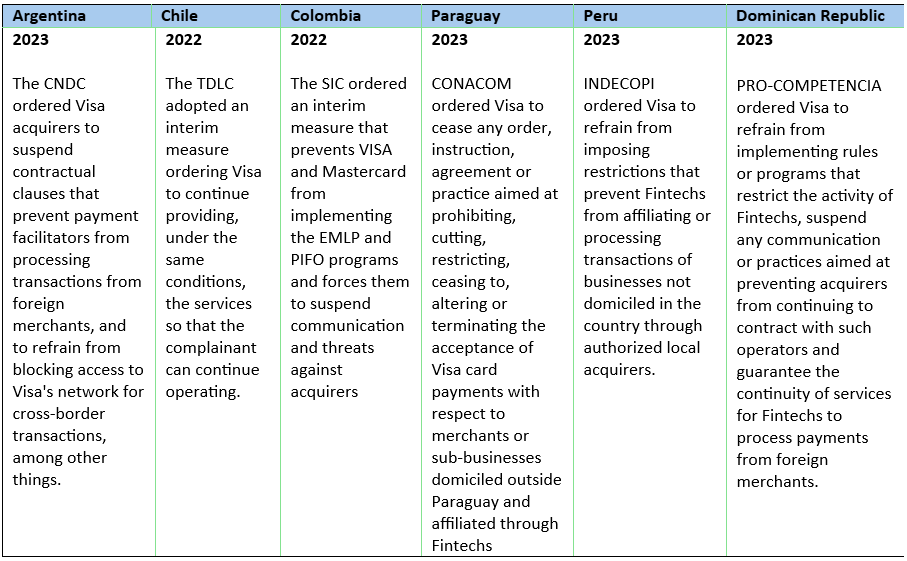
Source: own elaboration with public information and from Greco & Viecens (2023).
Most jurisdictions in Latin America and the Caribbean provide for the possibility of imposing both positive (obligations to do) and negative (obligations not to do) interim measures (Burnier da Silveira & Berbert-Born, 2025). In this case, these are measures of the type of not doing. In 2025, INDECOPI decided to sanction Visa for anti-competitive practices. In Panama and Paraguay, the agencies have signed commitments with Visa and/or Mastercard
III. Final Discussion
Transformation and the digital economy open up new markets and generate new actors and services. This has prompted agencies to update analytical tooling, adapt theories of damage, and remedial measures.
This article reviews a particular case of regional scope and presence where regional companies requested injunctions against payment card brands.
The existence of this research reflects a particular dynamic that has been acquiring in Latin America the interaction and, in many cases, the tension between the emerging business models driven by the digital economy and the traditional models represented by the incumbent actors of the payment markets, such as brands or card schemes.
Although these cases share certain features with the European or United States experience, both in terms of the markets involved and the theories of harm they raise, they present idiosyncratic characteristics of the region (Greco & Viecens, 2024). In particular, this is linked to the response of card brands to the emergence and expansion of Fintech companies that have developed local processing solutions for global payment services, as well as to the impact that these innovations have had on financial inclusion processes since these Fintechs arise to respond to the specific needs of the local population
This experience shows that the development of the digital economy finds competition agencies active in the reception and analysis of new cases, and willing to use tools such as interim measures that until now had been scarcely applied.
Click here for a PDF version of the article
Bibliography
Burnier da Silveira, P. & Berbert-Born, G. (2025), Interim Measures in Abuse of Dominance Investigations in Latin America and the Caribbean
OECD (2024), Interim Measures in Abuse Of Dominance Investigations in Latin America and the Caribbean, part of the series “OECD Roundtables on Competition Policy Papers”.
Greco, E., & Viecens, M. F. (2024), Competition in the digital economy: Latin America and the Caribbean in perspective with the European model, in Studies on artificial intelligence and digital economy, Aranzadi La Ley.
Greco, E., & Viecens, M. F. (2023), Financial technologies and means of payment: taxonomy of investigations by competition agencies in Latin America and the Caribbean (2023), Antitrust Yearbook, Procompetencia.
Greco, E., & Viecens, M. F. (2022). Digital Economy in Latin America: Reflections on Economic Concentrations in the Region, Revista De Derecho Administrativo, (21), 146-163.
Greco, E. & Viecens, M.F. (2021). Payment methods with new technologies in Latin America: recent actions by competition agencies. Latin American and Caribbean Competition Forum (OECD-IDB).
Greco, E. & Viecens, M.F. (2020a). Innovation and digital disruption in payment markets: The case of antitrust in Argentina. Mora, S. and Palazzi, P., compilers, Fintech: Legal Aspects, Volume III, 237-257.
Greco, E. & Viecens, M.F. (2020b). FinTech and BigTech: barriers to entry and innovation. State of Situation in Latin America, published in the Latin American Journal of Digital Economy and Society, (1).
[1] The author has submitted technical reports to competition agencies for some of the cases analyzed.
[2] One of the pioneering cases, that of Argentina, has been explained in detail in Greco & Viecens (2020a). Greco & Viecens (2020b, 2021, 2022, 2023) has documented and analysed cases, interventions and mergers investigated by competition agencies in the region in the payment methods sector.
[3] In some countries, brands announced the implementation of Visa’s EMLP (Expanded Merchand Location Pilot Program) and Mastercard’s PIFO (Payment Intermediary Foreign Exchange Operators) programs, which imply an increase in costs for Fintechs. In other countries, brands announced the closure of operations for Fintechs.