Consumers aren’t just choosing a Pay Later option.1 They’re selecting the precise payment method that fits their immediate financial goal at the time of purchase. That means the Pay Later ecosystem has entered a phase defined by segmentation and functional differentiation. The evidence: Thirty-one percent of consumers now turn to credit card installment plans, nearly three times the 12% using BNPL.
Consumer inclinations reveal why this segmentation is happening. The top motivations for using BNPL are speed and approval at the point of sale. Installment plans, meanwhile, operate as mechanisms for structured borrowing and credit management. Traditional credit cards with revolving balances serve broader liquidity, interest-avoidance and rewards objectives.
Store card installment plans occupy a distinct competitive position. They uniquely bridge immediacy and credit strategy, making them the only installment product that competes directly with BNPL at checkout while retaining credit management relevance.
How much financial stress a consumer is under reveals a lot about why they use different Pay Later tools. So does generational behavior. Gen Z shows the clearest separation of roles for payment methods: BNPL for immediacy, installment plans for credit strategy.2
These are just some of the findings detailed in “Speed vs. Strategy: How Consumers Choose Between BNPL and Card Installments,” a PYMNTS Intelligence exclusive report. This edition of the Pay Later Ecosystem Series examines which Pay Later methods consumers use and why, and draws on insights from a survey of 2,980 U.S. adult consumers conducted from Jan. 14, 2026, to Jan. 29, 2026.
Credit Card Installments Go Mainstream
Credit card installment plans outpace BNPL nearly three to one.
Across every major consumer group, credit card installment use continues to outpace BNPL. In January 2026, 31% of consumers used installment plans on general purpose cards, store cards or both, compared with 12% who used BNPL. The nearly three-to-one gap holds across generations, financial situations and income levels.
Younger consumers report higher usage of installment plans compared to BNPL, reinforcing that they aren’t abandoning traditional credit structures. This pattern persists regardless of financial condition. Even among lower-income households, installment plans hold a double-digit advantage, and the lead continues through middle- and higher-income segments. Whether consumers are financially stable or struggling, installment plans maintain a clear lead, while BNPL remains more concentrated.
Collectively, the data shows that installment plans are broadly embedded across the market, while BNPL plays a narrower, more situational role.
Financial Drivers
Whether a Pay Later product wins depends on a consumer’s financial motivations.
Seven motivations explain nearly all Pay Later decisions, and each payment method owns a different one.
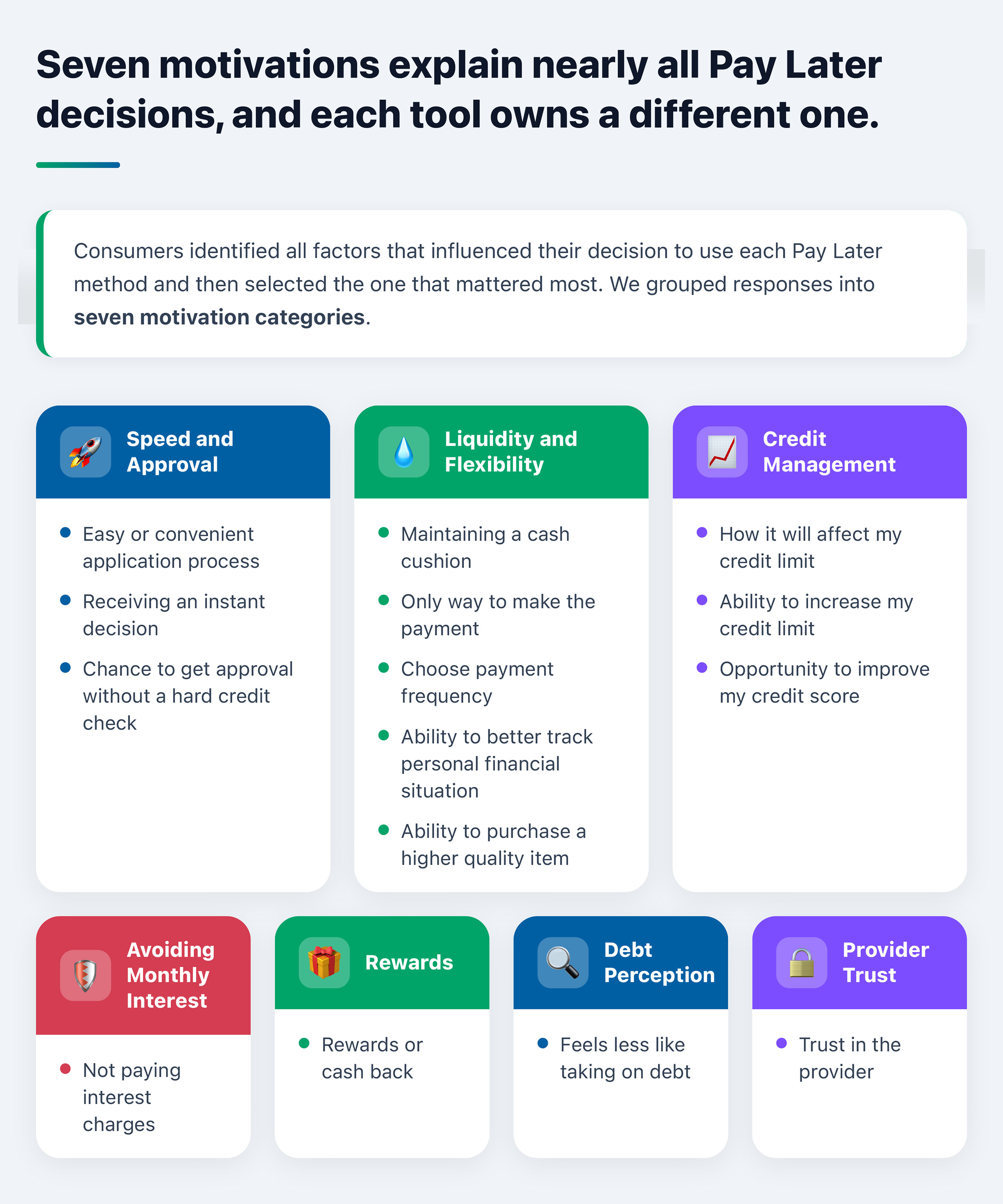
Consumers assign each Pay Later tool a distinct financial role: Speed defines BNPL, while credit defines installment plans and traditional cards serve broader financial goals.
Consumers don’t treat Pay Later tools as interchangeable. Each product appeals in distinct ways.
- BNPL functions as a low-friction access tool.
Speed and approval lead decisively as selling points, well ahead of credit management and liquidity. Consumers use BNPL to secure fast approval at checkout, not to manage long-term credit.
- General purpose card installment plans operate as structured tools for managing credit.
Credit limit management leads; speed and liquidity are secondary. These plans support deliberate credit positioning rather than impulse purchasing.
- Store card installment plans occupy a hybrid position.
Speed and credit are nearly tied, allowing store cards to compete at checkout while retaining relevance in credit limit management.
- Traditional credit cards reflect the broadest mix of motivations.
Credit limit management and liquidity both play major roles, with avoidance of monthly interest charges and the robustness of rewards contributing meaningfully.
In sum, the market has already segmented by financial intent. That means a Pay Later provider’s competitive advantage depends on how it aligns with the role consumers already assign to a given tool.

Store Cards’ Superpower
Store (private-label) card installment plans are the only Pay Later product that wins on both the checkout and credit strategy fronts.
Speed (32.7%) and credit limit management (32.3%) are virtually tied as consumer motivations for using store card installment plans. This makes store cards the only installment product that competes on BNPL’s core advantage without losing ground on credit positioning.
Consumers cite speed and credit management at nearly identical rates as drivers of their use of store card installment plans. This dual positioning is unique among all installment products.
In contrast, they cite the ability to manage their credit limits as driving their use of general purpose card installment plans. Because credit management clearly outpaces speed here, it signals that these installment plans are treated as a structured borrowing use case rather than a point-of-sale accelerator.
Liquidity plays a secondary role across both card types. Avoidance of interest, trust in the payment provider and perceptions about the role of debt in personal finances remain marginal drivers.
In sum, retailers and card issuers that design their credit products around the dual role of store cards build more durable relationships than either advantage alone would create.
Strategic Choices
Financial pressure reshapes how consumers use BNPL but not how they use card installment plans.
When money is tight, BNPL becomes about more than speed; among struggling consumers, speed, credit and liquidity converge.
When people are financially stressed, it changes how they think about BNPL but not installment plans. BNPL stops being just a convenience and becomes more a mechanism for coping with financial hardship. Installment plans, though, remain consistent: People use them to manage their credit limits regardless of their financial situation.
Speed remains the primary driver of BNPL use across all consumer financial situations. But under financial strain, the mix of motivations compresses. With financially stable consumers, speed clearly separates from credit and liquidity as a motivator. Among struggling consumers, that separation narrows, with credit and liquidity rising to nearly match speed.
This shows that when consumers are under financial pressure, BNPL expands beyond immediacy at checkout to become a short-term financial bridge. It absorbs liquidity and credit-related functions rather than serving purely as a friction-reduction tool. The upshot is that financial stress extends BNPL’s use case. It does not change its identity entirely, but it broadens its role.
Gen Z’s Self-Control
Gen Z uses Pay Later options strategically, not impulsively.
Younger consumers aren’t defaulting to one payment product; instead, they’re selecting the tool that fits the job. And while speed and instant approval drive people to BNPL across the board, younger shoppers care about this immediacy more than anyone else.
Among U.S. consumers overall, 43.4% cite immediacy and reduced friction through speedy approvals as the primary drivers, making speed the leading BNPL value proposition across age cohorts. But while speed consistently ranks first, the intensity of this preference varies.
Gen Z shows the strongest emphasis, with 55.0% citing BNPL’s speed and easy approval, well ahead of credit limit management (28.6%) and liquidity needs (15.7%). Other generations display a more balanced distribution of secondary motivations, including credit management and payment flexibility.
This pattern indicates that BNPL’s core appeal is structurally anchored in immediacy, though younger consumers place disproportionately greater weight on rapid approval and seamless transaction experiences. Speed and approval anchor BNPL usage across generations, with variation appearing in the strength, rather than the direction, of this preference.
Credit positioning defines installment usage across generations, with younger consumers giving it the strongest weight.
Unlike BNPL, whose motivations center on speed and approval, the use of credit card installment plans across generations is primarily driven by a desire to manage their cash flow as efficiently as possible.
Among U.S. consumers overall, 34.2% cite credit limit management as their leading reason for using installment plans, ahead of speed and approval (25.9%) and liquidity needs (23.1%).
This hierarchy holds across age cohorts, including Gen Z. While younger consumers strongly associate BNPL with immediacy, they frame installment plans through a credit-centric lens. Among Gen Z consumers, credit management (43.7%) substantially exceeds speed and approval (22.6%), reinforcing the role of installment plans as structured borrowing tools rather than friction-reduction mechanisms.
The consistency of this pattern indicates that consumers perceive installment plans as part of their financial management and expense planning. In contrast to BNPL’s association with immediacy, installment plans remain closely linked to credit control, budgeting and payment structuring across demographic groups.
How Gen Z spends confirms that they choose which Pay Later option to use based on what it does for them financially.
Gen Z’s spending behavior aligns closely with the motivational divide between usage of BNPL and credit card installment plans.
The cohort shows the strongest emphasis on speed and approval when using BNPL. But its purchasing patterns reveal that it uses the payment method for both discretionary and essential expenses, not just impulse-driven categories.
In January 2026, 5% of Gen Z consumers relied on BNPL for discretionary purchases, 6% for essential and monthly expenses and 4% for both. This spread indicates that BNPL’s value proposition of immediacy extends beyond occasional and nonessential spending.
Usage of card installment plans follows a different structure. For Gen Z, it skews toward essential and blended expenses. Eighteen percent use installment plans for both discretionary and essential purchases, and an equal share use them primarily for monthly or nondiscretionary spending.
Together, these patterns reinforce Gen Z’s differentiated framing of Pay Later tools: For these consumers, BNPL supports immediacy across purchase types, while installment plans serve as structured mechanisms for managing larger, recurring or budget-sensitive expenses.
Read More
PYMNTS Intelligence is the leading provider of information on the trends driving consumer use of Pay Later methods. To stay up to date, subscribe to our newsletters and read our in-depth reports.
Methodology
“Speed vs. Strategy: How Consumers Choose Between BNPL and Card Installments,” the newest installment of the Pay Later Ecosystem Series, a PYMNTS Intelligence exclusive series, is based on a survey of 2,980 adult consumers conducted from Jan. 14, 2026, to Jan. 29, 2026. This report examines trends in Pay Later usage and the consumer motivations that drive them. Our sample was balanced to match the U.S. adult population by age, gender, education and income.
1. In this series, Pay Later refers to traditional, general purpose credit cards used to revolve monthly balances, fixed installment payments on credit cards and store-branded cards, and buy now, pay later (BNPL) plans. While general purpose credit cards with revolving balances are the bulk of the industry, fixed installment payments on cards and BNPL represent meaningful chunks of the Pay Later ecosystem. These options can look similar at checkout—“pay over time”—but consumers do not treat them the same.↩
2. PYMNTS Intelligence uses the following approximate birth dates and approximate age ranges in 2026 for generational cohorts: baby boomers: born in 1964 or earlier and now aged 62 or older; Generation X: born between 1965 and 1980 and now aged 46–61; millennials: born between 1981 and 1996 and now aged 30–45; bridge millennials: born between 1978 and 1988 and now aged 38–48; zillennials: born between 1991 and 1999 and now aged 26–35; and Generation Z: born in 1997 or later and now aged 29 or younger.↩

