March 2026
PYMNTS Data Books

Beyond Cash: What Drives SMB Payment Change

SMBs aren’t clinging to cash and checks because they prefer them. They’re using them because too many businesses still lack the credit tools, access and support to move on, even as 45% say they want to reduce their reliance on cash. Gen Z-led firms show both the heaviest cash use and the strongest appetite for change.

Get Unlimited Access
Complete the form below for free, unlimited access to all our Data Studies, Trackers, and PYMNTS Intelligence reports.

Thank you for registering. Please confirm your email to view all our Trackers.
    yesSubscribe to our daily newsletter, PYMNTS Today.

    By completing this form, you agree to receive marketing communications from PYMNTS and to the sharing of your information with our sponsor, if applicable, in accordance with our Privacy Policy and Terms and Conditions.

    Small and medium-sized businesses are still relying heavily on cash and checks, but PYMNTS Intelligence data shows that many are ready for something better. What is holding them back is not resistance to change. Instead, it is access to the right credit products, concern about cost and a need for digital tools that match how they run their businesses day to day. The five data points below capture where that shift is happening and what it will take to move it forward.

    The SMB Payment Shift

    Cash or Check?

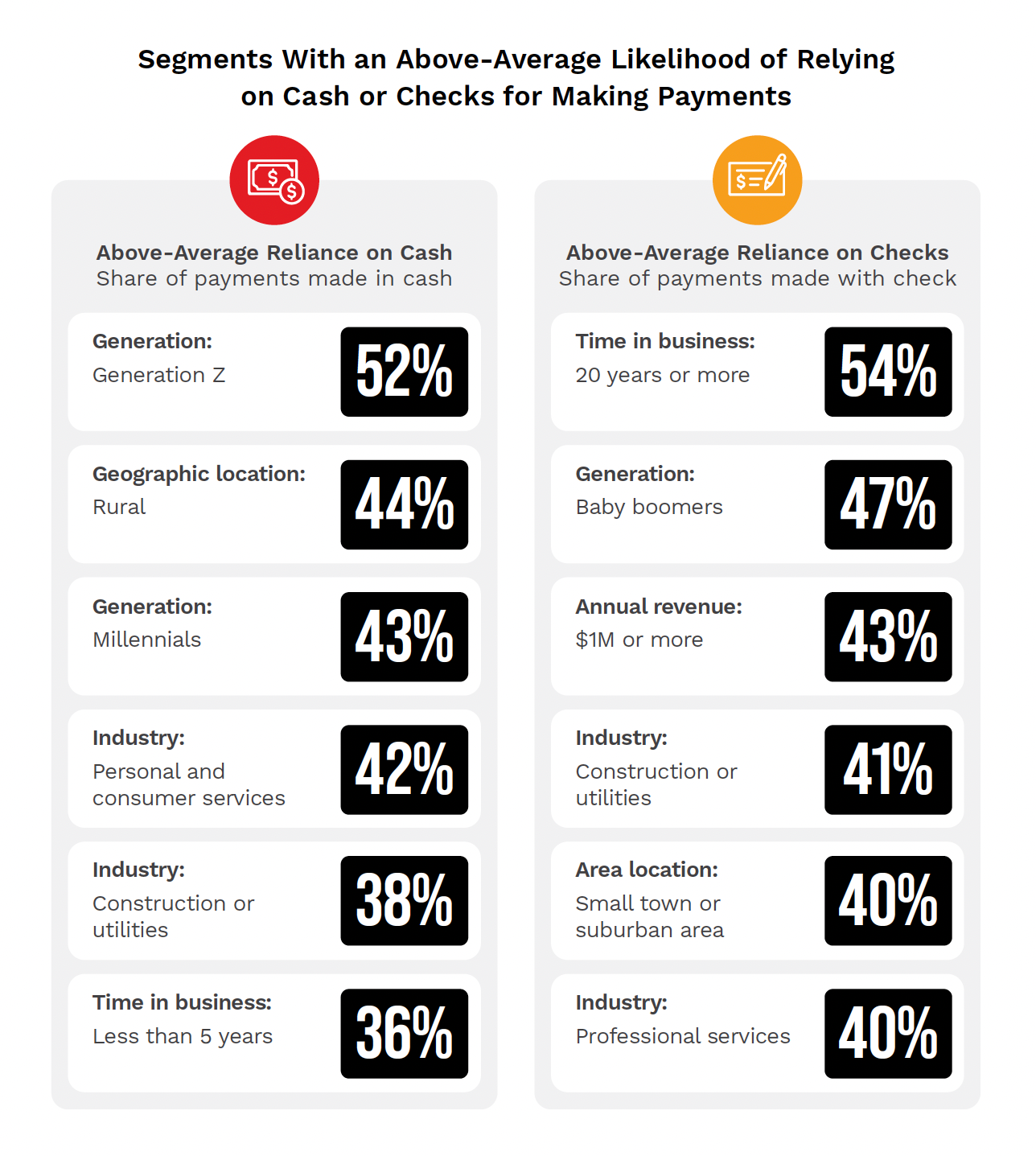
    Gen Z-led SMBs are the most cash-heavy, underscoring how payment habits often reflect business realities more than preferences.1

    Fifty-two percent of payments made by Gen Z-operated SMBs were made in cash, versus a 32% average across SMBs. The same chart shows checks remain just as entrenched overall, accounting for 37% of payments on average. This points to a split market in which younger firms lean on cash while older, larger ones continue to depend on checks.

    PYMNTS Intelligence SMB Growth Data Book March 2026 graphic showing what segments are more likely to rely on cash or checks for making payments.

    SMB Cash Reliance

    The businesses most tied to cash are often the ones most ready to leave it behind.

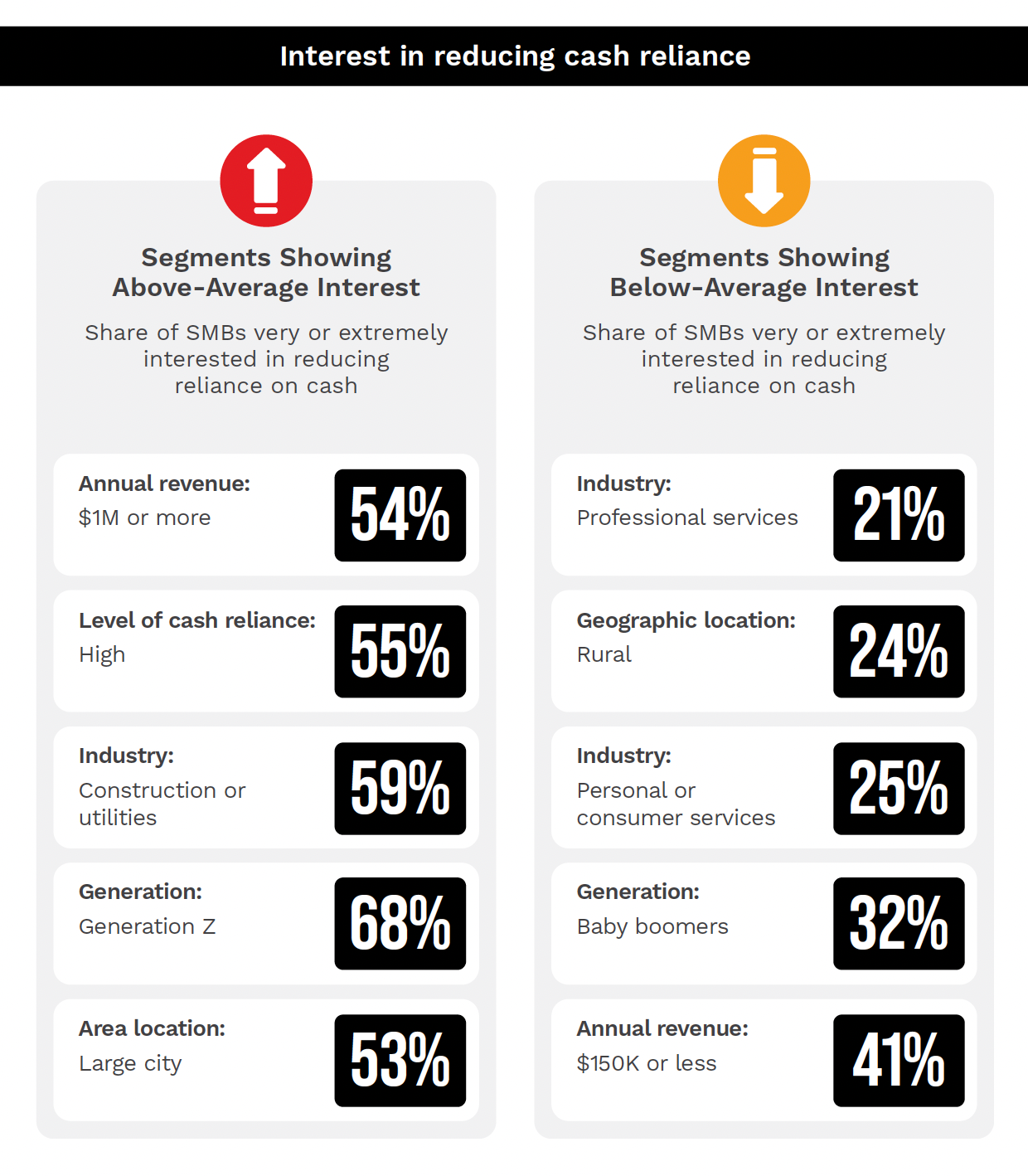
    Forty-five percent of SMBs say they are very or extremely interested in reducing their reliance on cash. Interest is even stronger among Gen Z-owned and -operated firms at 68% and construction or utilities firms at 59%, showing that the businesses feeling the most friction from cash are often the most open to alternatives.

    PYMNTS Intelligence SMB Growth Data Book March 2026 graphic showing select segments of SMBs that are interested in reducing their reliance on cash.

    SMB Access Gap

    Many SMBs still do not have business credit cards that could help them move away from cash.

    Six in 10 SMBs have a business credit card, but access is far from even. Only 22% of Gen Z-led firms, 36% of those in rural areas and 37% of the smallest businesses have one. The result is that many of the businesses most in need of flexibility remain stuck with older payment methods.

    Card Value

    SMBs see credit cards first as tools for protection and cash-flow flexibility.

    Sixty-three percent of SMBs say credit cards are the best method for disputing a payment and getting money back, while 59% say cards are best when they need to make a payment when they don’t have cash on hand. That makes it clear that cards are not viewed only as payment tools. They are also seen as a way to reduce risk and manage timing.

    Human Backup

    SMBs want digital tools, but many still want a real person when it matters.

    A self-serve digital application is the top service choice for 23% of SMBs, but live chat and a human phone representative are close behind at 18% each. Among high-cash-reliance SMBs, phone support rises to 25%, indicating that adoption depends not just on digital access but also on trust and human support.

    Methodology

    Beyond Cash: What Drives SMB Payment Change” is based on findings from the February 2026 edition of the SMB Growth Report. PYMNTS Intelligence surveyed 412 SMB decision-makers, including owners, founders, vice presidents and executive directors. The survey was conducted from Dec. 2, 2025, to Dec. 20, 2025, and examines how SMBs pay vendors and suppliers, how much they rely on cash and checks, and how they view business credit cards as an alternative.


    1. PYMNTS Intelligence uses the following approximate birth dates and approximate age ranges in 2026 for generational cohorts: baby boomers: born in 1964 or earlier and now aged 62 or older; Generation X: born between 1965 and 1980 and now aged 46–61; millennials: born between 1981 and 1996 and now aged 30–45; bridge millennials: born between 1978 and 1988 and now aged 38–48; zillennials: born between 1991 and 1999 and now aged 26–35; and Generation Z: born in 1997 or later and now aged 29 or younger.

    About

    PYMNTS Intelligence is a leading global data and analytics platform that uses proprietary data and methods to provide actionable insights on what’s now and what’s next in payments, commerce and the digital economy. Its team of data scientists includes leading economists, econometricians, survey experts, financial analysts and marketing scientists with deep experience in the application of data to the issues that define the future of the digital transformation of the global economy. This multi-lingual team has conducted original data collection and analysis in more than three dozen global markets for some of the world’s leading publicly traded and privately held firms.

    We are interested in your feedback on this report. If you have questions or comments, or if you would like to subscribe to this report, please email us at feedback@pymnts.com.

    Disclaimer

    PYMNTS Data Books may be updated periodically. While reasonable efforts are made to keep the content accurate and up to date, PYMNTS MAKES NO REPRESENTATIONS OR WARRANTIES OF ANY KIND, EXPRESS OR IMPLIED, REGARDING THE CORRECTNESS, ACCURACY, COMPLETENESS, ADEQUACY, OR RELIABILITY OF OR THE USE OF OR RESULTS THAT MAY BE GENERATED FROM THE USE OF THE INFORMATION OR THAT THE CONTENT WILL SATISFY YOUR REQUIREMENTS OR EXPECTATIONS. THE CONTENT IS PROVIDED “AS IS” AND ON AN “AS AVAILABLE” BASIS. YOU EXPRESSLY AGREE THAT YOUR USE OF THE CONTENT IS AT YOUR SOLE RISK. PYMNTS SHALL HAVE NO LIABILITY FOR ANY INTERRUPTIONS IN THE CONTENT THAT IS PROVIDED AND DISCLAIMS ALL WARRANTIES WITH REGARD TO THE CONTENT, INCLUDING THE IMPLIED WARRANTIES OF MERCHANTABILITY AND FITNESS FOR A PARTICULAR PURPOSE, AND NONINFRINGEMENT AND TITLE. SOME JURISDICTIONS DO NOT ALLOW THE EXCLUSION OF CERTAIN WARRANTIES, AND, IN SUCH CASES, THE STATED EXCLUSIONS DO NOT APPLY. PYMNTS RESERVES THE RIGHT AND SHOULD NOT BE LIABLE SHOULD IT EXERCISE ITS RIGHT TO MODIFY, INTERRUPT, OR DISCONTINUE THE AVAILABILITY OF THE CONTENT OR ANY COMPONENT OF IT WITH OR WITHOUT NOTICE.
    PYMNTS SHALL NOT BE LIABLE FOR ANY DAMAGES WHATSOEVER, AND, IN PARTICULAR, SHALL NOT BE LIABLE FOR ANY SPECIAL, INDIRECT, CONSEQUENTIAL, OR INCIDENTAL DAMAGES, OR DAMAGES FOR LOST PROFITS, LOSS OF REVENUE, OR LOSS OF USE, ARISING OUT OF OR RELATED TO THE CONTENT, WHETHER SUCH DAMAGES ARISE IN CONTRACT, NEGLIGENCE, TORT, UNDER STATUTE, IN EQUITY, AT LAW, OR OTHERWISE, EVEN IF PYMNTS HAS BEEN ADVISED OF THE POSSIBILITY OF SUCH DAMAGES.
    SOME JURISDICTIONS DO NOT ALLOW FOR THE LIMITATION OR EXCLUSION OF LIABILITY FOR INCIDENTAL OR CONSEQUENTIAL DAMAGES, AND IN SUCH CASES, SOME OF THE ABOVE LIMITATIONS DO NOT APPLY. THE ABOVE DISCLAIMERS AND LIMITATIONS ARE PROVIDED BY PYMNTS AND ITS PARENTS, AFFILIATED AND RELATED COMPANIES, CONTRACTORS, AND SPONSORS, AND EACH OF ITS RESPECTIVE DIRECTORS, OFFICERS, MEMBERS, EMPLOYEES, AGENTS, CONTENT COMPONENT PROVIDERS, LICENSORS, AND ADVISERS.
    Components of the content original to and the compilation produced by PYMNTS is the property of PYMNTS and cannot be reproduced without its prior written permission.