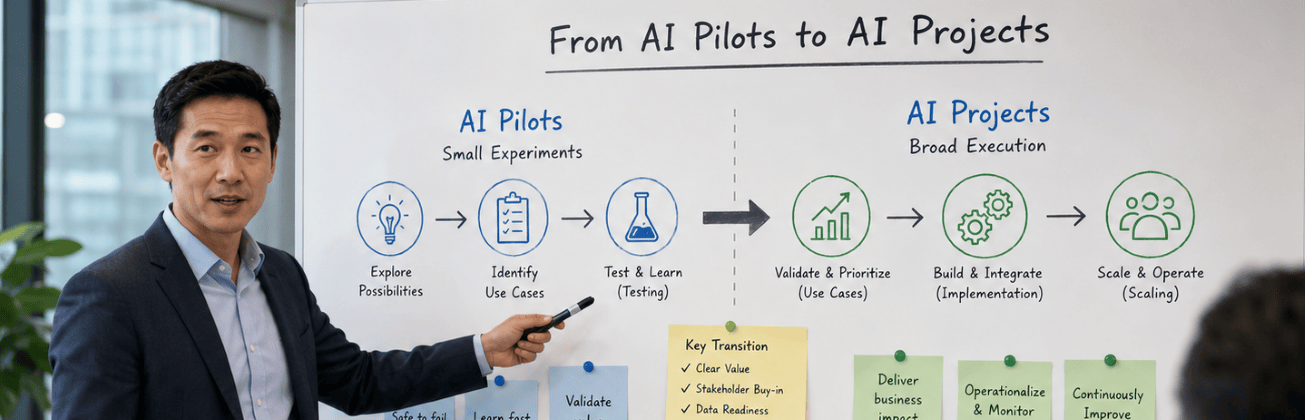
Artificial intelligence was supposed to trigger the next software arms race. Instead, it may be ending the last one.
Across a month’s worth of conversations with PYMNTS for June 2026 edition of the “What’s Next in Payments” series, “Aspirin or Vitamin? How AI Is Rewriting How Clients Buy,” six leading executives shared the four key pillars of exactly why the payments industry is finding out that AI is not simply changing enterprise software itself but changing what enterprises value inside software at an operational level.
The new differentiators are increasingly invisible to customers: infrastructure, governed data, trust, explainability, embedded workflows and operational resilience. The AI era, it turns out, may belong less to companies with the flashiest interfaces than to those with the strongest foundations.
Innovation has become easier. Differentiation has become harder.
Infrastructure Is the New AI Moat
As AI compresses software development timelines, the durability of product benefits is eroding. Capabilities that once differentiated platforms are becoming baseline expectations rather than sustainable advantages.
 “The real shift is not really from aspirin to vitamin or vitamin to aspirin. It’s from is AI a feature of the product layered on top of the product … or is it now part of the infrastructure of the product?” Entersekt Chief Information Officer Richard Bailey told PYMNTS.
The enterprise software companies likely to enjoy the greatest pricing power over the coming decade may therefore be those possessing assets that AI struggles to manufacture: proprietary data, embedded customer workflows, operational resilience and institutional credibility.
 “The model is the easy part,” Archana Prasad, senior vice president, payments and financial services at BILL, told PYMNTS. “Anyone can spin up a demo in a weekend with off-the-shelf models.”
What competitors cannot quickly reproduce, she argued, are “nearly two decades of financial workflow data, the integrations that sit at the center of how half a million businesses actually move money, and the trust those businesses have placed in the platform over the years.”
Rather than replacing traditional competitive moats, AI is exposing which moats were genuine all along.
 “If you’ve already done a lot of that hard work building up a very strong payment strategy that felt resilient in the pre-AI world, you might even be more prepared for this new era than you think,” said Judd Howard, senior product manager, AI at Spreedly.
As a result, rather than evaluating isolated capabilities, buyers are asking whether technology investments will remain durable as AI continues reshaping commerce.
 “What you cannot vibe code is infrastructure,” Ben Griefer, president and chief operating officer at Maverick Payments, told PYMNTS. “We deliver that underlying foundation that they can bolt onto.”
Software Is Becoming an Operating System, Not a Tool
The transformation extends beyond infrastructure into software’s fundamental purpose across enterprise operations. Artificial intelligence is enabling new solutions that can interpret information, recommend actions and even perform tasks independently.
 “A feature requires users to remember it exists. A capability embedded within an everyday workflow eventually becomes part of the operating system of the business itself,” WEX Chief Digital Officer Karen Stroup said. “It’s about reimagining how you work and creating a solution that tackles everything.”
“We encourage our teams to do a service design blueprint,” Stroup added. “Map the experience, talk about what you’re doing today, and then dream big.”
Organizations today expect software to reconcile invoices, detect fraud, optimize approvals, route payments and manage operational workflows with minimal human intervention. Human expertise shifts away from processing routine work toward supervising exceptions, exercising judgment and providing accountability.
“We started with tools that helped people do the work. Now we’re building systems that do the work alongside them, and increasingly for them,” BILL’s Prasad said. “The long-term direction is really about using AI to build more intelligent, touchless financial experiences — ones that remove work from customers’ plates, not just organize it better.”
The result is an enterprise stack that increasingly resembles an operating system rather than a collection of discrete applications. Competitive advantage, therefore, shifts from building better tools to becoming indispensable participants in how businesses operate.
“It’s a hope-based landscape,” Spreedly’s Howard said. “People are coming with the idea of setting themselves up for the future and continuing to grow.”
Architecture plays a central role in that effort.
 Matthew Pearce, vice president of fraud risk management and dispute operations at i2c, stressed that fragmented systems create blind spots that limit AI’s effectiveness, while unified platforms allow information to flow more freely across fraud, disputes and risk management functions.
The Competitive Edge Is Better Decisions, Not More Automation
Perhaps the most striking consensus across the interviews concerns how organizations should measure AI success, with executives agreeing that businesses must evaluate AI by its impact on decision quality.
As Entersekt’s Bailey told PYMNTS, “the big decision now for buyers around AI is not, can I use AI, but can I use AI to run the business?”
AI’s value lies not simply in processing more information but in making better decisions with it.
“Speed, precision and transparency have to rise together. If any one of those slip, the process really goes off the track,” i2c’s Pearce said.
As a result, firms are asking questions of AI, like, can fraud be identified with greater precision? Can approvals improve without increasing losses? Can customer friction decline while maintaining security?
“You can use a lot of tokens and build a lot of things that don’t matter,” WEX’s Stroup said.
Instead, she recommends measuring faster decisions, stronger products, improved customer outcomes and operational improvements.
After all, as the executives continually stressed, AI itself is becoming commonplace. Durable advantage lies in infrastructure, embedded workflows, decision quality and trusted execution.
“The only way to keep up,” Griefer said, “is pairing humans … with AI so that they have the tools to keep up.”
Trust Is Becoming Enterprise AI’s Most Valuable Product
As AI becomes more autonomous, another competitive dimension emerges.
Trust. It may be revealing that intelligence itself is becoming abundant while trust, governed data, embedded workflows and operational infrastructure remain extraordinarily difficult to replicate.
“At some point, someone has to look a CFO or an auditor in the eye and explain what happened and why it happened. That’s not a feature you bolt on after the fact. It has to be built into the foundation,” Prasad said. “Our customers aren’t just running workflows. They’re making financial decisions.”
Few environments combine such demanding requirements for speed, precision, fraud prevention, regulatory compliance and customer trust as payments and financial services. Every transaction tests whether autonomous systems can balance security with customer experience while remaining fully accountable.
“Payments, uniquely, because it’s so infrastructural, has been set up with a lot of the fundamentals around compliance and security so that it can scale with AI,” Howard said.
Trust becomes especially important as AI begins making or influencing commercial decisions. Rather than asking whether authentication occurred successfully, Pearce suggested organizations may increasingly ask an entirely different question.
“What is the intent of the purchase?”
Intent, context and judgment are fundamentally different problems than automation. And they represent a fundamentally different competitive landscape, one that may prove to be AI’s most important business consequence.