Making Health and Wellness Benefits Perform: What Modern Card Infrastructure Changes
What employers, administrators and participants get back when HSA, FSA and wellness dollars move on modern card infrastructure
Employees expect one thing from a health or wellness benefit. That the money is there and works when they need it. Programs that deliver on that, from enrollment through checkout, give something back the organization can measure. Eligibility gets checked before a dollar moves. Funds actually get used. Hours come back to the benefits team. And there’s room to launch the next program. Modern card infrastructure is what makes that routine.
01
How well a benefits program performs comes down to its infrastructure, not its training. Compliance, employee use, staff capacity and the ability to add new programs all improve when the payment system underneath does more of the work.
02
Modern benefit cards check eligibility, show balances and handle administration in real time. The right purchase clears instantly. The wrong one doesn’t clear at all.
03
The strongest case for change puts a dollar figure on four kinds of value before the technology decision gets made, using the organization’s own numbers instead of an industry average.
Get Unlimited Access
Complete the form below for free, unlimited access to all our Data Studies, Trackers, and PYMNTS Intelligence reports.
Thank you for registering. Please confirm your email to view all our Trackers.
WHAT THIS TRACKER DOES
This Tracker gives CFOs, HR executives and benefits administrators a practical way to measure what a benefits program gives back when it works well. It shows up in four places: eligibility checked at the point of purchase, participants who actually use the money set aside for them, staff hours moved from manual reconciliation to program strategy, and one platform that makes each new benefit type easier to add than the last.
Most finance leaders can say what their benefits program costs in premiums and contributions. Fewer can say what it gives back.
Total employer compensation costs for private industry workers averaged $46.60 per hour worked in March 2026, according to the U.S. Bureau of Labor Statistics. Benefits, including health coverage, retirement contributions, paid leave and similar programs, accounted for 30.1% of that figure, or $14.01 per hour worked. That means nearly one-third of what an organization spends on its workforce moves through benefit programs instead of paychecks. Whether that money does what it’s meant to do depends less on the size of the budget than on the infrastructure that moves it.
Benefits programs, whether employer-sponsored HSAs, government-funded assistance or wellness stipends, exist to support the people who use them. Whether they do comes down to three things the payment system either offers or doesn’t: real-time controls, automatic eligibility checks and a clear view of the money for the participant. When those are missing, it shows up in the numbers. NFP’s 2025 U.S. Benefits Trend Report notes that less than one-third of employees fully use their supplemental benefits, and 13% forget they have them at all. When all three are in place, the same budget reaches far more of the people it was meant for.
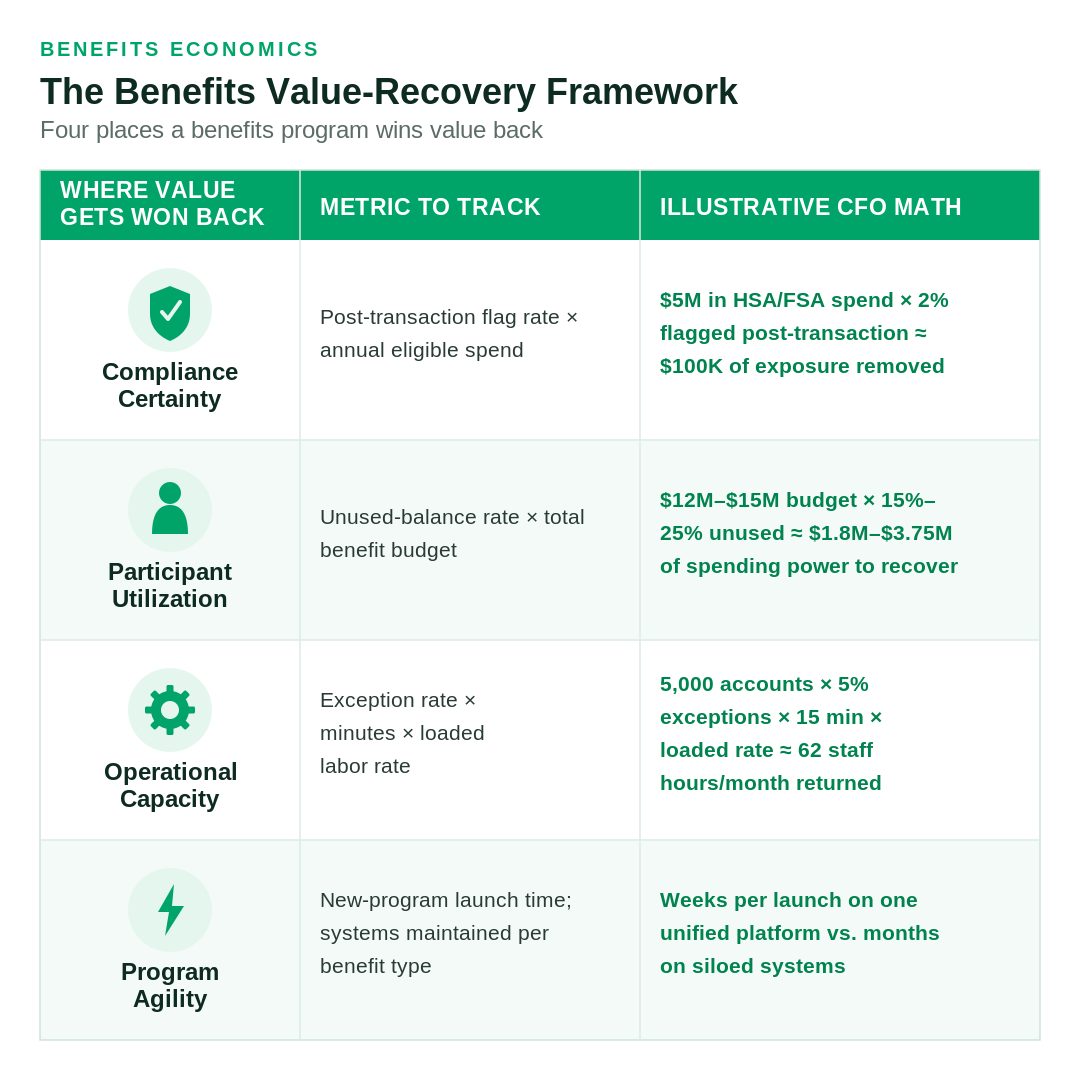
Benefits are a growing share of what it costs to employ someone, and they’re a daily point of contact between an organization and its people. That makes them worth managing all year, not just at open enrollment. Most HR leaders already know modern platforms exist. The more useful step is to put a number on what a better one would give back: cleaner compliance, funds that get used, admin hours recovered and faster launches. That math belongs at the start of the decision, not the end. It comes down to four places where a benefits program wins value back.
30%
of total private-industry compensation costs go toward benefits rather than wages, according to the U.S. Bureau of Labor Statistics.
1. Where Benefits Programs Win Value Back
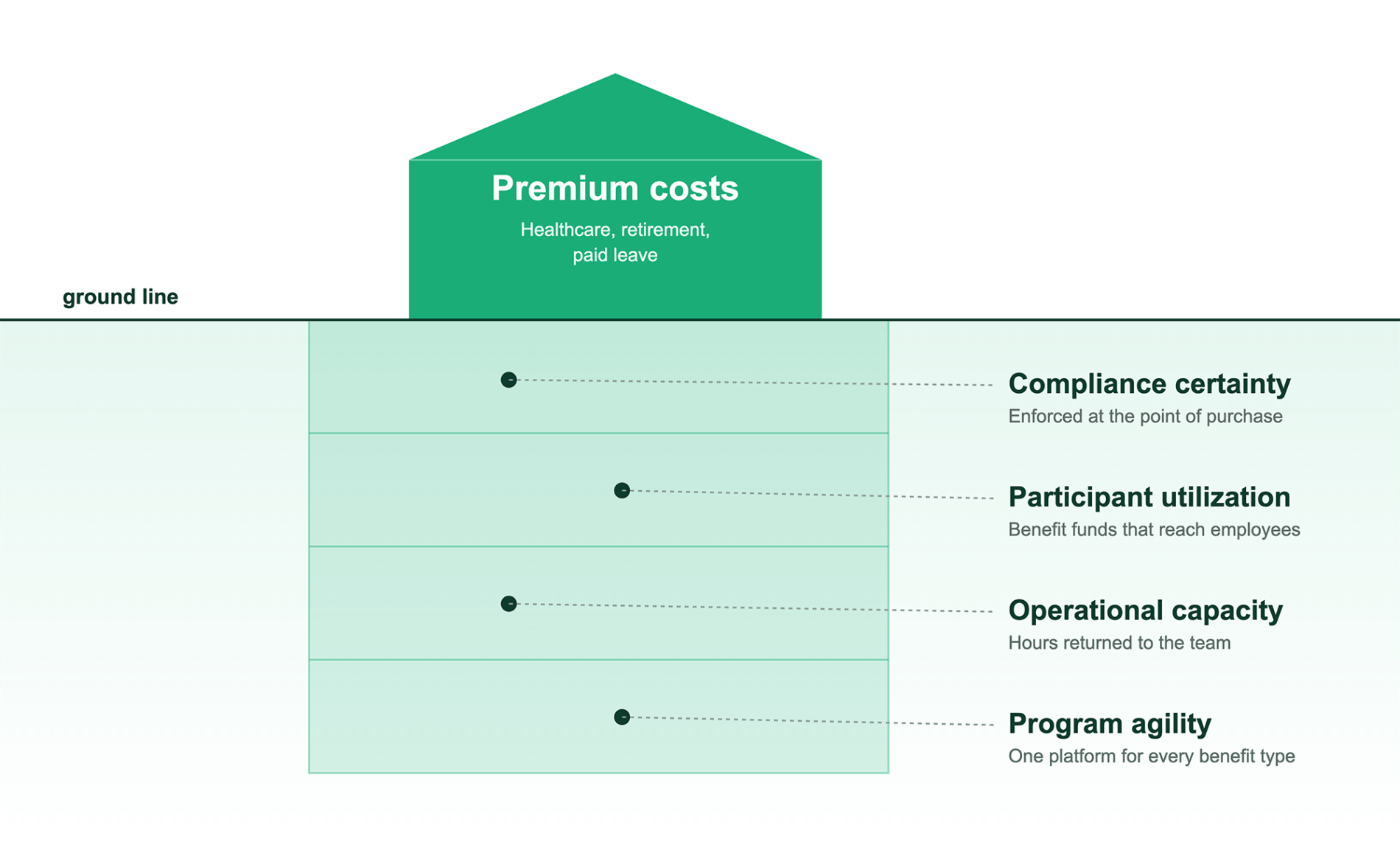
Every benefit dollar moves through several steps before it does its job: enrollment, allocation, spend, an eligibility check and, finally, reconciliation. At each step, a program either holds on to value or gives it away. Modern systems hold on to it at every step, and most of that gain never shows up on the premium line.
Figure 1. The premium line shows only part of what a benefits program controls, and only part of what it can win back.
Compliance certainty: enforcement at the point of purchase, not in the audit
Most benefit programs, such as HSAs, FSAs, wellness stipends and government-funded assistance, come with eligibility rules attached: This kind of purchase qualifies; this one doesn’t. What matters is when the rule gets applied. Applied at the point of purchase, it’s invisible to everyone and costs nothing to enforce. Applied later, in an audit, it arrives after the money is gone.
Spend controls tied to merchant category codes close that gap automatically, right at the point of purchase. An eligible purchase clears instantly. An ineligible one doesn’t clear at all. The value is easy to size. Take an organization with $5 million in annual HSA and FSA spend and 2% flagged in a post-transaction review. That’s roughly $100,000 a year at risk, plus the staff hours spent investigating, clawing back or writing off each flagged transaction. Real-time controls make all of it a non-issue.
Participant utilization: money that reaches the people it was set aside for
A program only pays off if the people it serves understand it. Castlight Health’s 2026 Employee Benefits Report found that when a new need comes up, 36% of employees go straight to their own solution, often paying out of pocket, instead of checking what their employer already offers. The same report shows what changes that: More than 80% of employees said they’d be more likely to stay with an employer that offers a flexible wellness allowance. It’s clarity and flexibility, not just generosity, that turn a benefits budget into loyalty.
Showing balances in real time is the most direct fix: A participant who can see the money is far more likely to use it. The prize is big. For an employer setting aside $12 million to $15 million a year, a 15% to 25% unused rate is $1.8 million to $3.75 million already paid for and waiting to be spent. Every point of use recovered is pay that reaches an employee instead of coming back as a forfeited balance.
Operational capacity: hours returned to the benefits team
The scarcest resource on most benefits teams isn’t budget. It’s time. Hours that could go toward tracking use and improving the program go to manual reconciliation and after-the-fact review instead. Automating that work hands the hours back.
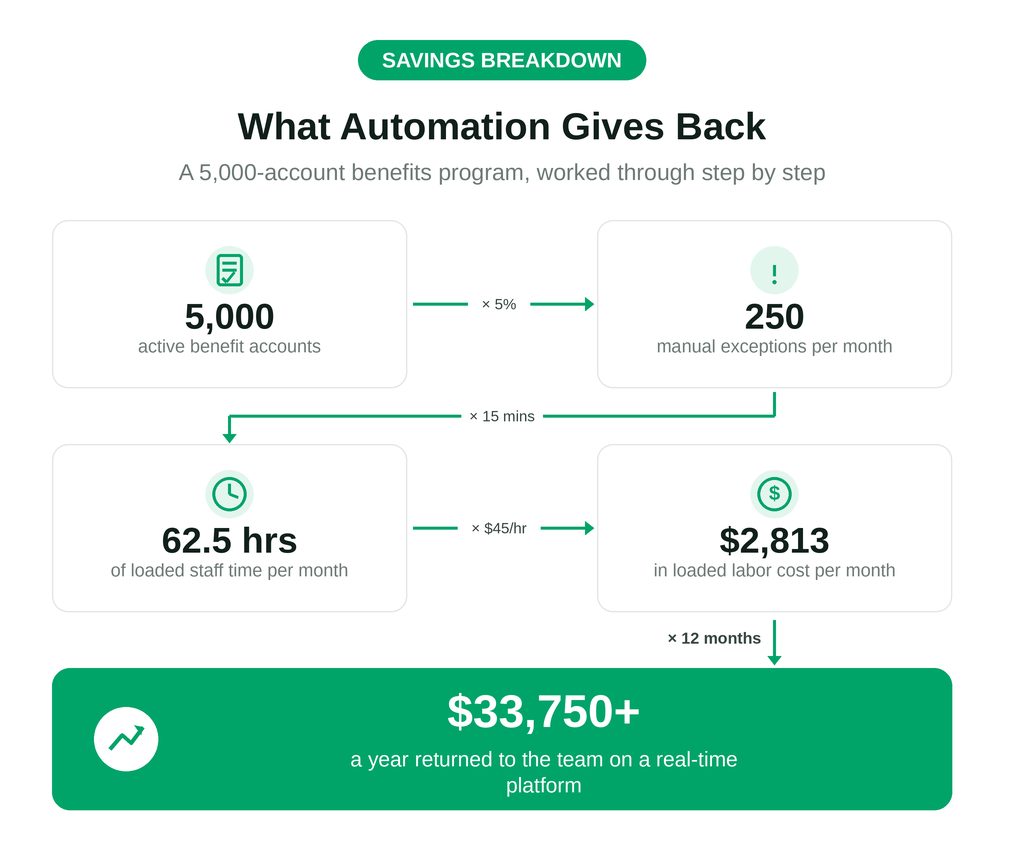
Take a benefits team running 5,000 active accounts. If 5% need manual attention (an eligibility dispute, a reimbursement request or a reconciliation exception) at 15 minutes of loaded staff time each, that’s roughly 62.5 hours a month. On a real-time, automated platform, most of those cases never happen, and those 62.5 hours go back to work only the benefits team can do.
Figure 2. This is what a real-time, automated platform gives back every year.
Program agility: one platform, every benefit type
Run HSAs, FSAs, LSAs and government-funded benefits on one platform, and each new benefit type becomes a setting to change rather than a system to build. The alternative is a separate cash register for every product category in one store: more hardware to maintain, more places for something to break and no single view of the business. It also compounds. Each program added to shared infrastructure launches faster than the one before it, which is what lets a benefits strategy grow at the pace the business needs.
2. The Six Capabilities Behind a High-Performing Program
Six specific capabilities decide how well a benefits program performs. Together they change what it can promise: a real-time answer for the participant, backed by real enforcement rather than a faster version of the same paperwork.
Category-level spend controls
Spend controls tied to merchant category codes (and to specific merchants, where needed) limit funds to eligible purchases automatically, at the point of purchase. Organizations stay compliant without leaning on audits or manual checks after the fact.
Support for multiple benefit types on one platform
HSA, FSA, LSA and government-funded benefits can all run on one system instead of a separate one for each. Organizations can manage several programs at once and roll out new ones faster, without rebuilding from scratch every time.
Real-time authorization and balance management
Transactions get approved or declined in real time based on eligibility rules and available balances, and balances update instantly after each one. That means fewer errors, fewer disputes and fewer support calls for administrators and participants alike.
Centralized administration and oversight
Central reporting, monitoring and admin tools show administrators exactly how benefits are being used and how the program is doing, replacing the spreadsheets and manual tracking that older programs tend to collect. That’s what lets the numbers in the framework above (flag rates, usage rates, exception volume) be measured instead of guessed at. You can’t manage what you can’t measure.
API-first ecosystem integration
Direct API connections to eligibility, enrollment and claims systems let data move automatically between them. Nothing stops for a manual handoff, which cuts busywork, improves accuracy and gets money to people faster.
Secure, enterprise-ready platform
Network-level security, regulatory compliance and enterprise-grade controls, built specifically for healthcare and government benefit programs, let organizations run regulated benefits with confidence, without building or maintaining compliance infrastructure of their own.
Put these six together and one idea holds them up: compliance that never gets in the way. Modern benefits infrastructure lets organizations check eligibility automatically, show participants their own balances in real time and launch new programs faster, all without adding headcount. Companies including evermore and SMI use SoFi’s Galileo to modernize benefits distribution on exactly this basis.1
3. What Makes a Modernization Land
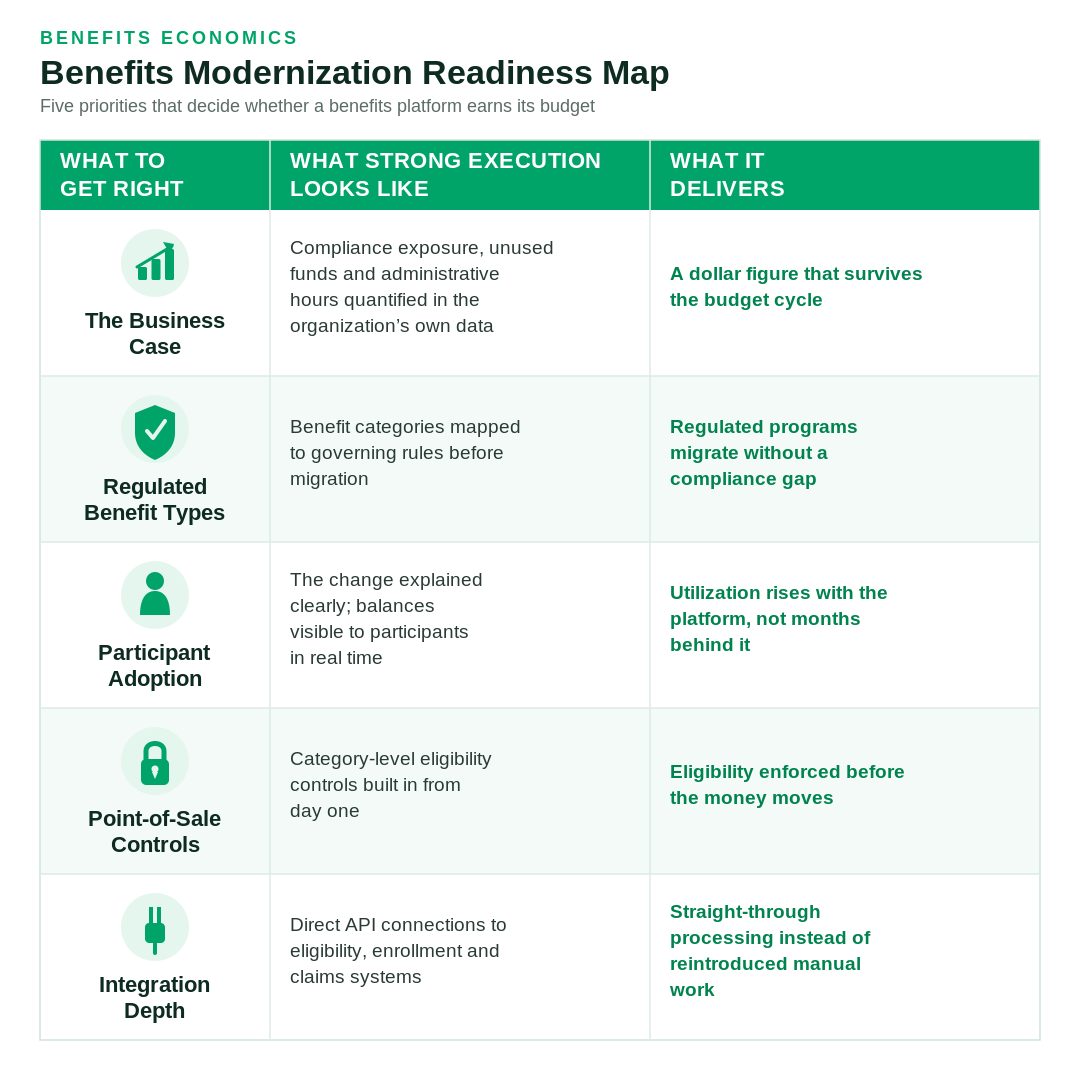
Technology is rarely what decides whether a benefits upgrade pays off. The teams that get it right build the business case, the compliance plan and the communication plan with the same care they give the platform. Five things separate the rollouts that work from the ones that stall.
Building the business case in CFO terms
Feature lists rarely survive a budget review. Dollar figures do. Lead with the framework above, stated in dollars rather than plan counts and fill it in with the organization’s own flag rate, usage rate and exception volume instead of an industry average. A case built that way is hard to argue with, because the numbers belong to the people in the room.
Compliance and regulated benefit types
Not every benefit is regulated the same way. HSAs, FSAs and government-funded assistance each come with their own eligibility, reporting and audit rules. The strongest plans map which categories are regulated, which rules apply to each and how the new platform’s controls meet them, all before the first dollar moves. Done up front, that map becomes the approval path instead of the bottleneck.
Participant communication and adoption
A better platform only pays off if participants understand it, trust it and use it. The organizations that see usage move are the ones that explain what changed and make balances easy to see at the same time they switch systems. Clear communication plus real-time balances is what turns a technical upgrade into the adoption the project was meant to deliver.
Point-of-sale controls from day one
Automatic, category-level eligibility checks at the point of purchase make every other control easier. Built in from day one, they mean the program never has to catch and undo purchases a looser setting technically allowed but the program was never meant to cover. They’re also far cheaper to set up at launch than to add later.
Vendor and platform selection
Benefits platforms vary widely in how directly they connect to the eligibility, enrollment and claims systems already running a program. A long feature list isn’t what separates a strong platform from a mediocre one. The real test is how directly it connects, by API, to the systems that already decide who’s eligible for what. Platforms that rely on manual file uploads or batch reconciliation give back most of the speed and savings the upgrade was meant to deliver.
The Benefits Value-Recovery Scorecard
Start with a scorecard, not a vendor demo. It’s a simple way to work out what the current program gives back today, and therefore what a better one is worth, before any technology decision gets made.
Score each question from 1 to 5. 1 = not measured or not available. 5 = measured, owned and actively managed.
Do you know what share of benefit transactions clear eligibility at the point of purchase, rather than getting flagged after the fact in an audit?
Can you put a dollar figure on the benefit funds that go unused each year, using your own data rather than an industry estimate?
What share of transactions clear without anyone touching them by hand, and how many staff hours does the rest take each month?
Can participants see their own balances in real time, without asking an administrator?
What share of your workforce reports a clear understanding of the benefits available to them?
Can you launch a new benefit type on your current platform without building a new, separate system?
Do you have a written map of which benefit categories carry specific eligibility or compliance requirements?
Do your controls check eligibility automatically at the point of purchase, and do you measure how often they do rather than assume it?
Does your platform connect directly, by API, to the eligibility, enrollment and claims systems already running the program?
What would prove a benefits modernization worked: fewer compliance flags, higher utilization, fewer admin hours, faster new-program launches or all of the above?
A low score isn’t a reason to wait. It shows where the business case still needs building, and that’s exactly where the upside is largest. A high score means the organization already knows its numbers, its risk points and what success looks like, which is the shortest path to a rollout that works.
THE BOTTOM LINE
A benefits program performs when the infrastructure underneath it does the work: eligibility checked at the point of purchase, balances participants can see in real time, administration handled centrally instead of by hand, and one platform already set up for the next benefit type. Those four things are what turn a benefits budget into cleaner compliance, higher use, staff hours back and faster launches.
All four can be measured, and that’s what makes the case fundable. The payoff also goes well beyond administering benefits a little faster: It gives the organization a clearer, safer way to keep the promise it made to every participant on day one.
Measurement note: There isn’t much published industry-wide data on flag rates, exception rates and unused balances for benefit card programs specifically. The figures above are illustrative, modeled at representative volumes rather than drawn from a single published benchmark. Organizations using this framework should swap in their own flag, exception and usage rates, which vary a lot by benefit type, workforce and how mature the program is.
SoFi Tech Solutions is the financial technology provider connecting banks, FinTechs and enterprises with innovative banking and processing capabilities to help people get their money right. This division of SoFi delivers modern digital solutions that are cloud-native, developer-friendly and regulation-ready, powering exceptional, customer-centric financial experiences across North and Latin America.
PYMNTS Intelligence is a leading global data and analytics platform that uses proprietary data and methods to provide actionable insights on what’s now and what’s next in payments, commerce and the digital economy. Its team of data scientists includes leading economists, econometricians, survey experts, financial analysts and marketing scientists with deep experience in the application of data to the issues that define the future of the digital transformation of the global economy. This multilingual team has conducted original data collection and analysis in more than three dozen global markets for some of the world’s leading publicly traded and privately held firms.
The PYMNTS Intelligence team that produced this Tracker: John Gaffney, Chief Content Officer Alexandra Redmond, Senior Editor and Writer
We are interested in your feedback on this report. If you have questions
or
comments, or if you would like to subscribe to this report, please email
us at
feedback@pymnts.com.
Disclaimer
The Embedded Finance Tracker® Series may be updated periodically. While reasonable efforts are made to keep the content accurate and up to date, PYMNTS MAKES NO REPRESENTATIONS OR WARRANTIES OF ANY KIND, EXPRESS OR IMPLIED, REGARDING THE CORRECTNESS, ACCURACY, COMPLETENESS, ADEQUACY, OR RELIABILITY OF OR THE USE OF OR RESULTS THAT MAY BE GENERATED FROM THE USE OF THE INFORMATION OR THAT THE CONTENT WILL SATISFY YOUR REQUIREMENTS OR EXPECTATIONS. THE CONTENT IS PROVIDED “AS IS” AND ON AN “AS AVAILABLE” BASIS. YOU EXPRESSLY AGREE THAT YOUR USE OF THE CONTENT IS AT YOUR SOLE RISK. PYMNTS SHALL HAVE NO LIABILITY FOR ANY INTERRUPTIONS IN THE CONTENT THAT IS PROVIDED AND DISCLAIMS ALL WARRANTIES WITH REGARD TO THE CONTENT, INCLUDING THE IMPLIED WARRANTIES OF MERCHANTABILITY AND FITNESS FOR A PARTICULAR PURPOSE, AND NONINFRINGEMENT AND TITLE. SOME JURISDICTIONS DO NOT ALLOW THE EXCLUSION OF CERTAIN WARRANTIES, AND, IN SUCH CASES, THE STATED EXCLUSIONS DO NOT APPLY. PYMNTS RESERVES THE RIGHT AND SHOULD NOT BE LIABLE SHOULD IT EXERCISE ITS RIGHT TO MODIFY, INTERRUPT, OR DISCONTINUE THE AVAILABILITY OF THE CONTENT OR ANY COMPONENT OF IT WITH OR WITHOUT NOTICE.
PYMNTS SHALL NOT BE LIABLE FOR ANY DAMAGES WHATSOEVER, AND, IN PARTICULAR, SHALL NOT BE LIABLE FOR ANY SPECIAL, INDIRECT, CONSEQUENTIAL, OR INCIDENTAL DAMAGES, OR DAMAGES FOR LOST PROFITS, LOSS OF REVENUE, OR LOSS OF USE, ARISING OUT OF OR RELATED TO THE CONTENT, WHETHER SUCH DAMAGES ARISE IN CONTRACT, NEGLIGENCE, TORT, UNDER STATUTE, IN EQUITY, AT LAW, OR OTHERWISE, EVEN IF PYMNTS HAS BEEN ADVISED OF THE POSSIBILITY OF SUCH DAMAGES.
SOME JURISDICTIONS DO NOT ALLOW FOR THE LIMITATION OR EXCLUSION OF LIABILITY FOR INCIDENTAL OR CONSEQUENTIAL DAMAGES, AND IN SUCH CASES SOME OF THE ABOVE LIMITATIONS DO NOT APPLY. THE ABOVE DISCLAIMERS AND LIMITATIONS ARE PROVIDED BY PYMNTS AND ITS PARENTS, AFFILIATED AND RELATED COMPANIES, CONTRACTORS, AND SPONSORS, AND EACH OF ITS RESPECTIVE DIRECTORS, OFFICERS, MEMBERS, EMPLOYEES, AGENTS, CONTENT COMPONENT PROVIDERS, LICENSORS, AND ADVISERS.
Components of the content original to and the compilation produced by PYMNTS is the property of PYMNTS and cannot be reproduced without its prior written permission.
The Embedded Finance Tracker® Series is a registered trademark of What’s Next Media & Analytics, LLC (“PYMNTS”).