What processor migration actually costs, saves and breaks
Processor invoices reveal only part of the cost of running a debit program. The larger expenses are hidden in false declines, manual exception handling, fraud losses and delayed product innovation. This Tracker sets out how institutions can quantify the true cost of legacy debit infrastructure, evaluate modernization opportunities and avoid the pitfalls that derail processor migrations.
Hidden costs extend well beyond processor fees, surfacing as revenue leakage, operational drag, fraud exposure and delayed innovation.
Modern debit infrastructure enables real-time decisioning, instant issuance, configurable controls and loyalty-driven experiences that strengthen customer relationships.
Successful modernization depends on disciplined planning around tokenization, migration sequencing, BIN sponsorship and post-conversion performance measurement.
Get Unlimited Access
Complete the form below for free, unlimited access to all our Data Studies, Trackers, and PYMNTS Intelligence reports.
Thank you for registering. Please confirm your email to view all our reports.
Most financial institutions know what their debit processor charges them. Far fewer know what that processor costs them.
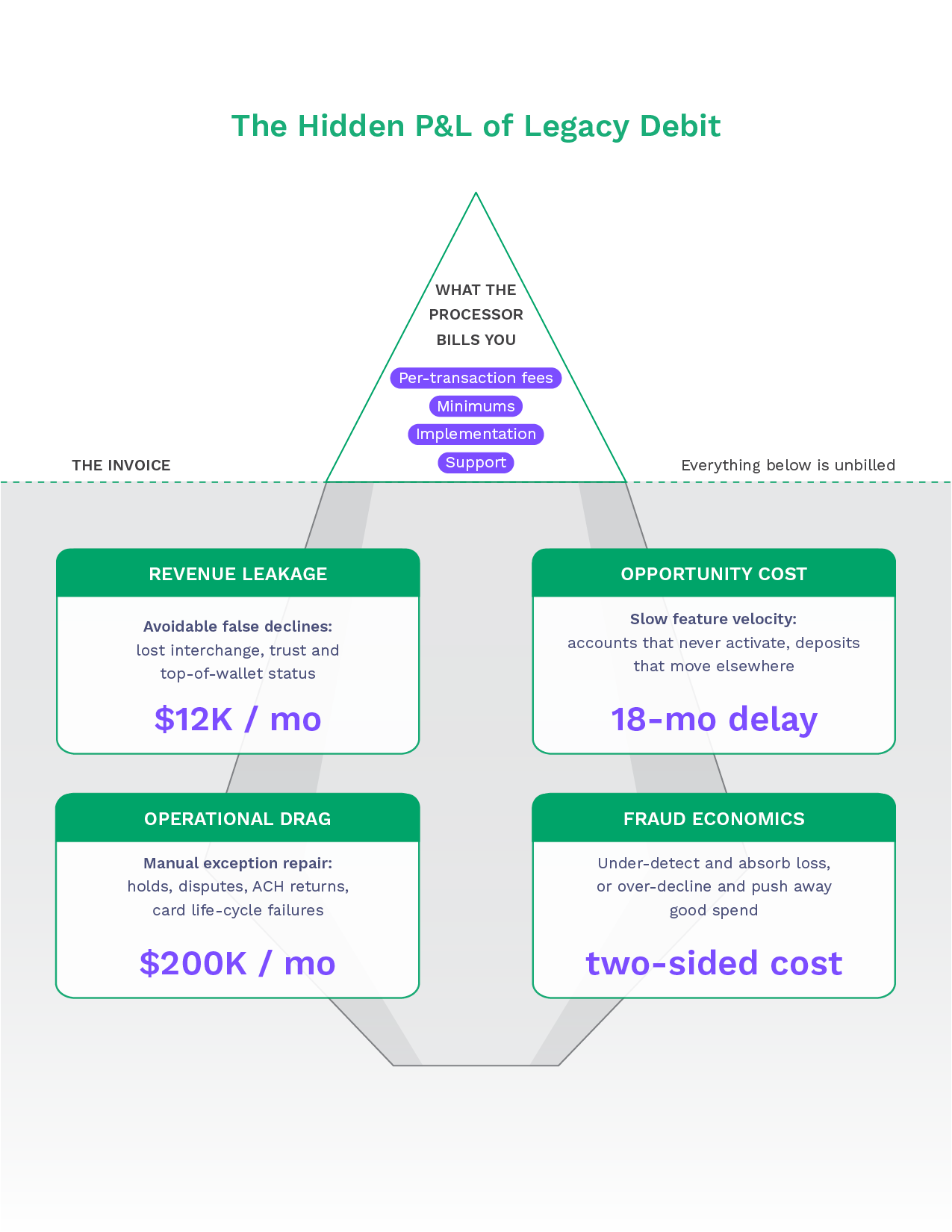
The invoice is the easy part. It shows per-transaction fees, monthly minimums, implementation charges and support costs. But the real debit P&L is usually hiding somewhere else: in good transactions that get declined, in fraud rules that block real customers yet still miss bad actors, in operations teams that spend thousands of hours reconciling exceptions, and in the 18 months it takes to launch a feature a competitor shipped in weeks.
That matters because debit is not a side channel. It is a daily relationship. Federal Reserve data shows debit accounted for 30% of consumer payments by number in 2024, against 35% for credit and 14% for cash. PYMNTS Intelligence finds that on consumers’ last in-store non-grocery purchase, 39.8% used debit versus 29% who used credit.
That makes debit infrastructure a revenue system, a risk system and a retention system at once. Treating it as a back-office processor contract misses the point. The real question for most CFOs is not whether debit is evolving (they know it is) but whether the institution can see what legacy debit is already costing before deciding whether migration is worth the risk. The answer usually depends less on the processor invoice than on four hidden costs.
1. What Legacy Debit Actually Costs You
Debit produces data every second: authorizations, declines, reversals, holds, disputes, chargebacks, wallet-provisioning events, merchant categories, latency spikes and reason codes. Used well, that data becomes a live operating system for the card business. Used poorly, it becomes a daily tax. That tax falls into four cost pools, and only the tip of it appears on the invoice.
Figure 1. The processor invoice is the visible tip; the larger cost of legacy debit sits below the waterline.
Revenue leakage from authorization performance
Approval rate is a revenue metric, not just an operations metric. Every good transaction declined is lost interchange, lost trust and, often, lost card preference. Galileo’s debit-processing materials advise tracking authorization success, proper declines, processor and network errors, false declines, p95/p99 latency, timeout rates, fraud loss and reason-code analysis together, rather than viewing approval rate in isolation.
The math is simple. Take a portfolio of 10 million attempted debit transactions per month. If avoidable false declines equal 0.50 percentage points, that is 50,000 good transactions lost. Federal Reserve data shows 2023 debit interchange averaged $0.22 to $0.24 per regulation-covered transaction. Even at $0.24, that is $12,000 per month in direct interchange, before account attrition, call-center contacts or lost top-of-wallet status. For exempt issuers, co-brand programs and higher-value relationships, the economics are larger.
Operational drag
Legacy debit often creates a manual repair economy. Staff reconcile mismatched holds, investigate posting delays, resolve disputes, trace ACH returns and work card life-cycle failures. Galileo’s materials point to straight-through processing rate, exception volume by type and mean time to resolve as core measures of operational health. The CFO question is not “Can we reduce head count?” It is “What work are our people not doing because the stack keeps breaking?”
If a bank handles 25,000 debit-related exceptions per month at 12 minutes of loaded staff time each, that is 5,000 staff hours monthly. At $40 per loaded hour, that is $200,000 per month, or $2.4 million per year. Halving the exception rate does more than save labor; it releases people into product work, risk tuning and faster dispute resolution.
Opportunity cost
A legacy processor may still authorize transactions but prevent product teams from moving at market speed. When instant issuance, real-time card controls or merchant-category rules require long integration cycles, the cost is not just the project budget. It is the new accounts that never activate, the direct deposits that move elsewhere and the customers who try a competitor while the institution is still in queue.
Fraud economics
Legacy fraud tools fail in two expensive ways: they under-detect and absorb losses, or they over-decline and push away good spend. A sound scorecard includes fraud loss per $1,000 settled, false-positive ratio, fraud-review labor, dispute cycle time and complaint rate. Approving more fraud is not progress; blocking good customers is not progress either. The target is better decisioning at the transaction level.
2. What Modern Debit Infrastructure Makes Possible
Modern debit infrastructure matters not because it sounds better, but because it changes what a bank or brand can do every day.
Real-time authorization and configurable controls
In a modern stack, each transaction is evaluated with current balance data, current risk context and product rules that can change without a long release cycle, enabling dynamic spending limits, merchant-category controls, location-aware risk rules and instant customer controls. Galileo describes modern debit processing as API-first, with instant transaction approval, funds movement, account updates, RESTful APIs, webhook notifications and analytics, plus an Events API that notifies institutions of account changes, authorizations, settlements and transactions in real time.
That changes the operating model. Product teams no longer wait for batch files or release windows to test a control. Risk teams no longer choose between broad rules and manual reviews. Customer teams can give cardholders controls that work now, not tomorrow.
Instant issuance
Digital card issuance is an activation strategy, not just a convenience. A checking account that opens on Monday but waits seven days for plastic is at risk before it starts. A card provisioned into a mobile wallet during account opening can produce a first transaction while the customer is still engaged. Galileo identifies instant card issuance, mobile-wallet provisioning, real-time notifications and unified app experiences as table stakes for modern co-branded debit.
Debit as a loyalty and engagement rail
The Southwest–Galileo Rapid Rewards Visa debit card shows how debit can extend rewards to customers who prefer spending funds they already have, granting Rapid Rewards points on everyday purchases without a credit check. Galileo’s Bill Kennedy frames debit rewards as a different but still valuable economics model built around loyalty, repeat business and platform efficiency.
The idea extends well beyond travel:
A gig platform can pay workers instantly after a shift and attach controls or rewards to spending.
An employer can support earned-wage access without pushing employees into a separate third-party experience.
A non-financial app can embed debit controls so a family, creator marketplace, travel club or benefits platform manages spend inside the experience users already know.
The common thread is control. Modern debit lets institutions decide faster, notify faster, pay faster and learn faster, driving direct engagement, reducing dependence on intermediaries and increasing customer lifetime value.
3. What Goes Wrong in Migrations, and How to Prevent It
Debit migrations fail in predictable ways. The risk is not that payments professionals don’t know migration is hard. The risk is that they know it is hard in general, but not where it breaks in practice.
Tokenization and wallet continuity
A customer with a debit card in Apple Pay or Google Wallet does not care that the issuer changed processors. They care only whether the card still works at the grocery store. EMVCo describes payment tokenization as replacing the primary account number with a payment token used from purchase through acquirer, network and issuer authorization. During migration, the institution needs a token inventory by wallet, network, BIN, token requestor and status, and a plan specifying whether tokens are mapped, reissued or kept alive through life-cycle management.
Cohort design
Do not migrate 500,000 cardholders at once, but do not migrate only the quietest accounts either, because that teaches little. A practical rollout starts with low-risk internal accounts, moves to low-volume customer cohorts, then tests high-usage, wallet-heavy and dispute-prone segments before broad conversion, sequenced by risk, volume, wallet penetration, fraud exposure, customer value and operational capacity.
BIN sponsor coordination
BIN sponsorship is not a checkbox. It is a critical path. Processor, issuer, sponsor bank and networks must align on BIN setup, routing, settlement, fraud responsibilities, compliance reporting, card art, tokenization, disputes and program controls. Dependencies discovered late can slip the calendar by months.
Parallel processing and rollback
Running old and new systems together sounds safe but can create confusion: which system is the source of truth, how holds are reconciled, how reversals are handled, what happens when latency differs. A sound parallel window includes shadow authorization testing, daily reconciliation, exception war rooms, rollback triggers and clear ownership. A practical range is 30 to 60 days, but the right answer is KPI stability, not a fixed date.
Declaring victory too early
“All cards migrated” is not done. Done means authorization rates are stable or better, false declines are not rising, fraud losses are controlled, exception volumes are down, complaint rates are flat or improving, wallet tokens are healthy and dispute handling meets regulatory timeframes. Under Regulation E, institutions generally must investigate reported electronic-fund-transfer errors within 10 business days, with longer windows available when requirements such as provisional credit are met. Migration success must include compliance operations, not just conversion volume.
The Readiness Diagnostic
The processor migration decision should not start with an RFP. It should start with a diagnostic. The question is not whether legacy debit is old, but whether the institution can quantify what the old stack is costing, and whether it is ready to move without breaking customer trust.
Score each question from 1 to 5. 1 = not measured or not available. 5 = measured, owned and actively managed.
Can your current stack support real-time authorization decisioning using current balance, risk and customer context?
Do you know your true debit authorization approval rate, separated by proper declines, fraud declines, processor errors, network errors, timeouts and false positives?
Can you calculate the dollar value of avoidable declines using your own transaction contribution, not a generic industry average?
What percentage of debit and deposit-account events flow straight through without manual repair?
How many FTE hours per month are spent on debit exceptions, disputes, reconciliation, card life-cycle failures and posting delays?
Can customers freeze cards, change controls, receive real-time alerts and provision cards into mobile wallets without contacting the call center?
How long does it take to launch a new debit feature, from approved business case to production?
Do you have a documented token migration plan for existing wallets, network tokens and card-on-file credentials?
Is your BIN sponsor aligned to the modernization timeline, including certification, settlement, compliance and fraud responsibilities?
What will prove the migration worked: better authorization rates, lower exception volumes, stable fraud performance, fewer complaints, faster activation, or all of the above?
A low score does not mean migration should wait. It means the business case is incomplete. A high score does not mean migration will be easy. It means the institution knows where the costs sit, where the risks are and what success has to look like.
The bottom line
The most expensive parts of legacy debit are rarely printed on the processor invoice. They show up in transactions that never happen, customers who quietly leave, teams doing work that software should handle, and products that arrive after the market has moved on.
The migration case starts when those costs become visible. It gets funded when they become measurable. It succeeds when the new platform does more than process debit, when it gives the institution a faster, cleaner and more profitable way to run the customer relationship.
Measurement note: The supplied materials do not include activation-lift, time-to-first-transaction or 30-day velocity data. A useful internal model compares digitally provisioned accounts with plastic-first accounts across first-transaction rate, days to first transaction, 30-day active rate, monthly transaction count and direct-deposit attachment.
Source note: This Tracker follows the supplied three-section brief and uses the Galileo/PYMNTS Intelligence source packet for core debit economics, co-branded debit and deposit-churn framing. The sponsor materials support the KPI framework, real-time/API-first capabilities and co-branded debit examples, but do not provide aggregate anonymized pre-/post-migration authorization-rate, activation-rate or fraud-performance benchmarks. Figures marked illustrative use modeled math where aggregate data were not available.
About
Galileo is a leading financial technology company whose platform, open API technology and proven expertise enable FinTechs and emerging and established brands to create differentiated financial solutions that expand the financial frontier. Galileo removes the complexity from payments and financial services innovation by providing flexible, open API building blocks and a secure, scalable, future-proof platform. Trusted by digital banking heavyweights, early stage innovators and enterprise clients alike, Galileo supports issuing physical and virtual payment cards, mobile push provisioning and more, across industries and geographies. Headquartered in Salt Lake City, Galileo has offices in Mexico City, New York City, San Francisco and Seattle. Learn more at galileo-ft.com.
PYMNTS Intelligence is a leading global data and analytics platform that uses proprietary data and methods to provide actionable insights on what’s now and what’s next in payments, commerce and the digital economy. Its team of data scientists includes leading economists, econometricians, survey experts, financial analysts and marketing scientists with deep experience in the application of data to the issues that define the future of the digital transformation of the global economy. This multilingual team has conducted original data collection and analysis in more than three dozen global markets for some of the world’s leading publicly traded and privately held firms.
The PYMNTS Intelligence team that produced this Tracker:
John Gaffney, Chief Content Officer
We are interested in your feedback on this report. If you have questions or comments, or if you would like to subscribe to this report, please email us at feedback@pymnts.com.
Disclaimer
The Embedded Finance Tracker® Series may be updated periodically. While reasonable efforts are made to keep the content accurate and up to date, PYMNTS MAKES NO REPRESENTATIONS OR WARRANTIES OF ANY KIND, EXPRESS OR IMPLIED, REGARDING THE CORRECTNESS, ACCURACY, COMPLETENESS, ADEQUACY, OR RELIABILITY OF OR THE USE OF OR RESULTS THAT MAY BE GENERATED FROM THE USE OF THE INFORMATION OR THAT THE CONTENT WILL SATISFY YOUR REQUIREMENTS OR EXPECTATIONS. THE CONTENT IS PROVIDED “AS IS” AND ON AN “AS AVAILABLE” BASIS. YOU EXPRESSLY AGREE THAT YOUR USE OF THE CONTENT IS AT YOUR SOLE RISK. PYMNTS SHALL HAVE NO LIABILITY FOR ANY INTERRUPTIONS IN THE CONTENT THAT IS PROVIDED AND DISCLAIMS ALL WARRANTIES WITH REGARD TO THE CONTENT, INCLUDING THE IMPLIED WARRANTIES OF MERCHANTABILITY AND FITNESS FOR A PARTICULAR PURPOSE, AND NONINFRINGEMENT AND TITLE. SOME JURISDICTIONS DO NOT ALLOW THE EXCLUSION OF CERTAIN WARRANTIES, AND, IN SUCH CASES, THE STATED EXCLUSIONS DO NOT APPLY. PYMNTS RESERVES THE RIGHT AND SHOULD NOT BE LIABLE SHOULD IT EXERCISE ITS RIGHT TO MODIFY, INTERRUPT, OR DISCONTINUE THE AVAILABILITY OF THE CONTENT OR ANY COMPONENT OF IT WITH OR WITHOUT NOTICE.
PYMNTS SHALL NOT BE LIABLE FOR ANY DAMAGES WHATSOEVER, AND, IN PARTICULAR, SHALL NOT BE LIABLE FOR ANY SPECIAL, INDIRECT, CONSEQUENTIAL, OR INCIDENTAL DAMAGES, OR DAMAGES FOR LOST PROFITS, LOSS OF REVENUE, OR LOSS OF USE, ARISING OUT OF OR RELATED TO THE CONTENT, WHETHER SUCH DAMAGES ARISE IN CONTRACT, NEGLIGENCE, TORT, UNDER STATUTE, IN EQUITY, AT LAW, OR OTHERWISE, EVEN IF PYMNTS HAS BEEN ADVISED OF THE POSSIBILITY OF SUCH DAMAGES.
SOME JURISDICTIONS DO NOT ALLOW FOR THE LIMITATION OR EXCLUSION OF LIABILITY FOR INCIDENTAL OR CONSEQUENTIAL DAMAGES, AND IN SUCH CASES, SOME OF THE ABOVE LIMITATIONS DO NOT APPLY. THE ABOVE DISCLAIMERS AND LIMITATIONS ARE PROVIDED BY PYMNTS AND ITS PARENTS, AFFILIATED AND RELATED COMPANIES, CONTRACTORS, AND SPONSORS, AND EACH OF ITS RESPECTIVE DIRECTORS, OFFICERS, MEMBERS, EMPLOYEES, AGENTS, CONTENT COMPONENT PROVIDERS, LICENSORS, AND ADVISERS.
Components of the content original to and the compilation produced by PYMNTS are the property of PYMNTS and cannot be reproduced without its prior written permission.
The Embedded Finance Tracker® Series is a registered trademark of What’s Next Media & Analytics, LLC (“PYMNTS”).