What outdated payout methods actually surrender in revenue, relationships and reach
Every payout an organization sends carries an implicit message about the relationship behind it. It might be settling an insurance claim, paying a gig worker, clearing a rebate or releasing loan proceeds. For most organizations still running on checks or batch transfers, that message is Wait. And waiting, it turns out, is far more expensive to the business than it looks.
Disbursement delay is not a back-office inconvenience. It is a measurable drain on float, recipient trust, administrative capacity and addressable market.
Card-based disbursement infrastructure converts payout speed into a controllable, governable, real-time process rather than a multi-day mail and clearing cycle.
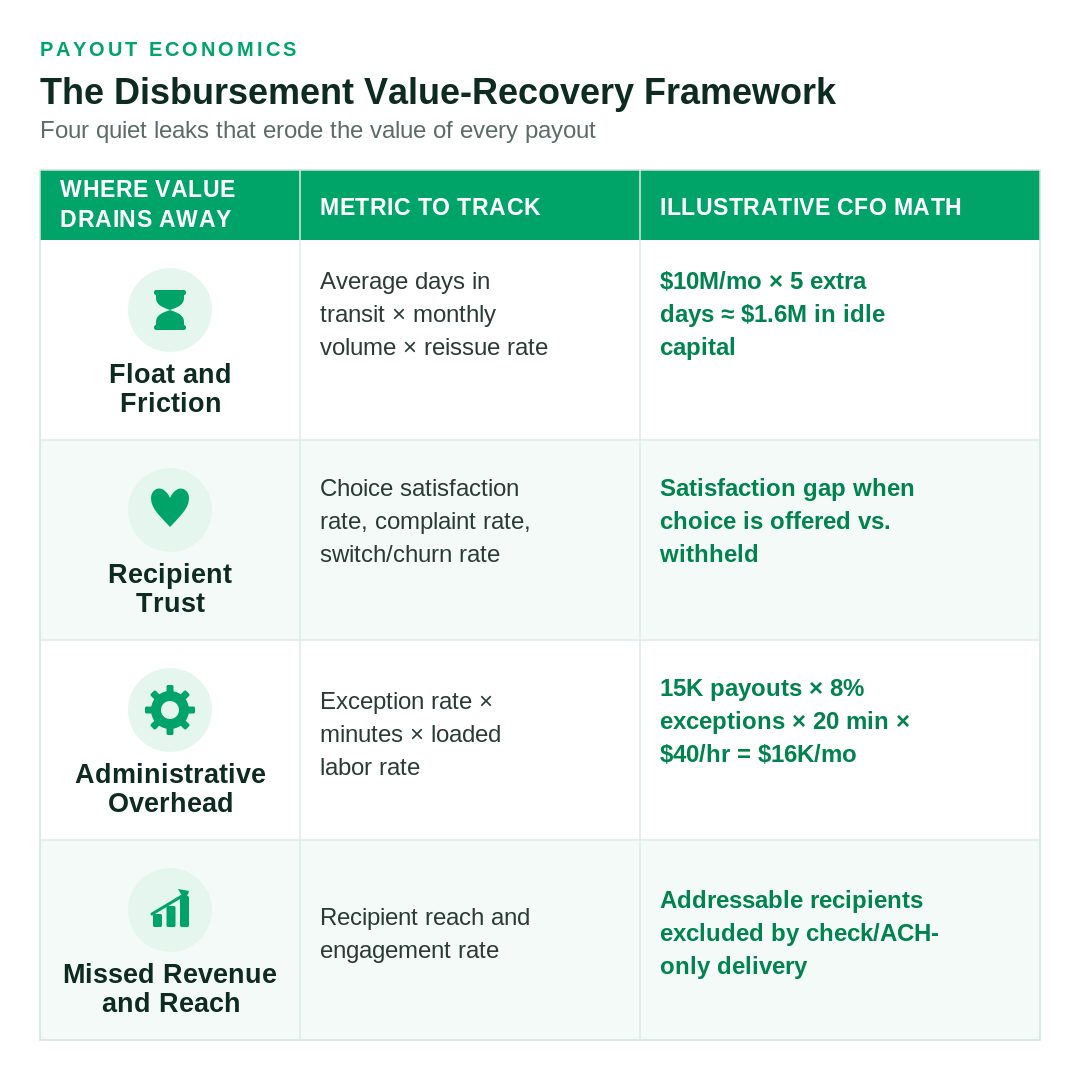
A disciplined disbursement modernization case rests on quantifying four cost pools before, not after, the technology decision is made.
Get Unlimited Access
Complete the form below for free, unlimited access to all our Data Studies, Trackers, and PYMNTS Intelligence reports.
Thank you for registering. Please confirm your email to view all our reports.
“
This Tracker gives CFOs and operations leaders a practical framework for quantifying what slow, check-dependent disbursement infrastructure actually costs. That cost shows up as capital tied up in transit, recipients who lose patience, staff hours spent on manual repair and customers that a faster competitor reaches first.
”
Most finance leaders can quote what their disbursement program costs in processing fees. Far fewer can quote what it costs in everything else.
A check is not just slow. It is a small, recurring liability that an organization carries from the moment it is cut to the moment it clears, and sometimes well beyond. It can be lost. It can be returned. It can be intercepted, or simply ignored. Every one of those outcomes has a dollar value and an operational cost attached to it. Almost none of that cost shows up on the disbursement line of a budget.
This is important, because disbursements are no longer a niche back-office function. They are a growing share of how money moves between institutions and the people who depend on them. Federal Reserve Financial Services research found that 78% of U.S. consumers now prefer faster payment options. That preference is already reshaping which rails carry the money: push-to-card and digital wallet disbursements continue to gain ground, while paper checks continue to lose it.
That trend makes disbursement infrastructure a liquidity system, a trust system and a growth system all at once. Treating it as a routine accounts payable (AP) function misses the point. Most CFOs already know that faster payout methods exist. The real question is whether the institution can quantify what the current method is costing it now. That answer should come before, not after, the modernization decision is made. It usually depends on four areas where value slips away.
1. Where Disbursement Value Drains Away
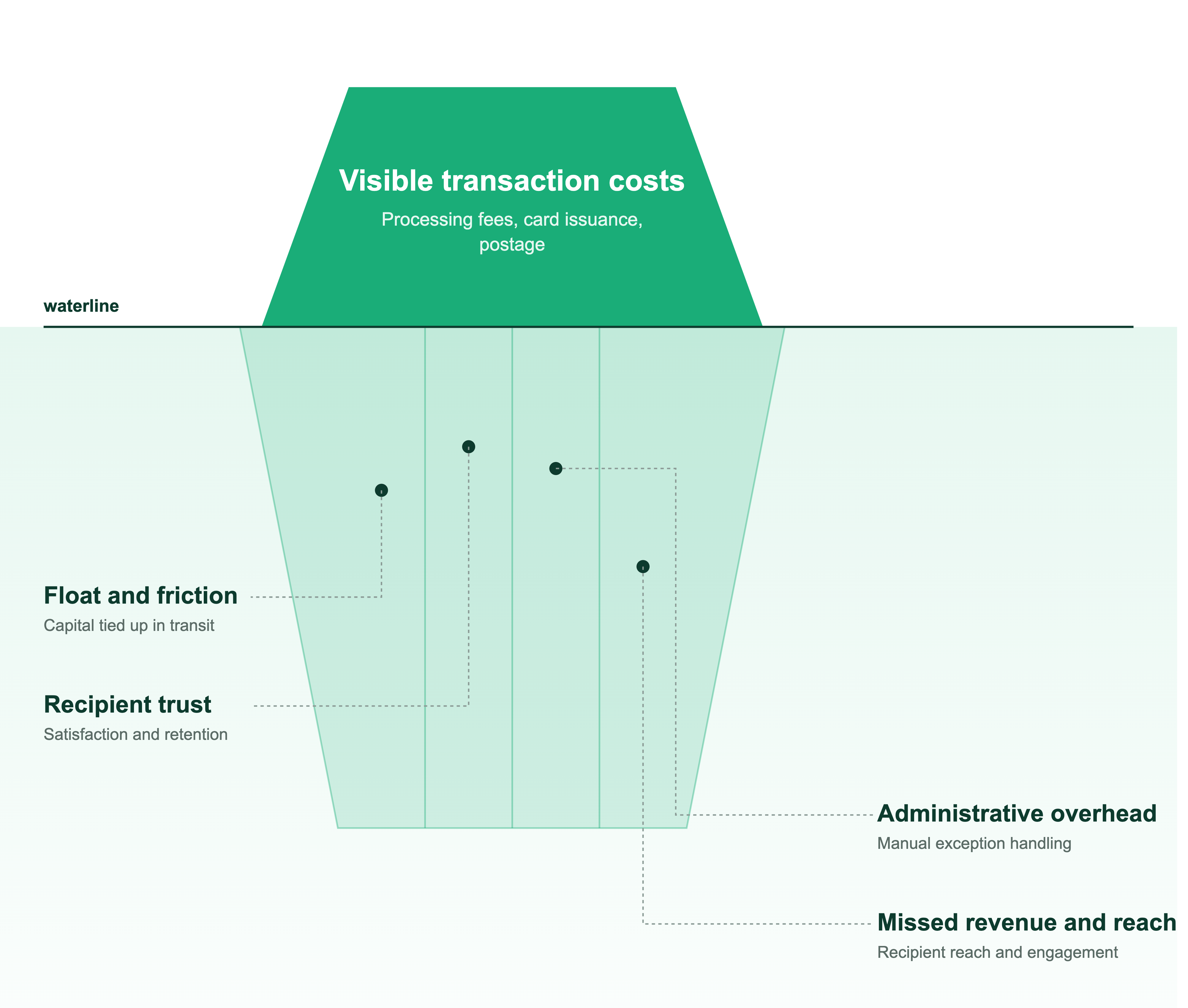
A payout generates a chain of events. There is approval, then issuance, transit, delivery, reconciliation and, eventually, confirmation that the recipient actually has the money. Each link in that chain has a cost. When run well, the chain is nearly invisible. When run on legacy rails, it becomes a recurring tax on the business. Only a fraction of that tax appears in visible transaction costs.
Figure 1. The visible costs of slow disbursements are just the tip of the iceberg. The larger costs sit below the waterline.
Float and friction: the cost of delayed disbursements
Every dollar sitting in transit between approval and delivery is a dollar the organization cannot use. Float, from the organization’s (payor’s) side, is capital that’s already committed but not yet usable until the transaction clears. Like water in a pipeline, it does nothing until it reaches the other end. A mailed check typically takes several business days to arrive, plus additional days to clear once deposited. A meaningful share never reach their destination cleanly. Lost mail, stale addresses and bank-side processing delays all interrupt the chain. Each interruption produces the same downstream sequence: a recipient inquiry, a manual investigation, a reissued payment and, in some cases, a second float period stacked on top of the first.
The math scales quickly. An organization disbursing $10 million per month that holds funds in transit for an average of five additional days, compared with same-day card funding, is effectively carrying roughly $1.6 million in idle capital at any given time. These are assets that could otherwise support operations, reduce borrowing costs or fund growth. Add a 1% to 2% reissue rate from lost or undeliverable checks, and the avoidable cost compounds before a single customer complaint is logged.
Recipient trust and instant disbursements
Disbursement speed is no longer viewed by recipients as a courtesy. It is increasingly viewed as a signal of how seriously an organization treats the relationship. Federal Reserve Financial Services research found that consumers report meaningfully higher satisfaction with financial institutions offering instant payments than those that do not, and 61% say it matters whether their financial institution offers instant payments at all. The inverse holds too. Slow, inflexible payout processes are becoming a competitive vulnerability rather than a neutral default.
This is especially acute in moments of financial stress. An insurance claimant waiting on funds after a car accident, a gig worker waiting on same-day earnings or a borrower waiting on loan proceeds is, in each instance, judging the organization’s reliability in real time. A delayed or failed payout in that moment does more than inconvenience the recipient. It erodes the trust the organization is trying to build, right when that trust counts the most.
Administrative overhead
Legacy disbursement processes are labor-intensive. Someone has to print and mail checks, track delivery, field calls about missing payments, investigate stale or returned funds, reissue and reconcile. None of that work shows up as a line item called “check-related labor,” but it consumes real staff hours every month, and it grows in direct proportion to disbursement volume rather than shrinking with scale.
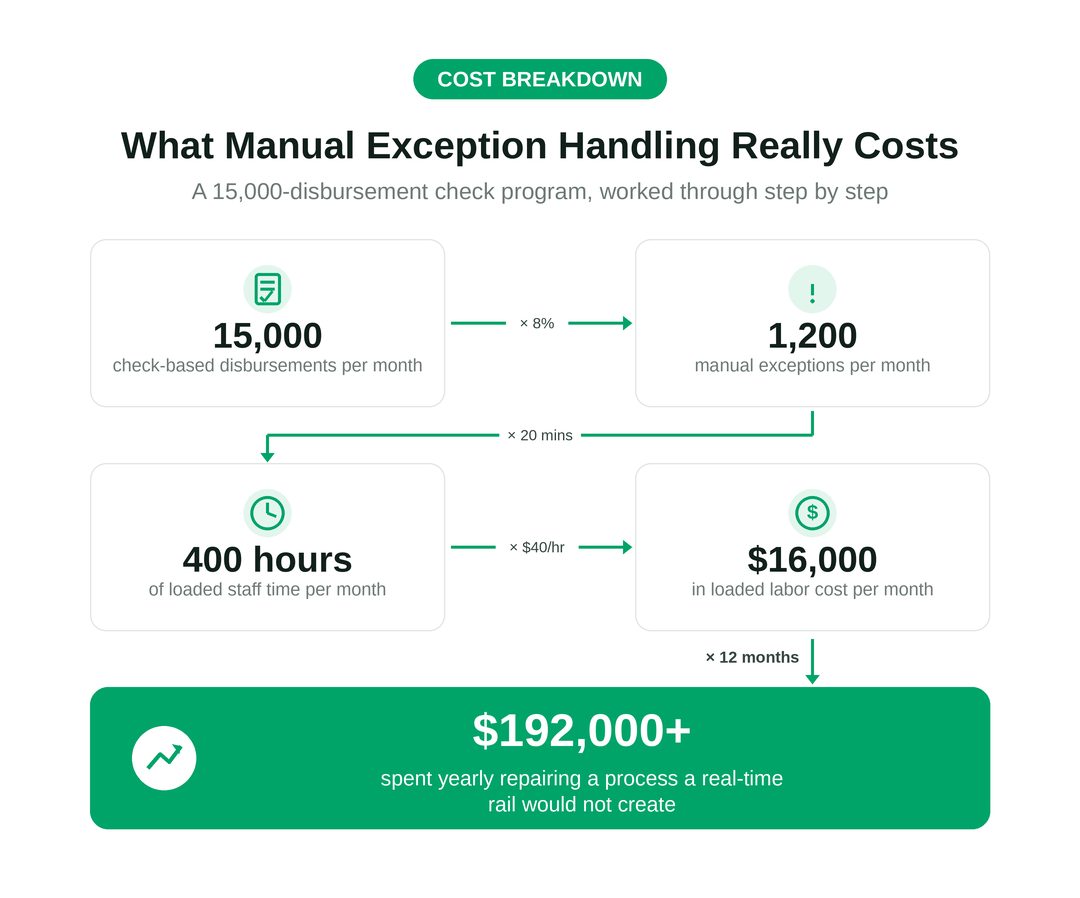
Consider an organization processing 15,000 check-based disbursements per month, where 8% require some form of manual exception handling (a returned check, an address correction, a reissue request) at an average of 20 minutes of loaded staff time per exception. That is 400 staff hours per month, or roughly $16,000 at $40 per loaded hour, dedicated entirely to repairing a process that a real-time card-based rail would not generate in the first place. At higher disbursement volumes, common across insurance, lending and B2B payout programs, that figure scales into the high six figures annually.
Figure 2. None of these hours or dollars would exist on a real-time, card-based disbursement rail.
Missed revenue and reach
The most overlooked cost of legacy disbursement infrastructure is not what it spends but what it fails to capture. Card-based disbursement unlocks a less obvious opportunity: engagement. A check is a closed transaction. A prepaid or virtual card is an open one. It can carry loyalty incentives, support repeat usage and create a recurring point of contact between the organization and the recipient, the kind of relationship that a one-time mailed payment can never build.
2. What Modern Disbursement Infrastructure Makes Possible
Modern disbursement infrastructure is not simply a faster version of the same process. It changes what an organization can promise a recipient, and how quickly it can deliver on that promise.
Instant, card-based funding
Replacing checks and wires with prepaid or virtual card funding lets an organization issue funds the moment a payout is approved. The recipient can access that money right away, at the point of sale, online or at an ATM. There is no mail cycle. There is no bank-side clearing delay, and no window in which the payment exists only on paper. The transaction either happens or it does not. There is no multi-day limbo in between.
One platform across disbursement types
Insurance claims, gaming winnings, loan proceeds, rebates and B2B payouts have historically been built on separate systems, each with its own workflow, vendor and failure points. A single disbursement platform that supports all these use cases lets an organization retire redundant infrastructure, standardize controls and bring new payout programs to market without building a parallel stack each time. This applies whether the organization is a FinTech, a bank modernizing legacy rails, or an insurer running separate claims, vendor and rebate payout workflows on different systems today.
Real-time funding with configurable controls
Because funds load to cards in real time, organizations can pair speed with governance rather than trading one for the other. Configurable controls that define how, where and when money can be spent let program administrators meet compliance requirements for regulated payouts (workers’ compensation, structured settlements, benefits disbursements) without reintroducing the delay that real-time funding was meant to eliminate.
Centralized program management
A single management console for issuance, funding, tracking and reconciliation gives administrators full visibility into payout activity across every recipient, replacing the patchwork of spreadsheets, bank portals and mail logs that check-based programs tend to accumulate. That visibility is what allows the metrics in the framework above (exception rates, reissue rates, float duration) to actually be measured rather than estimated.
API-first integration
Direct, API-first connections between disbursement infrastructure and the systems that originate payouts (claims platforms, lending systems, ERP workflows) enable straight-through processing from approval to funding. That removes the manual handoffs, the re-keyed data and the multi-day queues that sit between an approved payout and an issued one, and it is often the difference between a payout taking minutes and one taking days.
Reaching more recipients, more reliably
Card-based disbursement extends an organization’s reach across a broader and more diverse recipient base. Younger recipients, in particular, increasingly expect instant, mobile-first access to funds as the default rather than the exception.
The throughline across all six capabilities is control without delay. Modern disbursement infrastructure lets organizations decide faster, fund faster and reach a broader population of recipients, while maintaining the compliance posture that regulated payout programs require.
3. What Slows Disbursement Modernization, and How to Address It
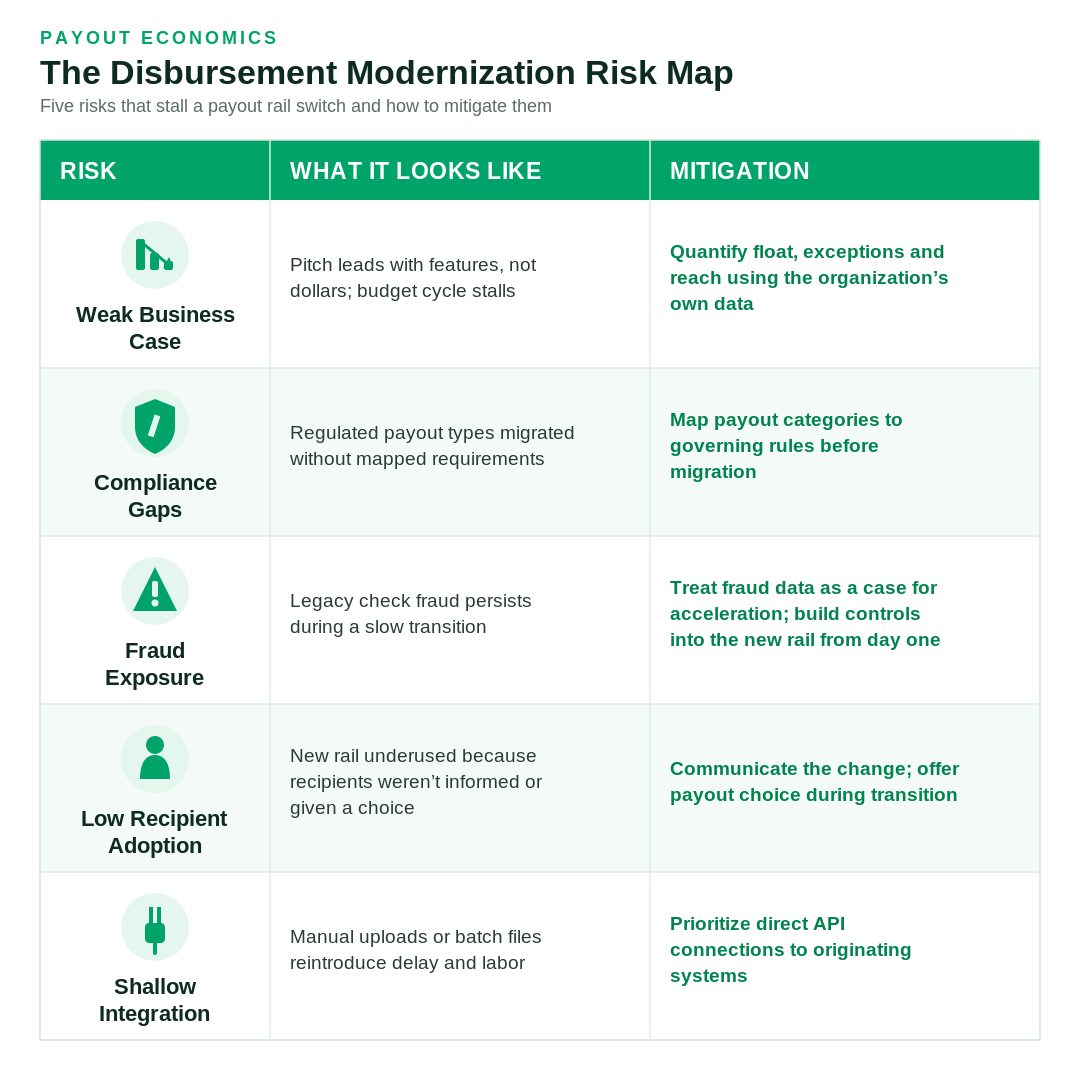
Organizations rarely fail to modernize disbursements because the technology is unavailable. They stall because the business case, the compliance posture or the implementation plan was never built with the same rigor as the legacy process it is meant to replace.
Building the business case in CFO terms
A disbursement modernization case that leads with technology features rarely survives a budget cycle. A case that leads with the float framework above, denominated in dollars rather than transaction counts, travels much further. The most persuasive version pairs the organization’s own disbursement volume with its own reissue, exception and complaint rates, rather than industry averages. The gap between legacy and modern costs varies enormously by program type and recipient population.
Compliance and regulated payout types
Not every disbursement carries the same regulatory weight. Workers’ compensation payments, structured settlements and certain benefits disbursements come with state-specific rules about payment method, timing and recipient consent. A modernization plan needs to map which payout categories are regulated, which regulator or statute governs each, and how the new platform’s controls satisfy those requirements before the first dollar moves on the new rail, not after.
Fraud exposure during the transition
Check-based payouts remain a significant and rising fraud target. The 2026 AFP Payments Fraud and Control Survey found that 76% of U.S. organizations experienced attempted or actual payments fraud in the past year. Checks were the payment method most frequently targeted, implicated in 58% of reported fraud incidents. A migration plan should treat that exposure as a reason to move faster away from checks, not as a reason to wait. The new card-based rail needs its own fraud and identity controls in place from day one.
Recipient communication and adoption
A faster payout method delivers value only if recipients understand it, trust it and use it. Organizations that simply swap the delivery rail without explaining the change, or without giving recipients a choice in how they receive funds, often see lower adoption than expected. Offering a choice of payout method during the transition, rather than mandating the new rail outright, tends to produce smoother adoption and avoids the appearance of removing an option recipients may still prefer in select situations.
Vendor and platform selection
Disbursement platforms vary widely in how directly they integrate with the systems that originate payouts. A platform that requires manual file uploads or batch reconciliation brings back much of the delay and labor that the modernization was meant to remove. The strongest evaluation criterion is not the breadth of a platform’s feature list. It is how directly the platform connects, via API, to the claims, lending or ERP system that already triggers the payout decision.
The Revenue-Recovery Scorecard
The modernization decision should not start with a vendor demo. It should start with a scorecard: a way to put a dollar figure on what the current disbursement model is already leaving behind, before any technology decision is made.
Score each question from 1 to 5. 1 = not measured or not available. 5 = measured, owned and actively managed.
Do you know the average time between payout approval and recipient access to funds, broken out by disbursement type?
Can you calculate the dollar value of capital currently tied up in disbursement float, using your own transaction volume rather than an industry estimate?
What percentage of your disbursements require manual exception handling, and how many staff hours does that consume monthly?
Do you track recipient satisfaction or complaint rates specifically tied to payout speed and method?
What share of your recipient base successfully receives and accesses funds on the first attempt, and what happens to those who do not?
Can recipients currently choose how they receive funds, or is the payout method fixed regardless of preference?
Do you have a documented map of which disbursement categories are subject to state or federal payout regulations?
How exposed is your current disbursement process to check fraud, and is that exposure measured or anecdotal?
Does your disbursement platform connect directly, via API, to the systems that originate payout decisions?
What would prove a disbursement modernization worked: faster funds access, fewer exceptions, higher recipient satisfaction, expanded reach, or all of the above?
A low score does not mean modernization should wait. It means the business case is still being built. A high score does not mean modernization will be effortless. It means the organization already knows where its costs sit, where its risks concentrate and what success has to look like.
The bottom line
The true cost of slow disbursements rarely appears as visible transaction costs. It shows up in capital that sits idle in transit, in recipients who take their business elsewhere without complaint, in staff hours spent repairing a process that should not need repair, and in an addressable population the organization cannot reach with a check.
The modernization case starts when those costs become visible. It gets funded when they become measurable. It succeeds when the new platform does more than move money faster, when it gives the organization a clearer, safer and more profitable way to keep its promise to every recipient on the other end of the payment.
Measurement note: The source used does not include aggregate exception-rate or reissue-rate data for disbursement programs. The figures above use modeled math at illustrative volumes rather than a published industry benchmark. Organizations applying this framework should substitute their own exception and reissue rates, which vary significantly by payout type, recipient population and program maturity.
About
SoFi Tech Solutions is the financial technology provider connecting banks, FinTechs and enterprises with innovative banking and processing capabilities to help people get their money right. This division of SoFi delivers modern digital solutions that are cloud-native, developer-friendly and regulation-ready, powering exceptional, customer-centric financial experiences across North and Latin America.
PYMNTS Intelligence is a leading global data and analytics platform that uses proprietary data and methods to provide actionable insights on what’s now and what’s next in payments, commerce and the digital economy. Its team of data scientists includes leading economists, econometricians, survey experts, financial analysts and marketing scientists with deep experience in the application of data to the issues that define the future of the digital transformation of the global economy. This multilingual team has conducted original data collection and analysis in more than three dozen global markets for some of the world’s leading publicly traded and privately held firms.
The PYMNTS Intelligence team that produced this Tracker:
John Gaffney, Chief Content Officer
We are interested in your feedback on this report. If you have questions or comments, or if you would like to subscribe to this report, please email us at feedback@pymnts.com.
Disclaimer
The Embedded Finance Tracker® Series may be updated periodically. While reasonable efforts are made to keep the content accurate and up to date, PYMNTS MAKES NO REPRESENTATIONS OR WARRANTIES OF ANY KIND, EXPRESS OR IMPLIED, REGARDING THE CORRECTNESS, ACCURACY, COMPLETENESS, ADEQUACY, OR RELIABILITY OF OR THE USE OF OR RESULTS THAT MAY BE GENERATED FROM THE USE OF THE INFORMATION OR THAT THE CONTENT WILL SATISFY YOUR REQUIREMENTS OR EXPECTATIONS. THE CONTENT IS PROVIDED “AS IS” AND ON AN “AS AVAILABLE” BASIS. YOU EXPRESSLY AGREE THAT YOUR USE OF THE CONTENT IS AT YOUR SOLE RISK. PYMNTS SHALL HAVE NO LIABILITY FOR ANY INTERRUPTIONS IN THE CONTENT THAT IS PROVIDED AND DISCLAIMS ALL WARRANTIES WITH REGARD TO THE CONTENT, INCLUDING THE IMPLIED WARRANTIES OF MERCHANTABILITY AND FITNESS FOR A PARTICULAR PURPOSE, AND NONINFRINGEMENT AND TITLE. SOME JURISDICTIONS DO NOT ALLOW THE EXCLUSION OF CERTAIN WARRANTIES, AND, IN SUCH CASES, THE STATED EXCLUSIONS DO NOT APPLY. PYMNTS RESERVES THE RIGHT AND SHOULD NOT BE LIABLE SHOULD IT EXERCISE ITS RIGHT TO MODIFY, INTERRUPT, OR DISCONTINUE THE AVAILABILITY OF THE CONTENT OR ANY COMPONENT OF IT WITH OR WITHOUT NOTICE.
PYMNTS SHALL NOT BE LIABLE FOR ANY DAMAGES WHATSOEVER, AND, IN PARTICULAR, SHALL NOT BE LIABLE FOR ANY SPECIAL, INDIRECT, CONSEQUENTIAL, OR INCIDENTAL DAMAGES, OR DAMAGES FOR LOST PROFITS, LOSS OF REVENUE, OR LOSS OF USE, ARISING OUT OF OR RELATED TO THE CONTENT, WHETHER SUCH DAMAGES ARISE IN CONTRACT, NEGLIGENCE, TORT, UNDER STATUTE, IN EQUITY, AT LAW, OR OTHERWISE, EVEN IF PYMNTS HAS BEEN ADVISED OF THE POSSIBILITY OF SUCH DAMAGES.
SOME JURISDICTIONS DO NOT ALLOW FOR THE LIMITATION OR EXCLUSION OF LIABILITY FOR INCIDENTAL OR CONSEQUENTIAL DAMAGES, AND IN SUCH CASES, SOME OF THE ABOVE LIMITATIONS DO NOT APPLY. THE ABOVE DISCLAIMERS AND LIMITATIONS ARE PROVIDED BY PYMNTS AND ITS PARENTS, AFFILIATED AND RELATED COMPANIES, CONTRACTORS, AND SPONSORS, AND EACH OF ITS RESPECTIVE DIRECTORS, OFFICERS, MEMBERS, EMPLOYEES, AGENTS, CONTENT COMPONENT PROVIDERS, LICENSORS, AND ADVISERS.
Components of the content original to and the compilation produced by PYMNTS is the property of PYMNTS and cannot be reproduced without its prior written permission.
The Embedded Finance Tracker® Series is a registered trademark of What’s Next Media & Analytics, LLC (“PYMNTS”).