
August 2026
The 2026 Certainty Project

Growth and Scaling: The Corporate Finance Inflection Point

Most middle market firms grew their revenue over the last 24 months (58%), and nearly half rebuilt their operations to keep up (45%). Their finance teams are feeling it.

Header image for the August 2026 edition of the PYMNTS Intelligence and Fynapse 2026 Certainty Project Report. PYMNTS Intelligence finds that cash flow forecasting is the top finance challenge as middle market companies manage rising complexity.

For middle market firms in the United States, revenue growth directly increases operational complexity. PYMNTS Intelligence’s latest research reveals that companies rapidly scale up operationally as they work to expand their sales and commercial reach, and their corporate finance functions feel these growing pains long before any changes appear in the top line. Over the last 24 months, one in five middle market firms increased revenue by at least 10% per year—a pace that if maintained puts them on track to soon graduate from middle market to enterprise. Faster growing companies were the most likely to add products, customers and staff.

Complexity, however, often keeps accelerating even when expansion pauses. Over half of middle market companies that did not increase revenue in the last two years still added at least one product or service line (56%). No-growth firms also reported supplier expansion, higher transaction volumes and new market entry at higher rates than their counterparts that increased their revenue during this period.

Cash flow forecasting is the first finance function to show the strain, and data readiness is what resolves it.

The pressure shows up most clearly in cash flow forecasting. Roughly two-thirds of middle market CFOs say cash flow forecasting has been difficult to manage or scale, and 37% name it as the single hardest finance or back-office challenge they faced in the last two years. The strain isn’t limited to forecasting itself. Reconciliation, reporting and data accuracy, and data integration follow close behind, underscoring how quickly cash visibility becomes a challenge.

For finance leaders, the time to act is now, whether or not their company is in a growth phase. Investments in stronger data foundations, fewer manual processes and more connected reporting can help firms manage complexity before it becomes a constraint. Fast-growing companies can use those investments to support continued expansion. Firms in a slower period can use them to strengthen the foundation for the next growth push.

What Is the Middle Market?

PYMNTS Intelligence defines the middle market as U.S. companies with annual revenues between $100 million and $1 billion. That is a 10x range, and the finance challenges at either end of it face different challenges.

Many CFOs are already budgeting accordingly, naming cash flow forecasting their top investment priority (52%), followed by the foundations that make it work, including real-time reporting (35%), reducing manual processes (33%) and unifying finance data (32%). These trends became much sharper among firms with three or more business changes, where reliance on manual processes fell to -92 on our “net help” scale measuring whether investing in a given area helped firms cope with rising operational complexity or held them back.

These are just some of the findings in Growth and Scaling: The Corporate Finance Inflection Point, a PYMNTS Intelligence report produced in collaboration with Fynapse. The report is based on a survey of 60 CFOs and senior finance executives at U.S.-based middle market companies with annual revenues between $100 million and $1 billion, conducted June 9–16, 2026. The report examines how revenue growth, operational complexity and uncertainty are reshaping corporate finance.

Ben Catterall

Ben Catterall

Global Head of Sales Engineering, Fynapse

Payments is evolving rapidly, and finance teams are under urgent pressure to keep pace. More customers, higher transaction volumes, new products and more markets need solid data foundations already in place so they don’t hold business back.

Two-thirds of CFOs named cash flow forecasting as their top priority. But accuracy needs a strong finance foundation. Better data doesn’t mean collecting more data; it means capturing and validating every transaction as it happens.

We saw one multinational payments client processing transactions across 18 countries. Their books seemed balanced—at the summary level. Only at transaction-level did we discover FX spreads quietly costing them 2% on average. Apply that to $100 million of cross-border payments, and that’s $2 million lost in a year.

Legacy ERPs built around batch processing and summarized data can’t keep pace with that complexity. As transaction volumes increase, finance teams get dragged into reconciling past transactions when they should be moving the business forward.

Layering an AI agent on top as an afterthought only scales the chaos faster. It’s great to see executives recognise that data infrastructure and visibility must come first. But earlier visibility on performance and risk requires live reconciliation.

That’s why Aptitude Software built Fynapse, the AI-native Finance ERP built for the scale, speed and regulatory demands faced by modern payments companies.

Payments need real-time, granular finance data to retain a competitive advantage and maintain regulatory-ready control. CFOs at middle market firms that fix their data foundations now will set the standard for enterprise-ready success.

Get Unlimited Access
Complete the form below for free, unlimited access to all our Data Studies, Trackers, and PYMNTS Intelligence reports.

Thank you for registering. Please confirm your email to view all our Trackers.
    yesSubscribe to our daily newsletter, PYMNTS Today.

    By completing this form, you agree to receive marketing communications from PYMNTS and to the sharing of your information with our sponsor, if applicable, in accordance with our Privacy Policy and Terms and Conditions.

    The Uncertainty Factor

    PYMNTS Intelligence defines “uncertainty” as corporate executives’ self-reported assessments of how unpredictable or unreliable financial, regulatory, market and operational conditions feel across their core operations and finances. These areas include accounts payable and receivable (AP and AR) and collections, cash and liquidity positions, macroeconomic conditions, consumer and customer demand, risk management, compliance and regulatory issues, supply chains, payments capabilities, exchange rates and competitive positions.

    Complexity Scales With Growth

    Most middle market firms are growing, and scaling is complex.

    Among the 60 CFOs surveyed, 58% said revenue increased over the past 24 months through mid-June 2026, while 42% saw flat or declining performance. One in five expanded by 10% or more. Tech firms accounted for most of the overperformance, exceeding the 10% mark at around 1.9 times the rate of the sample average.

    Growth translates to change in business category, not just a bigger number.

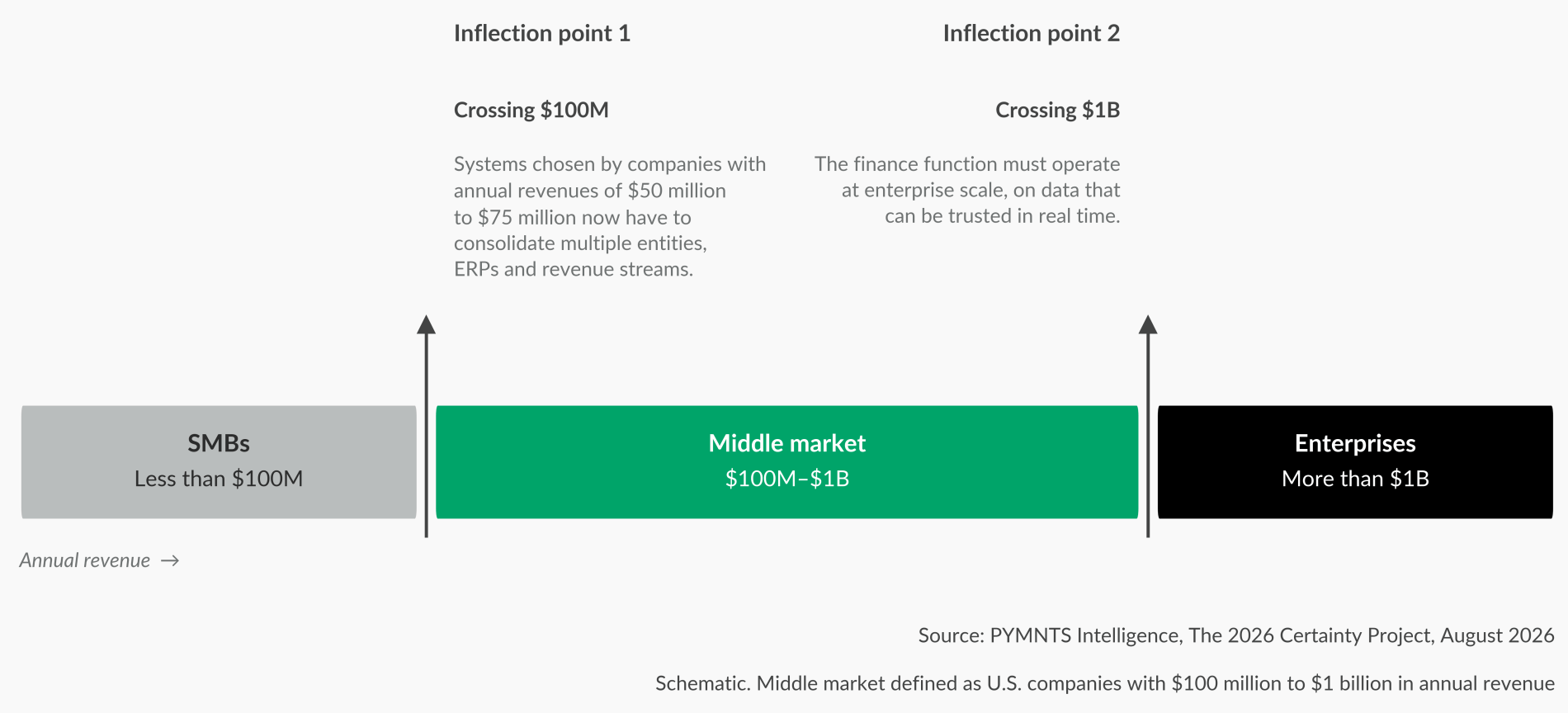
    Middle market companies vary widely in size and operational complexity. The revenue bracket runs from $100 million to $1 billion, and companies at either end of this range meet different versions of the same event. Firms near the $100 million floor most likely arrived there recently from the $50 million to $75 million range, and are usually running finance systems chosen for a company a fraction of their current size. Firms near $1 billion that keep growing are approaching the point where they have to operate as an enterprise. These crossings are the inflection points this report is named for and each puts pressure on corporate finance before other functions.

    Figure 2:
    Two inflection points bracket the middle market
    The revenue thresholds that define the middle market band, and what changes at each crossing

    Figure 2 for the August 2026 edition of the PYMNTS Intelligence Certainty Project series, done in collaboration with Fynapse. Figure 1: Two inflection points bracket the middle market; The revenue thresholds that define the middle market band, and what changes at each crossing.

    How close a company is to the next inflection point depends on where it sits in the revenue band and how fast it is moving. A firm with $750 million in annual revenue will cross the $1 billion mark in about three years at 10% growth, and in less than two years at 20%. The faster a firm grows, the more quickly it will face the structural challenges that come with crossing into an entirely new scale of operation.

    This pressure builds with momentum. Overall, 45% of firms made three or more significant business changes at the same time over the past 24 months, and 62% added product or service lines. Firms with revenue growth in the last 24 months led on most of these activities. At the same time, the data reveals that even firms with no topline expansion still reported high rates of scaling challenges. This emphasizes that the operational ramp-up needed to drive future growth can front-run the resulting increases in revenue. That means scaling difficulties must be solved first to unlock growth.

    Growth brings the biggest operational changes, and finance absorbs all of them.

    The widest gaps sit where growth makes itself especially visible. Firms with revenue gains were over 2.6 times more likely to have added customers (63% versus 24%) and to have increased staff (23% versus 8%), as well as 18% more likely to have added products (66% versus 56%). Interestingly though, those without growth were more likely to report supplier expansion (48% versus 29%), higher transaction volumes (40% versus 31%) and entries into new markets (24% versus 23%), demonstrating that complexity can and does increase even when revenue does not.

    This finding that complexity often multiplies even when growth looks static is critical to finance teams. Operational changes add reporting, reconciliation and cash-management demands whether or not stronger revenue generates the budget or the urgency to modernize systems. The resulting stress shows up first in areas that rely on timely, connected data.

    Growth compounds where uncertainty is lowest.

    Growth is easier to sustain when the operating environment is predictable, reinforcing a pattern seen across the Certainty Monitor research. Among low uncertainty firms, 78% grew over the past 24 months and none saw revenue decline. That share falls to 50% at medium uncertainty and 44% at high uncertainty, making growth 75% more common at the low end of the uncertainty scale than at the high end. Uncertainty does not prevent revenue from increasing, but it does multiply the growing pains that come with it.

    Cash Flow Visibility: The First Test of Scale

    Cash flow forecasting is the central pressure point for U.S. middle market firms.

    Nearly two-thirds (62%) of executives surveyed say it has been difficult to manage or scale cash flow forecasting. Fewer than half named other areas like reconciliation (42%) or data integration (40%). These findings reflect both the difficulty of maintaining effective cash flow forecasting as firms scale in complexity and the heightened impact of that difficulty on the bottom line.

    Cash flow forecasting isn’t only the most common problem—it’s also the most acute one. More than one-third (37%) of firms name it as the single most challenging area, far ahead of every other finance function. Data integration, accounts receivable and collections, and reconciliation trail in the 12% to 15% range. That said, corporate finance functions and the systems that support them have overlapping effects on forecasting, each affecting whether finance leaders can trust the liquidity picture in front of them.

    Uncertain operating environments multiply forecasting challenges. High uncertainty firms report far greater difficulty with data integration and reconciliation than low uncertainty firms, and firms that made three or more business changes show a similar jump. Data integration and reconciliation both reach 59% among firms with three or more changes, versus 24% and 27%, respectively, among firms with fewer changes. Manual or spreadsheet-based processes show the largest complexity effect, rising from 6% difficulty among less active firms to 52% among those with three or more changes. Strains that look contained in quieter conditions can quickly become bottlenecks when uncertainty and operating volume rise together.

    Scaling Tools That Work

    Automation and data integration are the best antidotes for growing pains.

    To better assess how different tools and strategies can empower firms to navigate complexity, we built a “net help” index. Its scores reflect the share of firms that say investing in a given area had a positive impact on their ability to manage complexity, minus those that report a negative impact.

    Overall, standardizing processes produced the highest net help score, at +93, followed closely by finance automation at +91 and data integration at +88. Outsourcing or working with partners (+80), hiring finance staff (+78) and upgrading enterprise resource planning systems (+73) also scored highly, while adopting AI registered a lower but strong score of +65. Manual and spreadsheet-based processes were the clear exception, with a net help score of -36, making them the only area in the sample that more often held firms back than helped them manage growth.

    Automation and data integration performed consistently across segments regardless of uncertainty level or the number of business changes a firm made. This suggests that investments in these areas deliver consistently positive, high-impact results across operating environments. Changes to hiring were helpful overall, but the pattern was less consistent, with the net help score strongest among low uncertainty firms but lower among those facing higher uncertainty. This points to the limits of adding staff when systems and processes remain under stress.

    Manual and spreadsheet-based processes moved in the opposite direction. They were roughly neutral for firms with one or two business changes, but became a major drag for firms managing three or more changes. That pattern is a clear sign that manual processes don’t fail all at once. They become costly when transaction volume, reporting needs and operational change exceed what disconnected workflows can handle.

    Finance teams are preparing for growth, but few are fully ready.

    Looking ahead, CFOs are cautiously confident about the next 24 months. Sixty-two percent said their finance and back-office systems are at least mostly prepared, though only 12% indicate complete readiness. These findings indicate that for most firms, preparedness appears to mean they know where upgrades are needed, not that the work is complete.

    Readiness varies substantially across segments. The tech sector holds a strong lead, with all companies either fully (31%) or mostly (38%) prepared. Goods firms trail furthest behind: None are fully ready and only 29% are mostly prepared. Services firms fall in the middle (10% fully, 67% mostly). Interestingly, companies in the $100 million–$400 million band are much more likely than those in the $400 million–$1 billion band to report being mostly prepared, but less likely to cite full preparation. Growth firms edge out no-growth firms at both levels. Zooming out, the common thread is that full preparation is rare, and even confident firms need additional investment to deliver on their plans.

    CFOs’ top investment priorities focus on finance visibility.

    Investment priorities track closely with where firms feel the most pain. Cash flow forecasting leads at 52%, with real-time reporting (35%), reducing manual processes (33%) and unifying finance data (32%) close behind. These priorities are less about adding new capabilities than about strengthening the finance infrastructure that recent complexity has pushed closer to its limits.

    AI comes after firms strengthen their financial foundations.

    Artificial intelligence tools offer one useful boundary on the investment story. Executives rate AI as helpful when already in place, but few name AI-driven finance and decision-support tools as a top, standalone priority. The near-term agenda is more basic: Fixing the visibility and data infrastructure foundations before layering on more advanced tools.

    Read More

    PYMNTS Intelligence is the leading provider of information on the trends driving innovation in finance, banking and digital payments. To stay up to date, subscribe to our newsletters and read our in-depth reports.

    Methodology

    Growth and Scaling: The Corporate Finance Inflection Point,” the latest installment of the 2026 Certainty Project, is based on a survey of 60 CFOs conducted from June 9–16, 2026. The survey polled executives at U.S.-based companies with annual revenues between $100 million and $1 billion. The report examines the relationship between revenue growth and operating uncertainty.

    About

    Fynapse is the Finance ERP. Built by Aptitude Software. Finance doesn’t need another system of record. It needs a system of control. Fynapse gives finance teams direct access to live, transaction-level data—governed, traceable and ready to act on.

    PYMNTS Intelligence is a leading global data and analytics platform that uses proprietary data and methods to provide actionable insights on what’s now and what’s next in payments, commerce and the digital economy. Its team of data scientists includes leading economists, econometricians, survey experts, financial analysts and marketing scientists with deep experience in the application of data to the issues that define the future of the digital transformation of the global economy. This multilingual team has conducted original data collection and analysis in more than three dozen global markets for some of the world’s leading publicly traded and privately held firms.

    Ignacio Marquez: Senior Research Analyst
    Daniel Gallucci: Senior Writer

    We are interested in your feedback on this report. If you have questions or comments, or if you would like to subscribe to this report, please email us at feedback@pymnts.com.

    Disclaimer

    The Certainty Project may be updated periodically. While reasonable efforts are made to keep the content accurate and up to date, PYMNTS MAKES NO REPRESENTATIONS OR WARRANTIES OF ANY KIND, EXPRESS OR IMPLIED, REGARDING THE CORRECTNESS, ACCURACY, COMPLETENESS, ADEQUACY, OR RELIABILITY OF OR THE USE OF OR RESULTS THAT MAY BE GENERATED FROM THE USE OF THE INFORMATION OR THAT THE CONTENT WILL SATISFY YOUR REQUIREMENTS OR EXPECTATIONS. THE CONTENT IS PROVIDED “AS IS” AND ON AN “AS AVAILABLE” BASIS. YOU EXPRESSLY AGREE THAT YOUR USE OF THE CONTENT IS AT YOUR SOLE RISK. PYMNTS SHALL HAVE NO LIABILITY FOR ANY INTERRUPTIONS IN THE CONTENT THAT IS PROVIDED AND DISCLAIMS ALL WARRANTIES WITH REGARD TO THE CONTENT, INCLUDING THE IMPLIED WARRANTIES OF MERCHANTABILITY AND FITNESS FOR A PARTICULAR PURPOSE, AND NONINFRINGEMENT AND TITLE. SOME JURISDICTIONS DO NOT ALLOW THE EXCLUSION OF CERTAIN WARRANTIES, AND, IN SUCH CASES, THE STATED EXCLUSIONS DO NOT APPLY. PYMNTS RESERVES THE RIGHT AND SHOULD NOT BE LIABLE SHOULD IT EXERCISE ITS RIGHT TO MODIFY, INTERRUPT, OR DISCONTINUE THE AVAILABILITY OF THE CONTENT OR ANY COMPONENT OF IT WITH OR WITHOUT NOTICE.

    PYMNTS SHALL NOT BE LIABLE FOR ANY DAMAGES WHATSOEVER, AND, IN PARTICULAR, SHALL NOT BE LIABLE FOR ANY SPECIAL, INDIRECT, CONSEQUENTIAL, OR INCIDENTAL DAMAGES, OR DAMAGES FOR LOST PROFITS, LOSS OF REVENUE, OR LOSS OF USE, ARISING OUT OF OR RELATED TO THE CONTENT, WHETHER SUCH DAMAGES ARISE IN CONTRACT, NEGLIGENCE, TORT, UNDER STATUTE, IN EQUITY, AT LAW, OR OTHERWISE, EVEN IF PYMNTS HAS BEEN ADVISED OF THE POSSIBILITY OF SUCH DAMAGES.

    SOME JURISDICTIONS DO NOT ALLOW FOR THE LIMITATION OR EXCLUSION OF LIABILITY FOR INCIDENTAL OR CONSEQUENTIAL DAMAGES, AND IN SUCH CASES, SOME OF THE ABOVE LIMITATIONS DO NOT APPLY. THE ABOVE DISCLAIMERS AND LIMITATIONS ARE PROVIDED BY PYMNTS AND ITS PARENTS, AFFILIATED AND RELATED COMPANIES, CONTRACTORS, AND SPONSORS, AND EACH OF ITS RESPECTIVE DIRECTORS, OFFICERS, MEMBERS, EMPLOYEES, AGENTS, CONTENT COMPONENT PROVIDERS, LICENSORS, AND ADVISERS.

    Components of the content original to PYMNTS and the compilation produced by PYMNTS are the property of PYMNTS and cannot be reproduced without its prior written permission.
