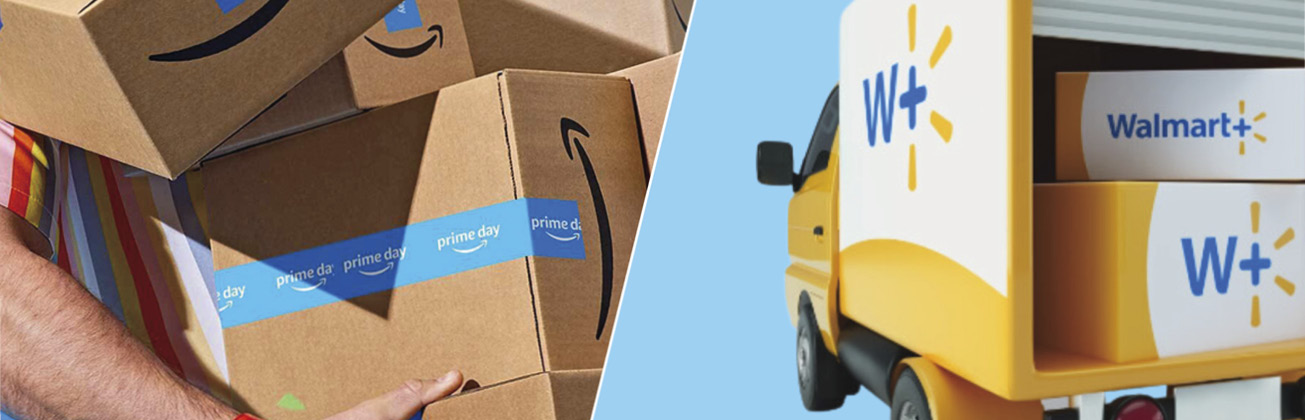
For the first time, the dates of Amazon Prime Day (four days over June 23 through June 26) and Walmart Deals (June 22 to June 28) overlapped, and it fundamentally changed how consumers shopped.
Participation surged as the share of adults who skipped both events plummeted from 48% of all U.S. consumers in 2025 to just 7% this year, bringing millions of new shoppers into the market. Overall, 93% of all consumers, or 244 million people, shopped at least one event, up from 135 million last year.
But bigger crowds didn’t translate into bigger spending per person (at Amazon, $308 this year versus $360 in 2025; at Walmart, $326 versus $484 last year). As older consumers flocked to the sales events, with participation among baby boomers and seniors soaring 263% at Walmart and 120% at Amazon, average spending per shopper fell sharply, signaling a shift toward more value-conscious buying.
At the same time, another force was reshaping the customer journey before shoppers ever opened the Walmart or Amazon app or visited their websites. One in five participants used an AI chatbot or assistant to compare products, find deals or research purchases, and most ultimately bought at least one product the technology recommended. Together, these trends reveal a retail landscape where growth no longer depends simply on attracting shoppers, but on winning increasingly price-sensitive consumers whose buying decisions are being influenced long before checkout.
These are just some of the findings of this year’s Amazon Prime Day and Walmart Deals Report. The study drew from a survey fielded in June 2026 of 2,160 U.S. consumers. Findings were compared against a July 2025 wave of 4,704 consumers.
The overlap expanded the market but shrank the average basket.
This year, as Amazon Prime Day and Walmart Deals overlapped for the first time, the two events pulled in new shoppers rather than just splitting existing ones between the two retail giants. The share of adults who participated in neither event plunged from 48% last year to just 7%, adding roughly 108 million participants.
The share of consumers who shopped Prime Day but not Walmart Deals jumped from 27% to 48%, and the share who only shopped Walmart Deals nearly tripled, rising from 6% to 16%. The share that shopped both events spiked from 19% to 29%.
The new shoppers weren’t the ones most retailers would have expected.
Baby boomers and seniors drove the participation surge but carry the smallest baskets, while millennials, the biggest 2025 spenders, cut back hardest.
Baby boomers and seniors, not known for their online commerce engagement, drove the biggest participation gains of any generation, up 120% at Amazon and 263% at Walmart compared to last year. Younger generations showed more modest increases in participation in Amazon’s event, and they also cut spending the most. Millennials’ participation rose 48% at Amazon and 24% at Walmart, but their spend fell 26% and 35%. Similarly, bridge millennials’ spending was down 25% and 41%, respectively. Even as participation grew, these retail giants earned less per shopper because the biggest spenders pulled back.
Groceries basically held up, but almost nothing else did.
The pullback was broad. Every Walmart category drew fewer shoppers in every category than in 2025, with groceries the most resilient (49%, down from 55%, still its top category), while Amazon held only clothing and beauty.
As consumers dialed back their spending, the share making different kinds of purchases declined. Walmart lost ground in every category tracked since 2025. Groceries fell the least, dropping 11% from 55% to 49% of Walmart event shoppers and keeping groceries as Walmart’s top category. The biggest declines came in travel services, down 56%, and books, music, hobby and toy items, down 52%.
Amazon held up better in every category, and it gained in clothing and accessories, up 2%, while beauty products held flat. Older shoppers tend to buy more staples like groceries over higher-margin discretionary categories like travel, so as the shopping base changes, spending shifts away from higher-margin categories.
With shoppers now participating in multiple events, the overlap has created a price war.
Participating in both events has given consumers the option to comparison shop, choosing the best deal for every purchase. Seventy-four percent of those who shopped at both events checked prices between Amazon and Walmart, and 46% say price alone decided where they bought. That figure is more than three times the share who cited loyalty as the deciding factor (15%).
When shoppers compared, they often ended up choosing Amazon: 38% of comparers usually or almost always bought there, versus 25% at Walmart. The overlap created new revenue opportunities for the retail giants, with 26% of both-event shoppers saying they spent more than they otherwise would have because both sales ran the same week.
The data shows that as consumers age, they can become more sensitive to price. Fifty-nine percent of baby boomer and senior shoppers of both events picked their retailer on price alone, compared with just 30% of Generation Z, making the oldest shoppers nearly twice as likely as the youngest to decide on price.
Price cuts seemed to motivate the influx of new, older shoppers, while younger consumers weighed a wider mix of factors before deciding where to buy.
Walmart may be seeing increased participation, but it still hasn’t caught up to Amazon.
When shoppers who participated in both events compared the two retailers’ discounts, Amazon retained its wide lead. Forty-three percent said Amazon’s deals were better, compared with 21% who favored Walmart, a two-to-one gap unchanged from 2025.
Amazon led on all six aspects measured, with the greatest gaps in product selection (43% versus 17%) and shipping time (42% versus 24%), strengths that Walmart’s improving prices haven’t overcome. Walmart came closest on regular, non-sale pricing, 32% versus 27%, but still could not pull ahead.
Similarly, Amazon continues to win on subscriber bases. Walmart+ membership rose from 34% to 42% of consumers, but that gain came from members who also carry Amazon Prime, so Walmart is picking up members who are already Amazon customers rather than winning its own loyal base.
It seems that Walmart may have an awareness issue: Just over one in four (26%) shoppers who didn’t participate in Walmart Deals said they simply didn’t know the event was happening, compared with 7% of Amazon Prime Day nonbuyers.
Artificial intelligence is now a major force in sales event purchasing decisions.
More than one in five (21%) participants in either or both events used an AI chatbot or assistant to shop, rising to 35% of Generation Z. Among AI users, 57% call the technology very or extremely influential and 74% bought at least one product mainly on an AI recommendation.
Among AI users, the most common tasks were comparing prices across retailers (38%) and finding deals (36%), followed by researching product features (32%). ChatGPT was the most popular AI platform, cited by 51% of AI users, followed by Google Gemini at 44%. It suggests that the comparison shopping that used to start on Amazon’s or Walmart’s own sites increasingly begins on third-party platforms.
While bringing AI into the mix may shift some control of the shopping journey away from Amazon and Walmart, it is contributing to their sales. Fifty-seven percent of AI users called the technology very or extremely influential in what they bought, and 74% bought at least one product mainly based on an AI recommendation, with 30% buying more than one.
AI’s influence can especially be seen among younger shoppers: 63% of Generation Z AI users called it very or extremely influential, versus 36% of boomers and seniors. Additionally, 80% of Generation Z AI users bought at least one AI-recommended product, versus 49% of boomers and seniors.
Financially strained shoppers were also more swayed by AI’s suggestions, with 45% of AI users who live paycheck to paycheck with difficulty buying more than one AI-recommended product versus 21% of those not struggling to pay their bills. In general, a growing share of purchasing decisions are now made somewhere neither Amazon nor Walmart can fully see or shape.
Read More
PYMNTS Intelligence is the leading provider of information on the consumer trends driving innovation in consumer finance, digital payments and financial inclusion. To stay up to date, subscribe to our newsletters and read our in-depth reports.
Methodology
This report draws on two independent survey waves from PYMNTS Intelligence: one fielded in July 2025 with 4,704 respondents, and one fielded in June 2026 with 2,160 respondents. The waves compare separate samples rather than tracking the same individuals, so year-over-year changes reflect shifts in the overall population, not in any one shopper’s behavior.
The 2025 wave covered Walmart+ Week, held April 28-May 4, 2025. The 2026 wave covers Walmart Deals, held June 22-28, 2026, which overlapped with Amazon Prime Day for the first time. Within the June 2026 wave, subgroups include 1,678 Amazon participants, 924 Walmart participants, 612 dual participants, 423 AI users and 1,567 AI nonusers. The July 2025 wave included 1,906 Amazon participants and 959 Walmart participants.
Percentage changes describe relative differences between waves, not percentage point differences. Some 2025 Walmart figures exclude respondents who were renormalized because they were not sure or did not remember. Measures described as better combine much better and somewhat better responses; very or extremely influential combines those two response options. Subgroup base sizes for smaller demographic breakouts were not included in the data export.