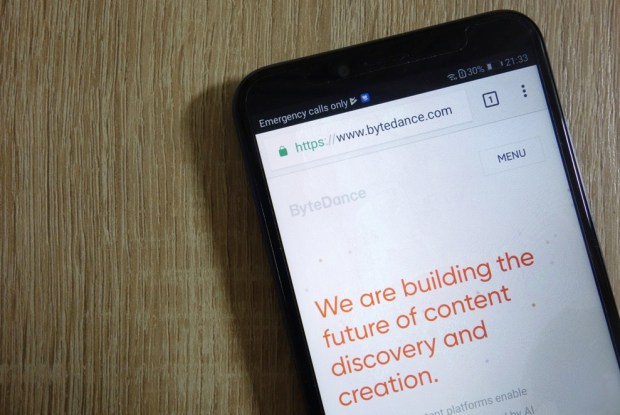
ByteDance, the Chinese media company, closed a $3 billion funding round led by SoftBank, making it the largest privately backed startup in the world.
Bloomberg, citing people familiar with the matter, reported late last week that ByteDance’s latest round of fundraising, which also included KKR & Co. and General Atlantic, gives it a valuation of $75 billion, surpassing Uber to become the most valuable unicorn startup. According to the report, proceeds from the fundraising are expected to go for expansion beyond Chinese companies. ByteDance owns Toutiao, the news aggregator in China, and TikTok, a hugely popular video platform in China. Uber is valued at $72 billion, noted Bloomberg, citing data from CB Insights. ByteDance is aiming to take on its rivals outside of China with the cash infusion. Douyin, a video service that operates outside of China as TikTok, is its biggest international success and is stealing viewers from Tencent and Facebook, noted the report.
We’d love to be your preferred source for news.
Please add us to your preferred sources list so our news, data and interviews show up in your feed. Thanks!
While the company has earned more than $2.5 billion in revenue in 2017, Bloomberg noted ByteDance hasn’t been able to turn a profit as of yet. In 2016 ByteDance rolled out Douyin, recognizing that consumers like short videos and karaoke clips that they can view on apps. In 2017 Bytedance acquired Musical.ly for $800 million and now has hundreds of millions of users. According to Bloomberg, what makes ByteDance’s story so interesting is that it was able to grow Douyin without needing money or seeking help from Alibaba or Tencent, the leading internet players in China. Many startups will look to the two powerhouses to partner when growing Chinese internet businesses. Both Alibaba and Tencent have tried to copy ByteDance’s service, but with varying degrees of success. What may be more of risk to the company than the competition, noted Bloomberg, is censorship in the country. Bloomberg noted that in April it had to shut down Neihan Duanzi, a popular joke sharing app, and temporarily remove Toutiao from the app stores.


 Add as Preferred Source