EMEA Daily: Coinbase Taps Solarisbank Exec for Growth in Europe

October 17, 2022 - 4 years ago

Coinbase

Today in Europe, the Middle East and Africa (EMEA), Coinbase has hired a new managing director for EMEA, and Samsung is launching its digital wallet in 11 new markets.

    Get the Full Story

    Complete the form to unlock this article and enjoy unlimited free access to all PYMNTS content — no additional logins required.

    yesSubscribe to our daily newsletter, PYMNTS Today.

    By completing this form, you agree to receive marketing communications from PYMNTS and to the sharing of your information with our sponsor, if applicable, in accordance with our Privacy Policy and Terms and Conditions.

    Coinbase Picks up Solarisbank Exec to Drive Growth in Europe

    Coinbase hired the former chief operating officer for Solarisbank to advance its current expansion drive across Europe.

    Daniel Seifert joined Coinbase as vice president and regional managing director, EMEA, overseeing Europe, the Middle East and Africa, a spokesperson from Coinbase told PYMNTS Monday (Oct. 17).

    He will be in charge of driving the company’s business growth in Europe and working to help further Coinbase’s mission in the region. Seifert will also build out the workforce with local talent, support regulatory efforts and ensure Coinbase is operating in full compliance with local regulatory requirements.

    Samsung Wallet To Launch in 11 New EMEA Markets

    On Friday (Oct. 14) Samsung Electronics announced that Samsung Wallet will be launched in 11 new markets in Europe, the Middle East and Africa (EMEA) before the end of the year. The digital wallet will also become available in Kazakhstan and Vietnam.

    The EMEA countries set to be included in the expansion of the service are Bahrain, Denmark, Finland, Kuwait, Norway, Oman, Qatar, South Africa, Sweden, Switzerland, and the UAE.

    FinTech One Finance Debuts BNPL Solution In Egypt

    Integrated financial services platform One Finance announced yesterday (Oct. 16) that it is rolling out a new buy now, pay later (BNPL) product for the Egyptian market.

    The company says it serves a range of different financing categories, including consumer goods and services, household appliances and durable goods, auto loans, education fees, home finishing.

    The company says it is targeting a 12% share of the local market which currently stands at about the equivalent of $750 million.

    According to Tarek Elhousseiny, One Finance chairman, the expansion is needed to mitigate the impacts global economic volatility which has heightened demand for consumer financing services that support purchasing needs.

    Half of ‘Big Retail’ Thinks Consumer Digital Experience Could Be Better

    A PYMNTS study “Big Retail’s Innovation Mandate: Convenience and Personalization,” produced in collaboration with ACI Worldwide and based on surveys of 300 retail operations, found at a baseline that “only around half of retailers in the U.S. and the U.K. believe that they have the right mix of digital tools to serve their customers well.

    Examining the state of digital transformation in what PYMNTS categorizes as “big retail” — in this case U.S. and U.K. merchants with a minimum of 50 store locations and revenues of at least $1 billion for U.S.-based companies or 100 million pounds (about $127 million) for U.K. operators — we found a high number of retailers who said more digital innovation is what’s needed now.

    Although half of merchants said they were pleased with their digital progress, an equal number said they haven’t gone nearly far enough, with over 70% of retail executives in the United States and United Kingdom saying digital-first tools are a necessity to lock in loyalty.

    For all PYMNTS EMEA coverage, subscribe to the daily EMEA Newsletter.

    Square Terminal Adds Niche Commerce Tools for Retail, Appointments 

    October 17, 2022 - 4 years ago

    Retail and Appointments Software ,Square Terminal, commere

    Square is introducing two specialized commerce tools on Square Terminal to make it easier for online merchants worldwide to sell their products and services.

      Get the Full Story

      Complete the form to unlock this article and enjoy unlimited free access to all PYMNTS content — no additional logins required.

      yesSubscribe to our daily newsletter, PYMNTS Today.

      By completing this form, you agree to receive marketing communications from PYMNTS and to the sharing of your information with our sponsor, if applicable, in accordance with our Privacy Policy and Terms and Conditions.

      Square for Retail and Square Appointments on Square Terminal are two solutions aimed at retailers and beauty and personal care professionals so they can provide customers with convenient on-the-go checkout experiences that save time, according to a press release on Monday (Oct. 17).

      See also: The Three Tiny Details That Get Consumers to Click Buy at Checkout

      With Square for Retail and Square Appointments on Square Terminal, businesses can ring up customers almost anywhere, making it easier to help sellers handle consumer demand wherever they are. 

      “Square for Retail on Square Terminal has helped me streamline and condense everything so I can use all the features I need on one device,” said Leldon Maxcy, owner of Leldon’s, a gift shop in Cullman, Alabama. 

      “I can use Square Terminal as an extra checkout to ensure I’m offering my customers a great experience anywhere, whether I’m selling at my brick-and-mortar store or at local markets on-the-go,” he added.

      Read more: Square Launches New Tools for Commerce Apps, Cash App Pay

      The new tools provide merchants instant interaction with buyers for payments, returns, exchanges and inventory, and are now available on all Square hardware. 

      With the addition of Square for Retail and Square Appointments, all of Square’s commerce software is now available on all hardware, offering flexible solutions sellers can use to operate and expand their businesses, according to the release. 

      “The holiday season is not only one of the busiest times of year, but also a crucial period for a merchant’s bottom line,” said Alyssa Henry, head of Square. 

      “By bringing Square for Retail and Square Appointments to Square Terminal just ahead of this critical time, sellers can access powerful integrations between software and hardware that gives them fast, efficient operations to increase sales and meet their customers’ needs, anywhere and anytime,” she said.

      Inflation Slows Ultrafast Grocers’ Ambitions

      October 17, 2022 - 4 years ago

      Those who have been skeptical of the hype around ultrafast grocery all along have been vindicated, at least in part, as players in the space continue to shrink, shut down and face other difficulties due to a more challenging macroeconomic environment.

        Get the Full Story

        Complete the form to unlock this article and enjoy unlimited free access to all PYMNTS content — no additional logins required.

        yesSubscribe to our daily newsletter, PYMNTS Today.

        By completing this form, you agree to receive marketing communications from PYMNTS and to the sharing of your information with our sponsor, if applicable, in accordance with our Privacy Policy and Terms and Conditions.

        Investors have been pulling back. The Financial Times noted Friday (Oct. 14) that funding for these startups has taken a sharp downturn from more than $4 billion last year to just over $1 billion so far in 2022.

        The largest remaining players in the space, Gopuff and Getir, have faced their own challenges this year. In July, it was reported that a Gopuff memo showed the company laying off around 1,500 employees and shutting down 76 warehouses — 12% of its network. Similarly, a Getir memo in May showed that the company intended to lay off 14% of the staff at its global headquarters.

        Read more: Delivery Firm Gopuff Cuts 1,500, Closes Warehouses

        In June, ultrafast grocer Jokr announced that it was ceasing operations in New York and Boston and focusing its attention on Latin America. Also in June, it was first reported that Gorillas was searching for a company to merge with or be acquired by and that the grocer had exited Belgium (with Gorillas leaving Italy shortly thereafter). Plus, in March, Buyk shut down, and it was reported that Fridge No More was closing up shop after discussions with restaurant aggregator DoorDash didn’t amount to anything.

        See more: The Quick Seems Dead as Ultrafast Grocers Retreat En Masse

        Also in May, an internal email from United Kingdom-based ultrafast grocer Zapp revealed the company was cutting 10% of its staff. Also in that period, ultrafast grocer Gorillas announced that it would lay off 300 workers, cutting its administrative staff in half. All these moves come as global inflation has many consumers becoming more conservative about their grocery spending.

        Read more: Grocery Shoppers Cut Back, Trade Down as Inflation Rises

        On the flip side, the need for ultrafast grocers to hone their value proposition beyond just promising speed, which seemed so pressing when there were several players operating in many major cities, has been pushed into the background as the space has thinned out. With less competition, the promise of speed may be enough for now.

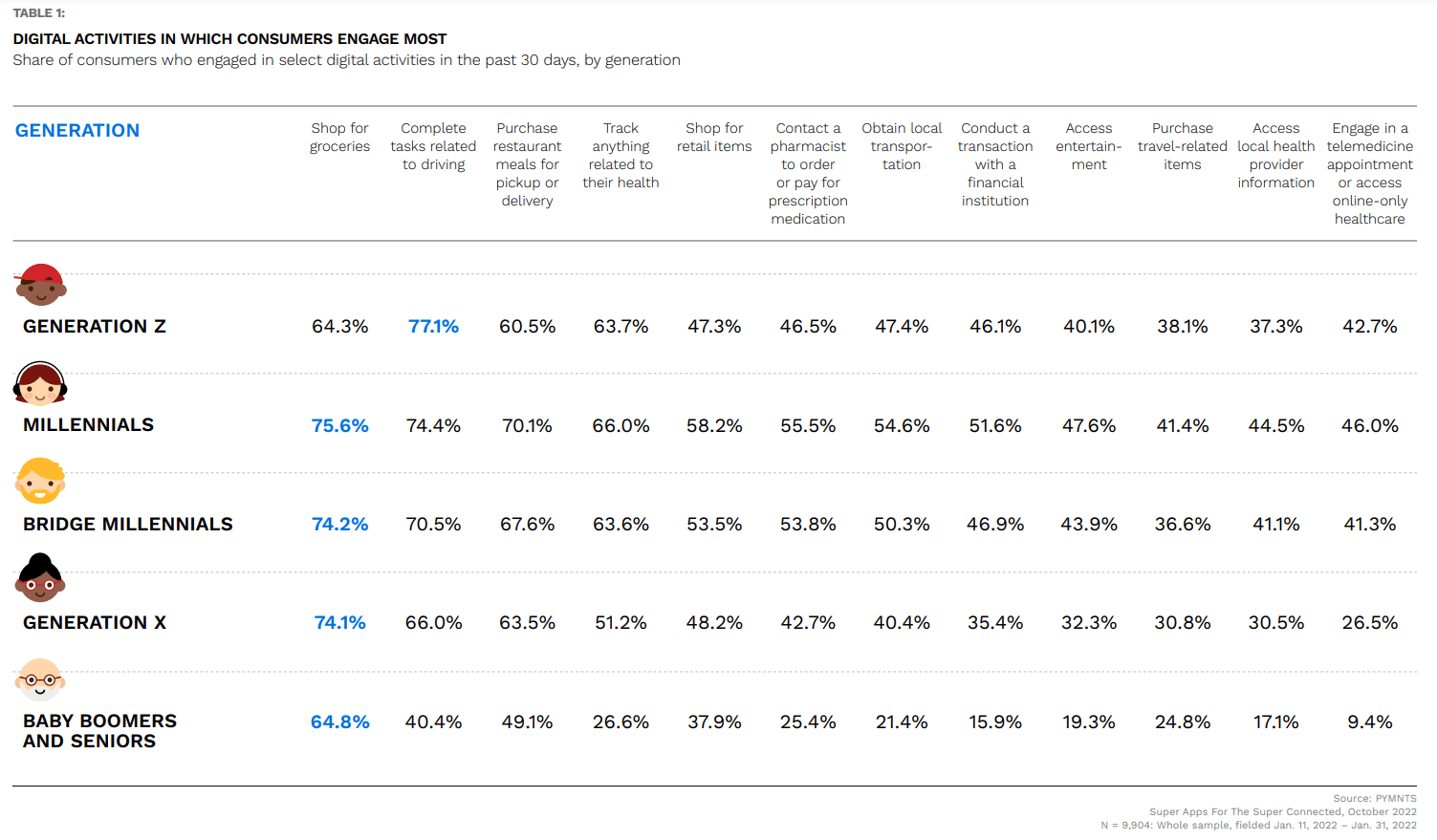
        There is a sizable market for online grocery. Research from PYMNTS’ new study “Super Apps for the Super Connected,” created in collaboration with PayPal, which drew from a survey of more than 9,900 consumers across the United States, the U.K., Australia and Germany, found that 76% of millennials in these four countries had bought groceries online in the previous 30 days. Plus, 74% of bridge millennials and Generation X consumers said the same.

        See more: Super Apps Promise Relief for Always-on Millennials

        Yet, in the U.S. alone, that share is lower. The July edition of PYMNTS’ ConnectedEconomy™ series, “The ConnectedEconomy™ Monthly Report: The Rise of the Smart Home,” which drew from a May survey of more than 2,600 U.S. consumers, found that 40% of consumers had bought groceries online for delivery in the prior month, and 16% of consumers purchased groceries for delivery every week.

        See more: New Data Shows Convenience Drove Smart Home Upgrades for 83M Consumers in 2022

        GOAT Group Buys Fashion Reseller Grailed

        October 17, 2022 - 4 years ago

        GOAT Group Buys Fashion Reseller Grailed

        eCommerce fashion platform GOAT Group has agreed to acquire apparel reseller Grailed, combining their forces amid a projected boom in second-hand luxury sales.

          Get the Full Story

          Complete the form to unlock this article and enjoy unlimited free access to all PYMNTS content — no additional logins required.

          yesSubscribe to our daily newsletter, PYMNTS Today.

          By completing this form, you agree to receive marketing communications from PYMNTS and to the sharing of your information with our sponsor, if applicable, in accordance with our Privacy Policy and Terms and Conditions.

          The companies announced the cash and stock deal in a news release Monday (Oct. 17), noting that it creates a community of 50 million members in 170 countries.

          Based in New York City, 9-year-old Grailed sells a curated collection of products from brands such as Gucci, Prada and Saint Laurent. GOAT Group previously invested in Grailed, contributing to the company’s $60 million Series B funding round last year.

          Read more: Menswear Marketplace Grailed Notches $60M in GOAT Group-Led Round

          The acquisition comes at a time when several luxury brands — Gucci, Burberry and Balenciaga among them — are entering the secondhand apparel space amid a surge in resale or reCommerce initiatives.

          See more: Luxury Brands Take Second Look at Secondhand Sales

          “Gucci retakes the No. 1 spot, while must-have bags and celebrity clout are driving Dior and Balenciaga up the charts,” designer resale platform The RealReal’s Luxury Resale Annual Report said in August, pointing to a 24% increase in demand for Gucci branded items over the past year that had pushed Louis Vuitton from the No. 1 spot.

          But as PYMNTS noted in September, rather than allow third-party platforms to profit from surging demand for resale, both Gucci and Balenciaga have advanced their own reCommerce offerings as a service to keep those sales in-house.

          PYMNTS’ Karen Webster predicted the rise of luxury retail earlier this year once it became apparent that inflation would continue to dominate the news.

          “The smart luxury retailers will set aside their disdain for the democratizing of their luxury brand and use it as an entry point to build the next generation of brand loyalists — on their terms,” Webster wrote.

          That prediction has become reality as luxury brands increasingly lean into resale. A report last month by The Wall Street Journal pointed to findings from Bain & Co. which say secondhand luxury sales would increase annually at around 15% over the next five years, double the anticipated rate of new sales.

          For all PYMNTS retail coverage, subscribe to the daily Retail Newsletter.

          Half of ‘Big Retail’ Thinks Consumer Digital Experience Could Be Better

          October 17, 2022 - 4 years ago

          APAC Cart Abandonment Rises Absent Localized Payments

          While the past three years of digital transformation in retail has led to a rapid expansion of online and mobile selling tools and automated processes, a new survey of over 150 brands showed high levels of dissatisfaction over existing tech innovations.

            Get the Full Story

            Complete the form to unlock this article and enjoy unlimited free access to all PYMNTS content — no additional logins required.

            yesSubscribe to our daily newsletter, PYMNTS Today.

            By completing this form, you agree to receive marketing communications from PYMNTS and to the sharing of your information with our sponsor, if applicable, in accordance with our Privacy Policy and Terms and Conditions.

            Although half of merchants said they were pleased with their digital progress, an equal number said they haven’t gone nearly far enough, with over 70% of retail executives in the United States and United Kingdom saying digital-first tools are a necessity to lock in loyalty.

            Examining the state of digital transformation in what PYMNTS categorizes as “big retail” — in this case U.S. and U.K. merchants with a minimum of 50 store locations and revenues of at least $1 billion for U.S.-based companies or 100 million pounds (about $127 million) for U.K. operators — we found a high number of retailers who said more digital innovation is what’s needed now.

            The PYMNTS study “Big Retail’s Innovation Mandate: Convenience and Personalization,” produced in collaboration with ACI Worldwide and based on surveys of 300 retail operations, found at a baseline that “only around half of retailers in the U.S. and the U.K. believe that they have the right mix of digital tools to serve their customers well.

            This dissatisfaction is leading many retailers to launch innovation strategies designed to improve the customer experience and their digital capabilities, such as those that collect and analyze customer purchasing data.

            The research found that “basic digital tools”— like mobile apps, touchless QR and barcode scanners, coupons and rewards — are well integrated into retail operations, with just about half of those surveyed saying their current tools and features deliver on these experiences.

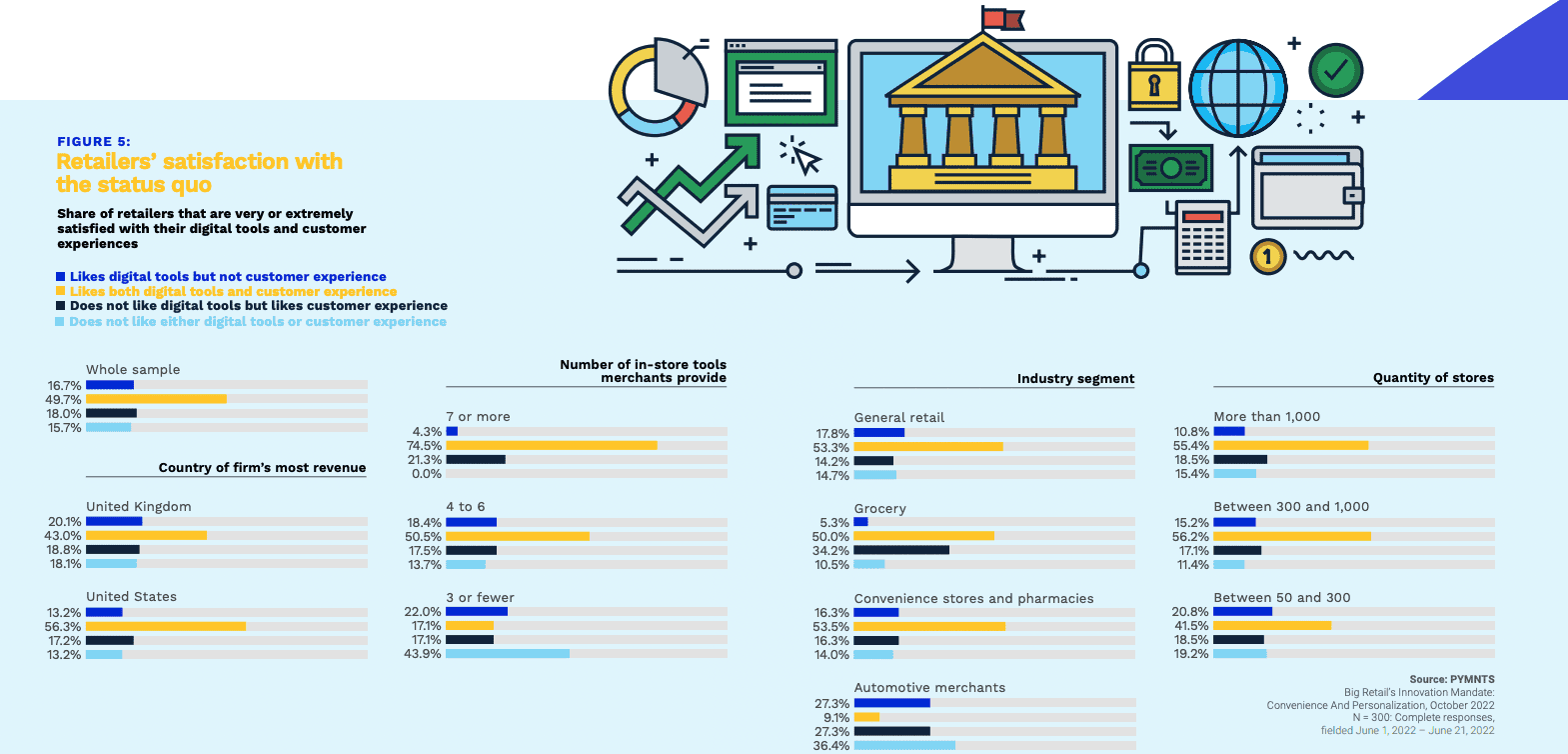
            Digging into stats of specific categories, 53% of general retailers and 54% of pharmacy and convenience stores said their current digital tools are sufficiently advanced for the shopping experiences they need to offer. It drops from there, with 50% of grocery and 9% of automotive merchants saying they’re content with digital tools and customer experience as they are now.

            This indicates a massive market of retailers shopping for themselves — solution shopping, to be exact — to match the satisfaction reported by more digitally progressed peers and competitors.

            “Retailers that use more digital tools enjoy them and the customer experiences they help create,” the study stated, with research finding that “three-quarters of retailers that currently use the most digital tools — seven or more — were satisfied with the digital features employed and the customer experiences created.”

            PYMNTS found that just 17% of those using the fewest digital tools (three or less) are satisfied with the shopping experience they are currently offering.

            Data, Digital Go Hand-in-Hand

            U.S. retailers have pulled ahead of their U.K. counterparts by offering more digital choice, and that’s given them confidence in the corresponding digital shopping experiences they can offer.

            “American retailers showed a higher rate of satisfaction with the digital tools they use and their customer experiences than U.K. retailers, at 56% and 43%, respectively,” the study stated. “One would thus expect American retailers to use more digital tools than U.K.-based retailers, and this holds true: U.S. retailers used an average of 5.3 digital tools, whereas U.K. retailers used an average of 4.7 tools.”

            Data is the fuel that these tools run on, making payments-related data tracking a vital component of the tools retailers choose and use in popular hybrid digital-physical setups.

            The study found a clear correlation here.

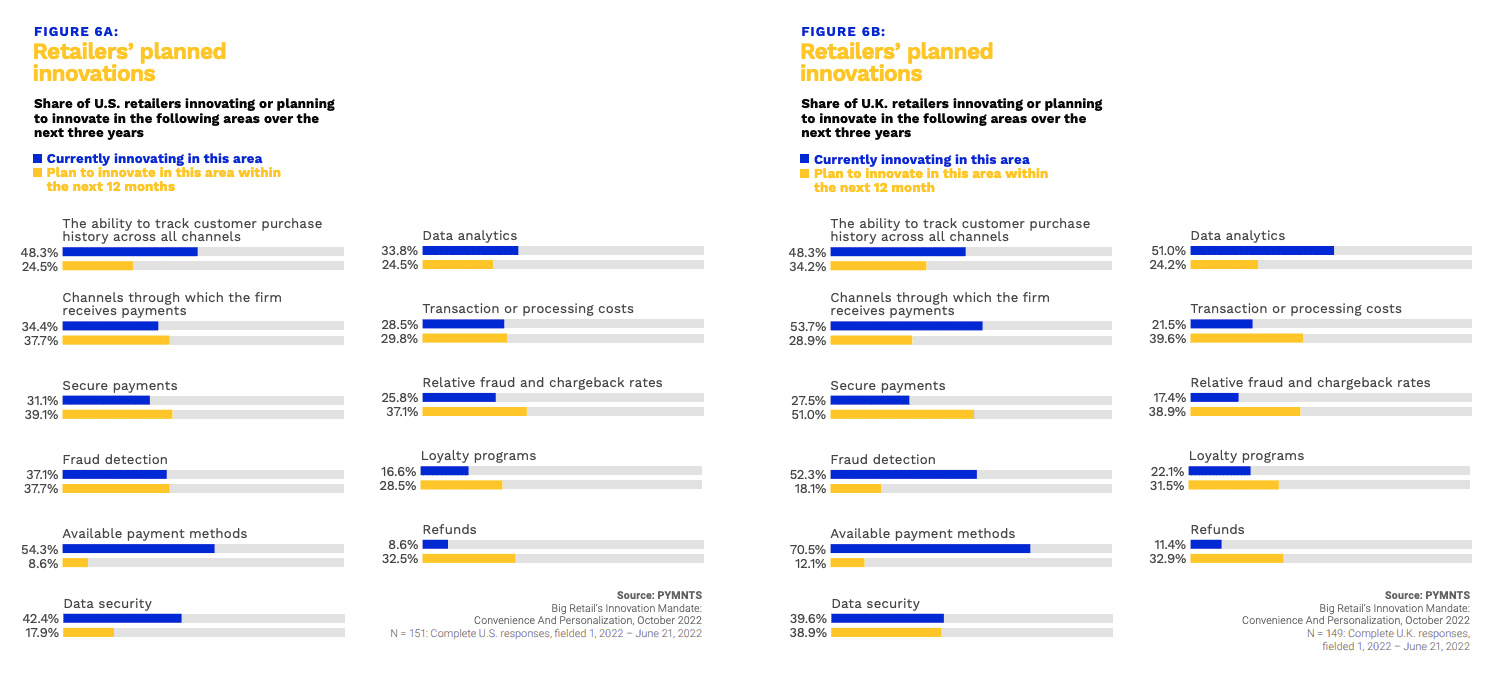
            “The majority of U.S. and U.K. retailers have introduced or plan to adopt innovations to track omnichannel customer purchasing data,” with 48% percent of U.S. and U.K. retailers having already adopted this strategy, the study found. “An additional 25% of U.S. retailers plan to do so in the next 12 months, along with 34% of retailers in the U.K.”

            For all PYMNTS retail and EMEA coverage, subscribe to the daily Retail and EMEA Newsletters.

            Walmart Joins Best Buy in Offering OTC Hearing Aids

            October 17, 2022 - 4 years ago

            Walmart will begin selling over-the-counter (OTC) hearing aids, taking advantage of a U.S. Food and Drug Administration ruling allowing the sale of the devices.

              Get the Full Story

              Complete the form to unlock this article and enjoy unlimited free access to all PYMNTS content — no additional logins required.

              yesSubscribe to our daily newsletter, PYMNTS Today.

              By completing this form, you agree to receive marketing communications from PYMNTS and to the sharing of your information with our sponsor, if applicable, in accordance with our Privacy Policy and Terms and Conditions.

              “A person’s ‘whole health’ is a combination of many factors, including hearing, that influence physical and mental well-being,” said Walmart Chief Medical Officer Dr. John Wigneswaran in a Monday (Oct. 17) news release. “Offering easy access to OTC hearing aids — something that seems quite small — is a solution that can improve our customer’s health outcomes and their ability to live better and healthier.”

              The FDA announced its ruling in August, saying it would allow the millions of Americans who could benefit from the use of hearings aid to purchase them straight from stores or online retailers with no need for a doctor’s exam, prescription, or fitting adjustment from an audiologist.

              Walmart said in the release it will sell an assortment of OTC hearing aids, ranging from $199 to $999 per pair, from brands that include Lexie powered by Bose and HearX. Hearing aids are available at Walmart.com and at the company’s Vision Centers in Colorado, Michigan, Missouri, Ohio, Pennsylvania, Tennessee and Texas, ahead of a nationwide rollout. Customers can also find them at 474 Sam’s Club Hearing Aid Centers.

              Walmart’s announcement follows an earlier decision by Best Buy to sell OTC hearing aids at 300 of its stores.

              Read more: Best Buy Jumps Into Hearing Aids After FDA Clears OTC Sales

              The FDA said nearly 30 million Americans could benefit from a hearing device.

              But as PYMNTS noted last year, government data shows far fewer people wear hearing aids than need them, with just 30% of seniors with hearing loss wearing them, and 16% of adults between 20 and 69.

              See more: Connected Tech Overcomes Hearing Aids Stigma

              The reason? Cost and aesthetics, Olive Union Chief Financial Officer Edward Hall told PYMNTS last year.

              For all PYMNTS retail coverage, subscribe to the daily Retail Newsletter.

              Karma Looks to Save Shoppers Time and Money With Embedded Payments Feature

              October 17, 2022 - 4 years ago

              eCommerce shopper

              If saving money is a top priority for shoppers right now, saving time would not be far behind. Add in visibility on product availability in the size, color, or style of your choosing, and the empowered eCommerce assisted shopping experience starts to take shape.

                Get the Full Story

                Complete the form to unlock this article and enjoy unlimited free access to all PYMNTS content — no additional logins required.

                yesSubscribe to our daily newsletter, PYMNTS Today.

                By completing this form, you agree to receive marketing communications from PYMNTS and to the sharing of your information with our sponsor, if applicable, in accordance with our Privacy Policy and Terms and Conditions.

                At least, that’s the thinking at Karma, which has just launched “Pay With Karma” at the outset of the busy holiday season, an artificial intelligence (AI)-driven behind-the-scenes shopping tool that searches hundreds of retail sites in the new payments network for the exact product customers are looking for, then alerts them when the price changes or an offer comes online, via a checkout link that handles payments, shipping and delivery coupons with a single click.

                “If you look at the checkout process today, it’s a big point of friction,” Karma Co-founder and CEO Jonathan Friedman told PYMNTS. “You need to put in your input, you need to sign up, you need to add your credit or debit card, which is why [merchants] still experience around 75% shopping cart abandonment,” he said, calling his company’s new solution simple and disruptive.

                In short, he said, Karma is adding a frictionless way to pay on top of the frictionless way to shop that the company has perfected over the past seven years enroute to its present base of over 4 million users, with another 150,000 signing on each month.

                One and Done

                As part of the Pay with Karma launch, the company has debuted a “mind blowing” YouTube ad campaign and also increased influencer outreach, all of which will be promoting the new feature. In addition to avoiding the hassle and risk of creating multiple profiles and sharing personal information in many places, shoppers can also take advantage of a range of payment options that suit their particular needs given the cost of underlying purchases.

                To that point, Friedman said the new system is powered globally by Stripe and other payment providers and also offers multiple payment options, including Apple Pay, Google Pay and interest-free installment plans.

                “The way it works is you connect your information once to Karma’s wallet, and then you can transact anywhere throughout the journey, even from a single product page, without even hitting the checkout,” he said. “This is a much faster way to transact at the point of sale,” he added, noting the additional benefit of coupons, loyalty rewards and credits being automatically applied.

                Big Intentions

                For its part, Karma’s low-price priority is powered in part by a commission-sharing scheme in which Friedman said the company is happy to share some of the money with customers that it is paid by retailers for facilitating a sale.

                On the flip side, while hundreds of retailers have signed up to be part of the payments network, that is a small sliver of the 100,000+ total roster of retailers available on the app and site. It’s a gap that Friedman is obviously looking to close, and he is confident that the rollout will see more brands adding the payments option to capture the combined benefits of value and convenience.

                “If you look at how people use Karma today, they’re mainly using it to plan their next purchase. So the ‘buy intent’ is extremely strong and we see 3 to 4x over benchmarks,” Friedman said, in reference to the increased conversion rates that the Karma’s time and money saving features bring to retailers, as well as an average order value of $170.

                Rather than comparative shopping by putting items in numerous shopping carts and then checking back to each if and when you are ready to buy, Karma’s angle is to be customers’ only shopping cart where they can easily see and compare everything they’ve saved in a single place and then buy with swipe when they chose to.

                Given the sluggish economy and the fact that seasonal sales are happening much earlier this year and merchants are sitting on a lot of inventory that they’re feeling pressure to move, Friedman said Karma is well positioned to support both customers and retailers during this challenging phase.

                “We see less impulse buys. We see less ‘junk buying’ and a shift toward quality and consumers being a bit more cautious,” he said. “I think Karna is highly relevant because we encourage less impulse buying,” he added. “We’re all about helping consumers get what they really want and having less buyer’s remorse.”

                For all PYMNTS retail coverage, subscribe to the daily Retail Newsletter.

                40% of Millennials ‘Very’ Interested in Super Apps

                October 17, 2022 - 4 years ago

                The super app — and, with it, one-stop mobile control over a broad range of everyday activities online and offline — is poised to receive an open-armed embrace from consumers.

                  Get the Full Story

                  Complete the form to unlock this article and enjoy unlimited free access to all PYMNTS content — no additional logins required.

                  yesSubscribe to our daily newsletter, PYMNTS Today.

                  By completing this form, you agree to receive marketing communications from PYMNTS and to the sharing of your information with our sponsor, if applicable, in accordance with our Privacy Policy and Terms and Conditions.

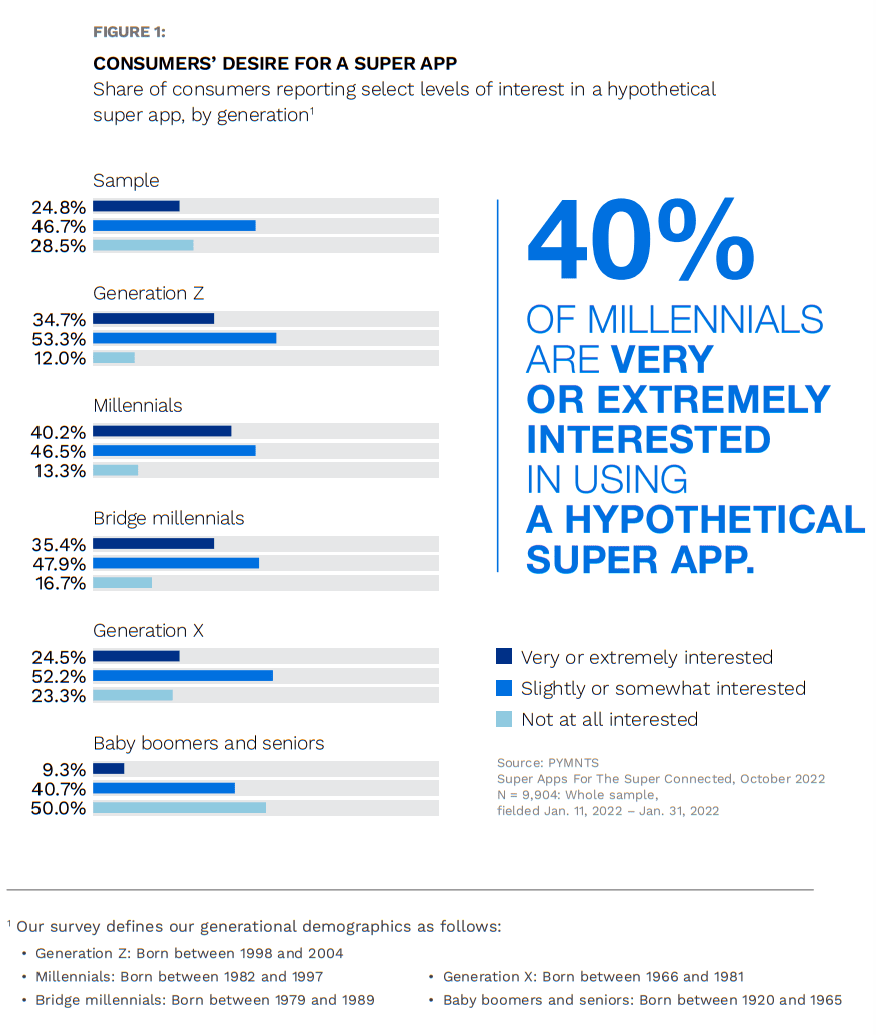
                  In the United States, the United Kingdom, Australia and Germany, the clamor is there across all demographics. But younger consumers may hold the key to super apps’ firm entrenchment in all areas of physical, online, peer-to-peer and B2C interactions.

                  PYMNTS’ latest research in collaboration with PayPal, is detailed in the report “Super Apps For The Super Connected,” which shows that a significant set of activities is already being done online.

                  Get the Report: Device Overload: Super Apps Promise Digital Consolidation

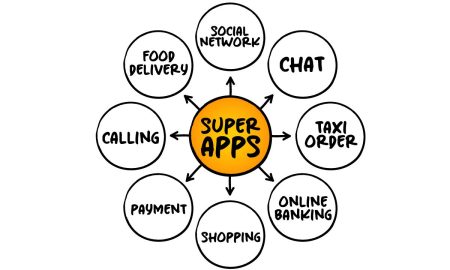
                  Of the more than 9,900 consumers surveyed, more than 70% buy groceries online every month, 48% track health data and 38% purchase local transportation through these channels. The technology is firmly in place to help them springboard to a super app: Respondents own a median of 6.5 “connected” devices.

                  As for the appeal of the super app across all cohorts: 40% of millennials are very or extremely interested in using them. And more than two-thirds of the overall sample have expressed similar levels of interest.

                  More on Retail