Banks have an opportunity to help more scam victims recover their money by making reporting what happened clearer.
The September PYMNTS Intelligence report “Fraud’s Loyalty Tax: How Scams Cost Banks Their Customers,” based on a survey of 9,524 consumers in the United States, examined how scams reach victims, what they lose and how they respond. Its detailed scam findings drew on 1,913 respondents describing their costliest personal scam.
Most victims reported the incident to their bank, but a growing share reported it nowhere. The findings suggested that banks could help more customers seek assistance through clearer instructions and support that recognizes the emotional strain of being scammed.
Key findings from the report:
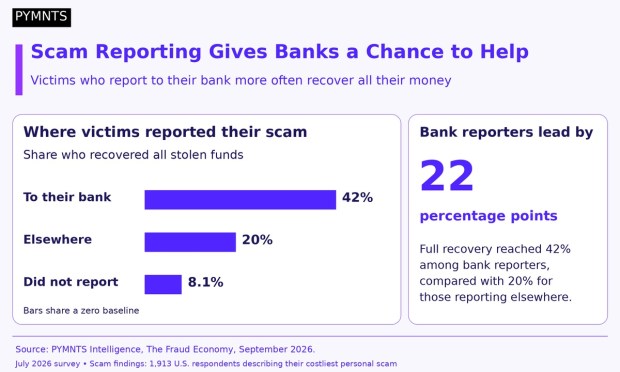
- Reporting to a bank is associated with stronger recovery results. Among victims who reported the scam to their financial institution, 42% recovered all their stolen funds. That compared with 20% who reported through channels outside the bank, a 22-percentage-point difference. Only 8.1% of non-reporters recovered everything. Reporting doesn’t guarantee reimbursement, and the comparison doesn’t establish that reporting alone explains the difference. Still, among victims who recovered any money, 79% received it through their financial institution. Banks serve as a recovery help desk for many customers after a scam.
- Consumers often lack basic reporting guidance. The share of victims who reported the incident to their bank was 58%, roughly unchanged from 57% in September 2025. Meanwhile, 11% didn’t report it at all, a 26% increase. Among non-reporters, 28% didn’t know reporting was an option. Another 18% cited a lack of clear instructions, up 26% from the earlier survey. The findings point to a practical opportunity. Explain where customers should report a scam and what they should expect after filing.
- Emotional strain can keep victims from seeking help. Among non-reporters, 23% said reporting felt too emotionally draining. Romance scam victims were particularly unlikely to come forward, as 40% told no one, compared with 11% across all victims. A process that’s easy to follow, with respectful communication, could make reporting feel more manageable. The survey identified the obstacle, although it didn’t test which responses would work best.
Other findings showed why banks have reason to improve that experience. Some 17% of scam victims had already switched financial providers because of being scammed, rising to 25% among those who lost more than $5,000. Yet victims were more likely to increase their use of online and mobile banking than reduce it.
Customers haven’t abandoned digital banking. Helping them report a loss and understand what happens next gives financial institutions an opportunity to support these relationships.
At PYMNTS Intelligence, we work with businesses to uncover insights that fuel intelligent, data-driven discussions on changing customer expectations, a more connected economy and the strategic shifts necessary to achieve outcomes. With rigorous research methodologies and unwavering commitment to objective quality, we offer trusted data to grow your business. As our partner, you’ll have access to our diverse team of PhDs, researchers, data analysts, number crunchers, subject matter veterans and editorial experts.