Small businesses are finding room to take on more work without adding staff, and their artificial intelligence-related staffing decisions more often involve a hire they didn’t make than a worker they let go.
The PYMNTS Intelligence report “New Data Shows Small Businesses Use AI to Grow Without Hiring,” published in October, was based on a survey of 533 small- to medium-sized businesses (SMBs) in the United States. It examined how AI affected daily work, finances and staffing decisions.
The report found that 74% of SMBs use AI at least occasionally. Among businesses that have used it, 60% said they produce more work without adding staff, and 72% said they finish tasks faster. For an owner trying to serve more customers with the same team, AI can act like an extra pair of hands. The findings suggest businesses have opportunities to expand their capacity without immediately taking on the recurring expense of another employee.
Key findings from the report:
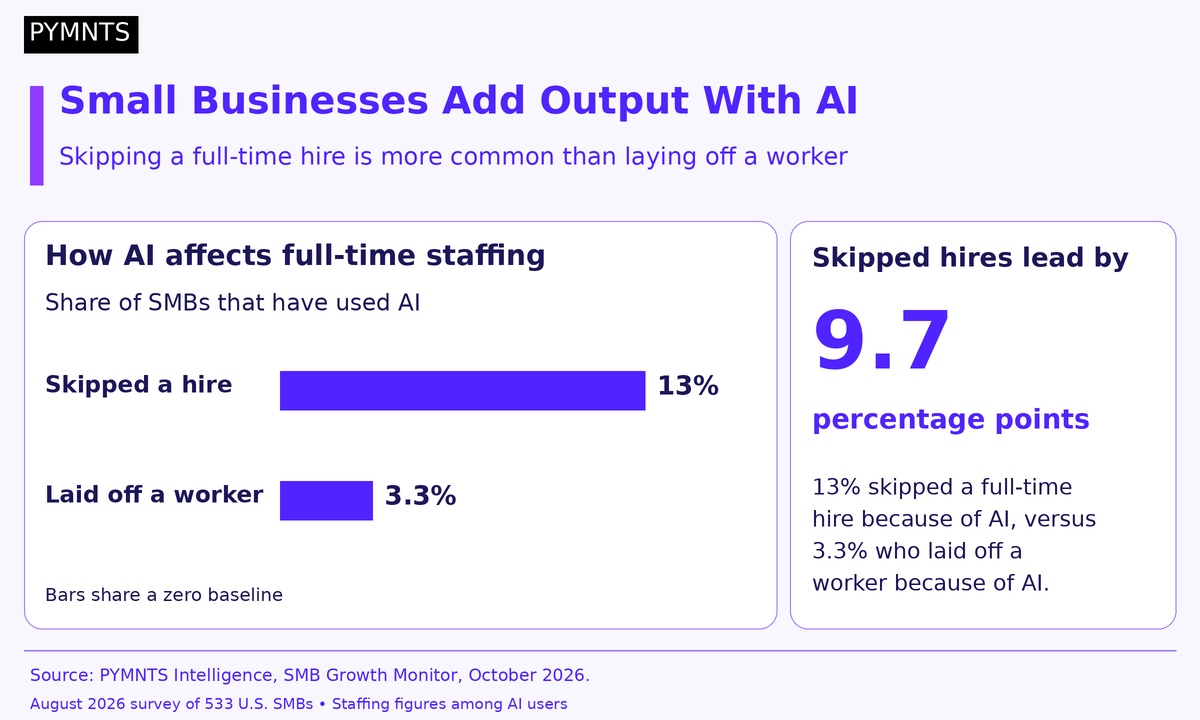
- Skipped hires are more common than layoffs. Among AI users, 13% skipped a full-time hire they otherwise would have made, compared with 3.3% who laid off someone because of AI. That’s a 9.7-percentage-point difference. Overall, 26% took at least one of four staffing actions, including skipping a hire, cutting hours or a role, ending or not renewing an arrangement, or laying someone off. Roughly three-quarters reported none of those changes.
- Growing businesses are also reconsidering their next hire. Among AI users whose revenue increased, 16% skipped a full-time hire, compared with 10% of those whose revenue stayed flat. Layoffs remained uncommon in both groups, at 4% and 2.2%, respectively. The pattern suggests AI-related staffing decisions extend beyond businesses facing weak sales. Owners with growing revenue are also finding ways to handle work without filling every position they previously expected to add.
- The gains include work businesses couldn’t previously handle. Some 45% of AI users said the technology let them take on assignments beyond their previous capabilities. Customer service was the most common application, followed by marketing, bookkeeping and sales. These everyday uses help explain how AI can increase output across a small company. Using the technology for these functions, however, doesn’t necessarily mean a business replaced a paid worker.
The report also revealed opportunities for businesses selling human expertise. Some 23% gained customers who specifically wanted a person doing the work, while 14% picked up assignments fixing AI-generated output. These findings suggest owners can use AI to improve internal efficiency while continuing to sell services customers want people to deliver.
AI can create new work even as it changes how businesses decide who does it.
For all PYMNTS AI coverage, subscribe to the daily AI newsletter.
At PYMNTS Intelligence, we work with businesses to uncover insights that fuel intelligent, data-driven discussions on changing customer expectations, a more connected economy and the strategic shifts necessary to achieve outcomes. With rigorous research methodologies and unwavering commitment to objective quality, we offer trusted data to grow your business. As our partner, you’ll have access to our diverse team of PhDs, researchers, data analysts, number crunchers, subject matter veterans and editorial experts.