Card issuers once had more time to introduce products, process transactions and tell customers what had happened to their money. FinTechs helped shorten that timetable.
Consumers accustomed to real-time digital services don’t necessarily understand why a card account can’t show an available balance, a pending balance and a statement balance at the same time. They want to know what they can spend and what is happening in the account when they look at it.
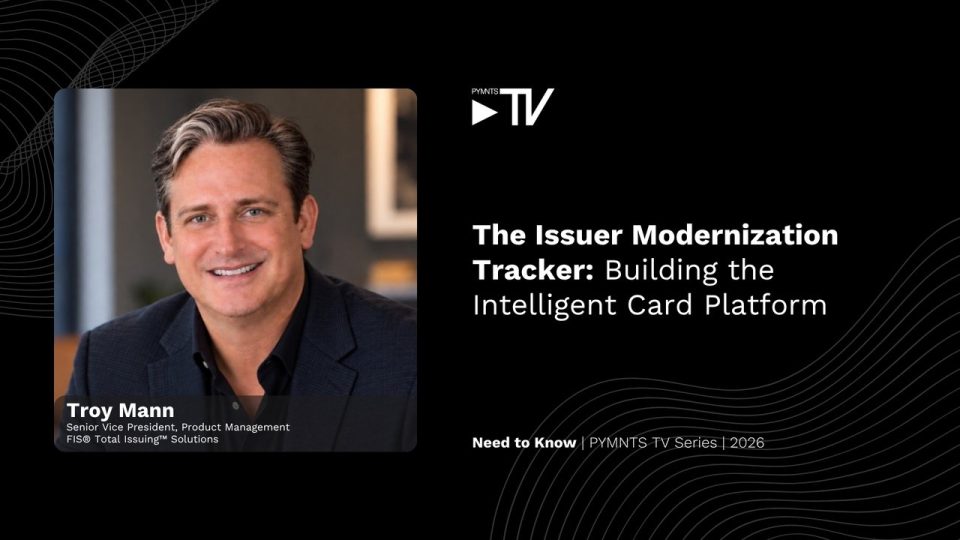
“They need control, they need transparency,” Troy Mann, senior vice president, product management at FIS® Total Issuing™ Solutions, told PYMNTS. “When they can’t find it in their legacy banks, they go find it with FinTechs.”
For banks and credit unions, competing on that basis reaches beyond the mobile interface. The issuing platform determines how quickly an institution can introduce a product, what information it can put in front of a customer and how readily it can change an account or offer.
Mann said he has seen the product-launch process from inside that machinery. His first job in the business at TSYS (now part of FIS) involved getting new products into the market, and launches on older systems could take months and, in some cases, more than a year. Card branding, BINs, product terms and configuration all added steps.
FIS had been developing a self-service approach intended to remove some of those handoffs. Before that work reached the market, artificial intelligence changed what the process could look like, Mann said.
An issuer could describe the product it wants to introduce, the market it wants to pursue, comparable terms and the rewards it wants to offer. AI can use that information with existing workflows to propose how the product could be configured before people make the final decisions.
“It’s not a replacement, but it is an accelerant, and I think that’s how we all have to use AI,” Mann said.
The Issuing Platform Has to Know the Customer
Launching a card faster has limited value if the institution’s systems can’t carry what it knows about the customer from one interaction to another, across the branch, call center, website and mobile app. Policies coded and executed separately across these channels tend to produce different answers depending on where the customer shows up, Mann said.
Connecting these environments gives the issuer a way to use the same customer information across them. The resulting decisions cover much of the card relationship. An issuer might identify a customer who is traveling and rarely exceeds a credit limit, for example, and determine whether additional credit is appropriate. Other information could inform payment options, rewards or fraud controls.
Trust depends partly on getting those decisions right, Mann said. A smooth transaction isn’t always the desired result if the circumstances call for another check.
“Friction isn’t always bad,” Mann said. “Using the data to understand when to implement friction to protect the customer, using data and AI [to understand] when to accelerate and ensure things are frictionless, that’s what’s going to keep you top of wallet and ultimately build trust.”
Much of the modernization work comes down to whether the information needed to make such decisions exists in usable form.
Older systems were built when storing data carried a higher cost. Transaction information could be discarded, overwritten or combined with other information, Mann said. An institution that later discovered a use for a particular piece of data could find that it was no longer available.
AI raises the cost of these gaps because its usefulness depends on the information available to it.
“They need access to their data,” Mann said. “They need it in a way that it can be easily accessible.”
Mann said he sees issuers applying AI first to two areas. Internally, it can examine portfolio configurations and performance to help institutions adjust products. On the customer side, it can help select offers, recommendations and actions based on information available at the time of the interaction.
These capabilities give issuers more ways to compete, but Mann said the underlying requirements remain scale and resiliency. He said he expects institutions that modernize successfully to have more freedom over which products they offer, which markets they enter and whether their systems operate in the cloud or on premises.
Watch the full interview with Troy Mann to learn more about:
- Why FinTech competition is changing what consumers expect from card issuers.
- How issuers can shorten product launches and connect decisions across customer channels.
- Where real-time data and AI can influence fraud, credit, portfolio management and customer offers.