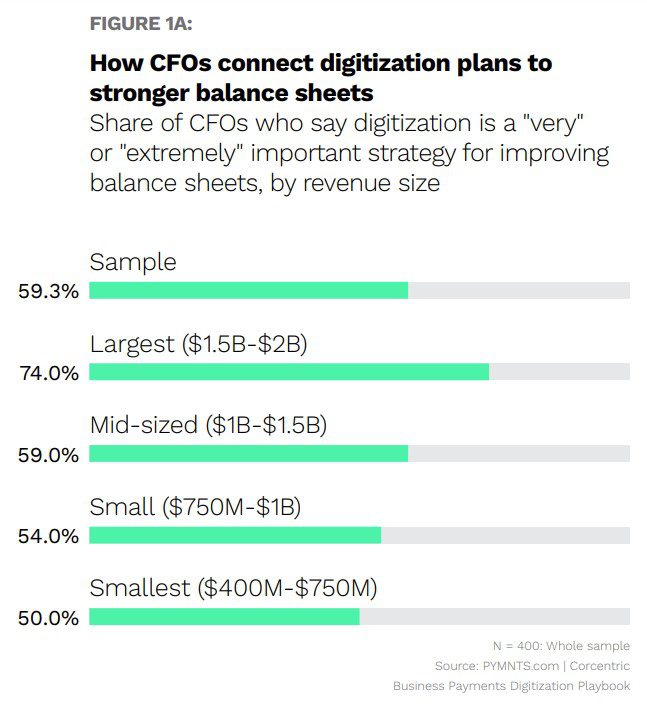
Six in 10 chief financial officers (CFOs) believe that payments digitization is “very” or “extremely” important to building healthier balance sheets, according to “Business Payments Digitization,” a PYMNTS and Corcentric collaboration based on a survey of 400 CFOs from middle-market firms that generate $400 million to $2 billion in annual revenues.
Get the report: Business Payments Digitization
The larger their firm, the more likely the CFO is to connect digitization plans to stronger balance sheets. That was the case with 74% of the largest firms included in the study ($1.5 billion to $2 billion), 59% of mid-sized firms ($1 billion to $1.5 billion), 54% of small firms ($750 million to $1 billion) and 50% of the smallest firms ($400 million to $750 million).
Many CFOs say that the pandemic played a key role in their initiative to accelerate digitization efforts.
We’d love to be your preferred source for news.
Please add us to your preferred sources list so our news, data and interviews show up in your feed. Thanks!
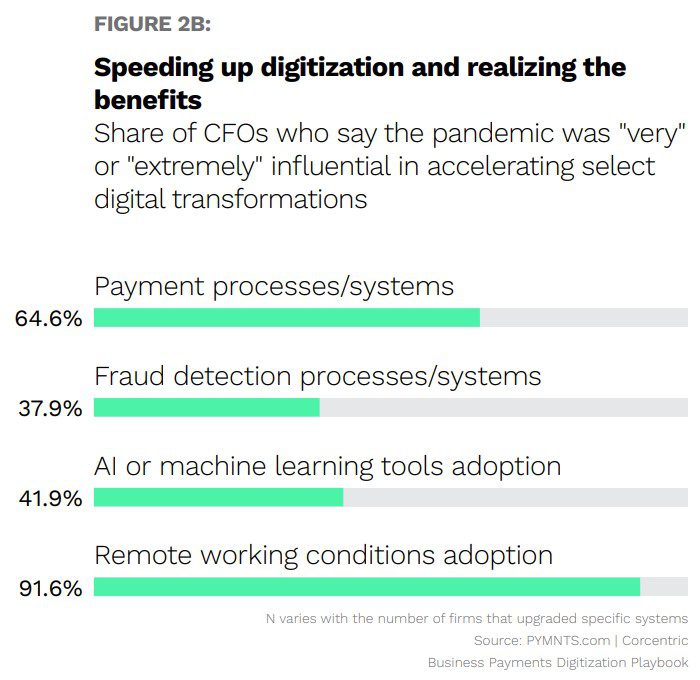
In fact, 65% say the pandemic was “very” or “extremely” influential in speeding up their digital transformation of payment processes and systems.
In addition, 92% said the same of remote working conditions adoption, 42% said it of artificial intelligence or machine learning tools adoption and 38% said it of fraud detection processes and systems.
The CFOs have accelerated several digitization initiatives since March 2020.
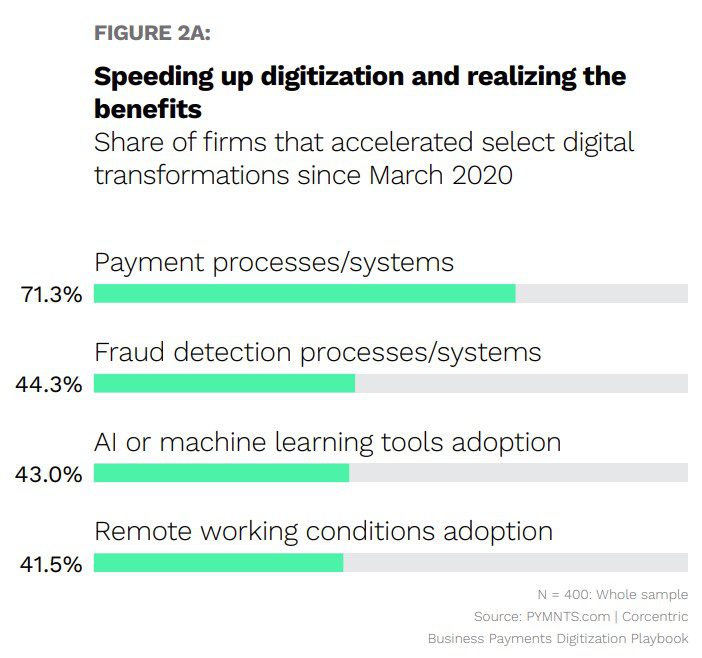
Payment processes and systems were at the top of the agenda for most, with 71% of the CFOs saying they have sped up digitization of that digital transformation.
In addition, 44% said the same of fraud detection processes and systems, 43% said that of artificial intelligence or machine learning tools adoption and 42% said it of remote working conditions adoption.
The pandemic’s strong influence on these decisions to make improvements to their technology and operations suggests that many companies perceived the crisis as an opportunity to achieve some longstanding company goals.



 Add as Preferred Source