Two decades into the 21st century, Big Tech’s largest firms suddenly decided to spend hundreds of billions of dollars and countless hours of technical resources on building avatars without legs wandering through sterile virtual office spaces. At the same time, investors poured their own billions into platforms promising to replace Zoom fatigue with virtual reality fatigue.
Most of that hype has since deflated. However, while nobody wants to attend a quarterly business review as a cartoon head, the technologies underpinning those visions, such as simulation, real-time 3D modeling and synthetic environments, have since migrated to the factory floor, where they make sense.
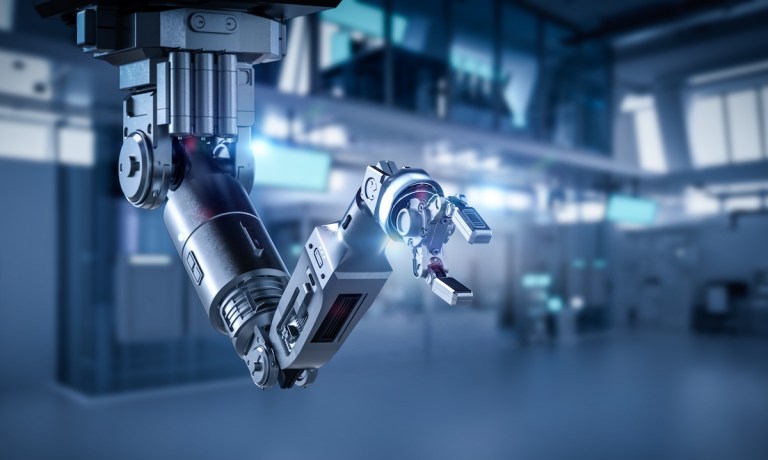
Amazon Devices & Services, in collaboration with Nvidia, for example, announced this month that it is rolling out “zero-touch manufacturing” powered by Nvidia AI and digital twin simulations. The concept sounds deceptively simple and entails robots that can learn to assemble and inspect new products without ever touching a single prototype. Robotic arms can now rely on photorealistic replicas of a factory floor where every movement is modeled, tested and optimized in software.
By combining synthetic data, AI-driven planning and physics-based simulations, the companies said they can cut prototyping costs, slash lead times, and push more devices into production faster using robotic arms.
In a manufacturing sector long defined by expensive physical prototyping, fixed-function assembly lines and rigid supply chains, the ability to iterate virtually could be transformative, particularly as supply chain snarls continue unabated and uncertainty reigns.
Advertisement: Scroll to Continue
Read also: Making Sense of Spatial Computing and Digital Twins for Industry
Digital Twins Eye Move From Buzzword to Industrial Backbone
The term digital twin has been around since at least the early 2000s, when NASA engineers talked about building virtual counterparts of a spacecraft. At its core, a digital twin is more than just a 3D model. It’s a live, data-driven simulation that mirrors the physical system in real time. Sensors feed information back and forth between the real and the virtual, enabling constant optimization.
Consider the traditional path of building a new device. For decades, manufacturing has been characterized by fixed-function assembly lines, rigid supply chains and costly trial-and-error prototyping. Engineers draft designs in CAD, then commission physical prototypes. These are tested in labs, where failures like mechanical stress, heat dissipation and component misalignment can ultimately require another iteration. Each loop costs weeks and tens of thousands of dollars. Multiply this across dozens of products, and the expenses balloon.
In consumer electronics, where margins are razor-thin and product cycles ever shorter, this inefficiency has been an accepted cost of doing business.
With digital twins, much of this cycle moves into simulation. A robotic arm can be trained to assemble a fragile part virtually, learning thousands of variations overnight in Nvidia’s servers. Synthetic data generated in Omniverse teaches the AI how to respond to edge cases like a slightly warped component, a misaligned feeder or a sudden change in torque. When the real robot is finally tasked with assembly, it arrives with “experience” accumulated in a risk-free virtual environment.
The result is fewer prototypes, less scrap and faster scaling from pilot runs to mass production.
See also: How the B2B Metaverse Opportunity Enables Tomorrow’s Industrial Economy
The Bigger Picture Reveals a Sector in Transition
Manufacturing has long been dominated by high upfront capital expenditure, amortized over years of stable production. But as consumer demand becomes less predictable and supply chains more volatile, that model falters. Virtual iteration offers a way out. Factories can be reconfigured in simulation before any wrenches are turned. Robotics systems can adapt on the fly. Product roadmaps can shrink from years to quarters.
Amazon is not alone in its experimentation, and neither is the manufacturing sector. Increasingly, digital twins are finding their way into novel areas like drug discovery and medical trials.
“What we think of is using digital twins to help you get to quick decisions that are still confident,” Jon Walsh, founder and chief scientific officer at Unlearn, told PYMNTS in June. “Yes, this drug doesn’t work; we should stop. Or yes, it does work, and we should accelerate planning for phase III.”
What’s different now is accessibility. Cloud infrastructure and off-the-shelf AI models have lowered the barrier to entry. A mid-tier firm can rent compute power and deploy twin-based simulations without building a supercomputer.
Digital twins may never trend on TikTok, but they could transform the $16 trillion global manufacturing sector. Where the metaverse was about escapism, digital twins are about precision. Where avatars flopped, virtual robots may yet prove indispensable.
For all PYMNTS digital transformation and B2B coverage, subscribe to the daily Digital Transformation and B2B Newsletters.