Cryptocurrency has a Generation Z problem.
That’s an unmistakable conclusion of looking at PYMNTS’ 2022 U.S. Crypto Consumer report, released Monday (April 18).
Read more: Cryptocurrency Use in Online and in-Store Purchases
It isn’t as if they dislike crypto the same way baby boomers do. It’s that very few of them are actually buying it or using it for payments — particularly compared to millennials, who have jumped on the crypto bandwagon with great enthusiasm.
Most notably, fewer than 11% of Gen Z respondents to a survey of 2,334 U.S. consumers even have a crypto wallet or exchange account, compared to 28% of millennials, 29% of bridge millennials, and 18% of Gen Xers. Only baby boomers, at 6%, are less likely to own crypto.
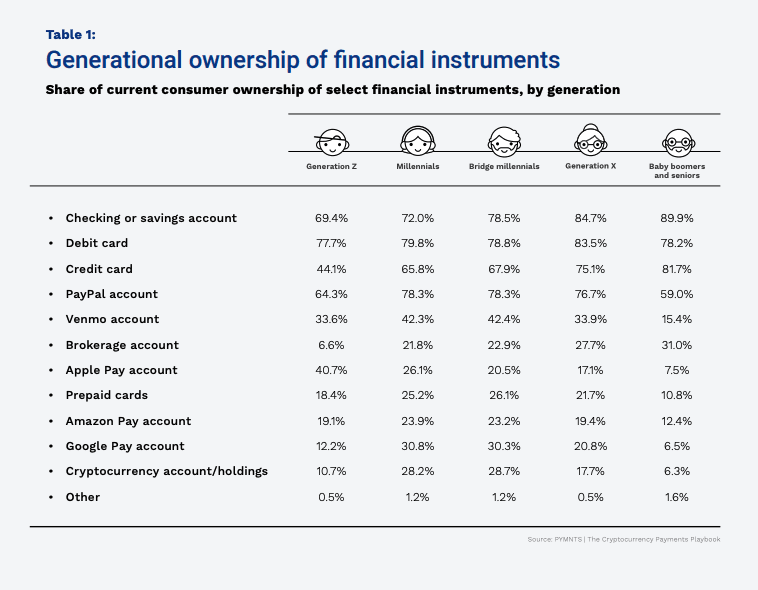
While nearly two-thirds have PayPal accounts — which can support bitcoin, Ether, Litecoin and Bitcoin Cash, all payments-focused cryptocurrencies — that isn’t enough to say that they are dipping their toes in the crypto waters on that channel.
Advertisement: Scroll to Continue
One answer is simply that Gen Z doesn’t have as much to spend as millennials. And yet that’s generally less of a problem in crypto, both because expensive tokens like bitcoin and Ether can be purchased in very small amounts — exchanges from Charles Schwab to crypto-friendly Robinhood are offering so-called fractional shares to address that — and because there are plenty of inexpensive cryptocurrencies that can be bought cheap in hopes that they’ll “moon.”
For example, Solana, one of the top “Ethereum killers” competing for smart-contract platforms including non-fungible tokens (NFTs) and decentralized finance (DeFi) was up more than 11,000% in 2021. The much-maligned memecoin Dogecoin grew more than 3,500% that year, while bitcoin ended the year up only 60%.
Crypto Payment Attitudes
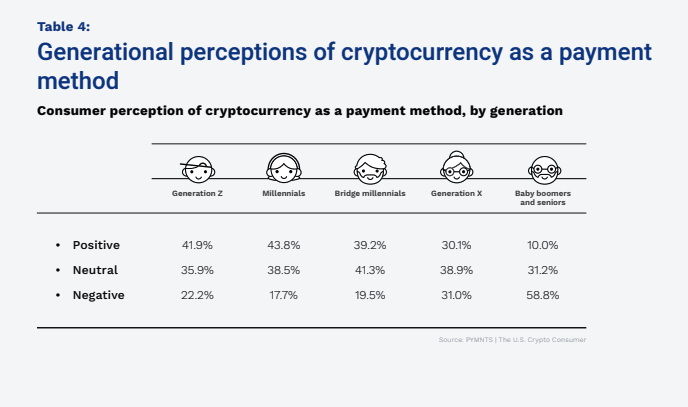
There’s some backing for this answer in Gen Zers’ perception of crypto as a payment method, with 42% seeing it as a good solution, second only to millennials (44%) but above bridge millennials (39%).
However, there are also more Gen Z consumers who have a negative view of crypto payments than either millennial segment.
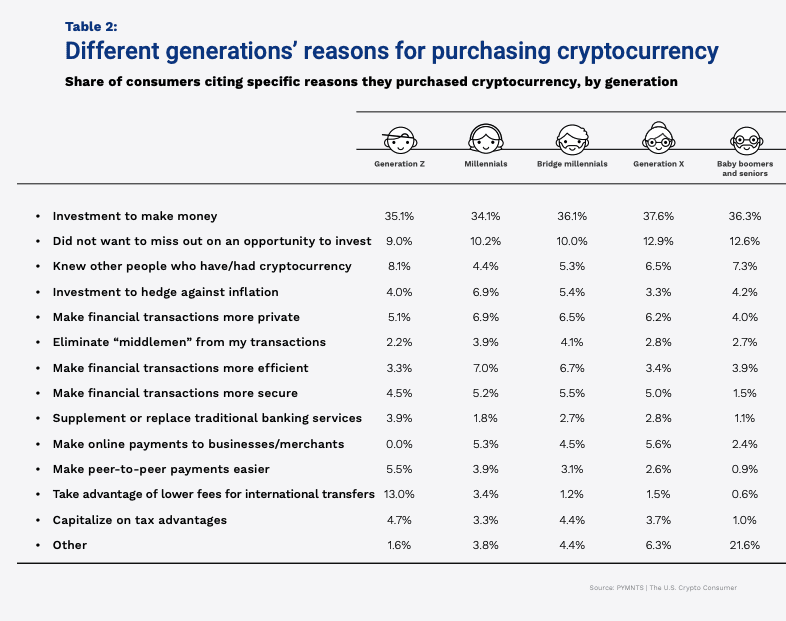
But when asked for reasons they bought cryptocurrencies in the first place, not one Gen Z consumer told PYMNTS that they did so to make online payments to businesses or merchants. Why that wasn’t a big factor in any demographic — Gen X led the way with about 6%, slightly more than millennials — it’s worth noting that even some baby boomer crypto owners were thinking about crypto as a payments tool (more than 2%).
Remittances Gain Traction
There is one segment of payments in which Gen Z led the way: reducing international transaction fees. Thirteen percent cited that as a reason they buy cryptocurrency — more than any other answer except investing.
While there are several reasons for cross-border payments, the one focused on most heavily by crypto payments firms is remittances, as migrant workers pay incredibly high fees for their small transactions — 7% to 10%, and even more for some particularly less developed countries. It’s a big enough issue that the UN has made “cutting the cost of family remittances” an official goal.
See more: Crypto Finds Growing Acceptance in Cross-Border Remittances
That 13% was nearly four times any other generation’s reason for buying crypto. Of course, that makes a lot of sense, as migrant workers tend to be young.