Both incomes and consumer spending increased in June, according to estimates released Thursday (July 31) by the Bureau of Economic Analysis (BEA).
Personal incomes increased 0.3% at a monthly rate in June, partially offsetting the 0.4% decrease seen in May, the BEA said in a Thursday press release. Disposable personal income, or income less personal current taxes, also grew 0.3%, after slipping 0.5% in May.
Within the income categories, compensation of employees grew less than the aggregate, by 0.2%, the slimmest increase of 2025, after consecutive 0.4% increases in April and May. Wages grew by 0.1% in June. After netting out the effect of inflated prices, BEA reports “real” disposable incomes were flat in June, after taking a 0.7% hit in May.
Personal consumption expenditures (PCE) grew by 0.3% in June, on par with the growth in disposable income. Nondurable goods grew 0.7%, while purchases of durable goods were flat after adjusting for seasonal variations. Services expenses grew 0.3% in June.
When the effect of higher prices is discounted, personal consumption expenditures rose 2.1% over the last 12 months. This is higher than the equivalent increase in real disposable income (1.7%). Both trends are decelerating as the year progresses.
Growth in real disposable personal incomes peaked in April at 2.7%, while in the same period real expenditures grew 2.9% year-on-year. In each of the first six months of the year, expenditures grew more than incomes on a year-on-year basis.
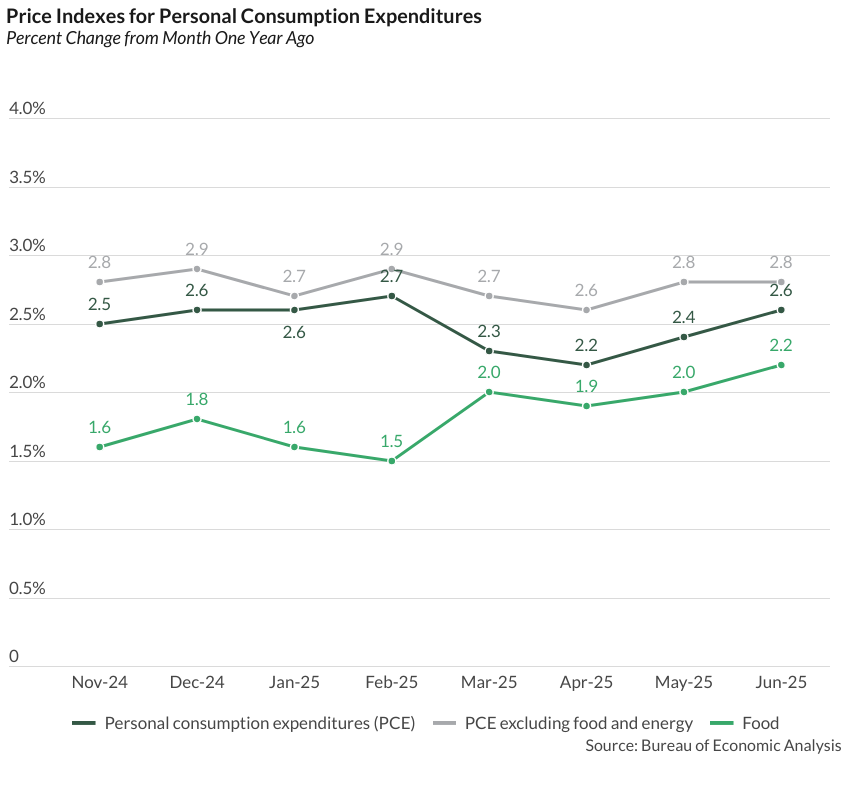
The PCE price index, which is the Fed’s chosen inflation metric, increased 0.3% in June and 2.6% on a 12-month perspective. This is an acceleration from the 2.4% seen in May and the 2.2% seen in April. Durable goods saw a 0.9% yearlong increase, above the 0.5% and -0.3% variations registered in the previous two months. Excluding food and energy, the PCE price index increased 0.3% in June and 2.8% from one year ago.
In June the personal saving rate (personal saving as a percentage of disposable personal income) was 4.5%.
The BEA reported Wednesday (July 30) that a pickup in consumer spending, together with a drop in imports, led real gross domestic product (GDP) to return to growth in the second quarter.
Real GDP grew at an annualized rate of 3% during the quarter after dropping by 0.5% in the first quarter, according to the BEA.
The University of Michigan’s Surveys of Consumers said its preliminary results found that consumer sentiment inched up in July to reach its highest level in five months, though it remained below its December reading and its historical average.