The buyer-supplier network has always had a gap between its promise and its payoff. The buyer picks the platform. The supplier may pay to participate. In return, the supplier gets the buyer’s invoice format, the buyer’s approval process, the buyer’s terms and the buyer’s payment schedule, with very little visibility into when payments will arrive. The network was designed to be a two-sided marketplace. In practice, being connected isn’t the same as making it easier to pay — or get paid.
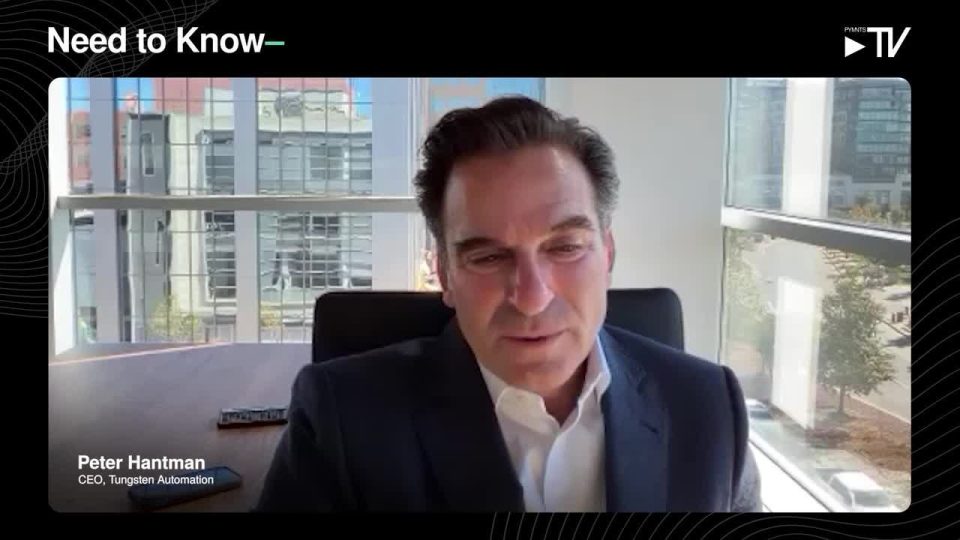
Peter Hantman, CEO of Tungsten Automation, acknowledged that weakness directly. He told PYMNTS CEO Karen Webster that connecting buyers and suppliers isn’t enough if the payment process still leaves both sides looking for answers. His fix starts with making that connection pay off for both.
That’s the premise behind Pay+, which extends Tungsten’s invoice-to-pay platform into payment execution. The buyer still retains control of the process. The supplier gets two things that make the connection count: information about where its money is, and a choice about when it arrives.
Buyers Can’t Give Suppliers Answers Without the Right Signals
Ask a supplier what it wants from a buyer’s payment process and the answer is unglamorous. Hantman said the immediate concern is usually whether the supplier will get the agreed amount, on time, through the agreed method. The next thing is knowing. When was the invoice approved? When will the funds reach the bank account? A supplier that has those two dates can manage its cash. One that doesn’t is guessing, and guessing can be expensive. Buyers need those signals, too, not just to manage payments, but to give suppliers answers.
Most networks don’t give suppliers those dates because the systems upstream don’t hold on to them. An invoice can be captured, matched, approved and queued for payment, and shed useful information at every handoff. If the payment system only receives an approval signal, Hantman said, it misses the reasoning and the human interventions behind that decision. Buyers are left with less context to manage the payment and suppliers with fewer answers about what happens next.
Tungsten’s starting point is that it already holds that history. The company was built on reading invoices and documents, and Hantman said its technology has moved beyond extracting data to identifying information, assessing fraud risk and supplying context to business systems and the people who use them. Historically, that work ended with a “clear to pay” signal handed back to the customer. Tungsten didn’t execute the payment. Pay+ closes that gap and carries the invoice history through to the moment the money moves. That gives buyers the context to keep suppliers informed and suppliers the visibility to plan.
Payment Terms Should Create Options, Not Trade-Offs
The second thing the network has to offer the supplier is a decision. Buyers want longer terms. Suppliers want cash sooner. Supply chain finance, dynamic discounting and third-party financing have bridged those positions for years, Hantman said, but transaction costs have kept adoption low.
The window between approval and payment execution is where those options live. Hantman said that window can be evaluated for financing or discounting opportunities, including the familiar one where a supplier accepts a little less to be paid now. He also raised the reverse: a supplier that would rather wait longer and receive more. Funded by the buyer or by a third-party investor, the supplier picks.
That’s the difference between a network that serves the buyer and one that serves both sides. Longer payment terms don’t have to put buyers’ working capital goals at odds with suppliers’ cash-flow needs. In the one Hantman describes, the same approved invoice becomes a menu. Take the discount and the cash today. Hold for the full amount on the due date. Wait past it and earn something for the patience. The buyer’s working capital goals don’t go away, while suppliers gain more flexibility over when and on what terms they get paid.
The Information Has to Be Good Enough to Act On
None of this works if the data behind those choices can’t be trusted. That’s where artificial intelligence (AI) comes in, and where Hantman draws the line on how far it should go.
“The ability for an agent to earn the right to make judgment calls based on evidence requires that the agent be able to access judgment calls made along the way to see the cumulative risk associated with a particular transaction,” he said.
Fraud raises the stakes. Hantman pointed to manipulated documents produced with generative AI. A sudden change in a supplier’s payment preference might be routine or might be an attack. Viewed alongside invoice history and past payment behavior, the right response is usually clear. Viewed as an isolated signal at the moment of payment, it often isn’t. A network that keeps a supplier from being impersonated is working for the supplier as well as buyer.
Regulation sets another boundary. Multinationals deal with shifting rules for compliant invoicing, tax authorities that now sit inside the B2B payment flow, ERP migrations and regional systems. Hantman said a single global conversion is impractical for most large companies, which is why he expects early Pay+ customers to start with domestic payments in the United States or parts of Europe, even as multinational customers push for more.
The CFO’s Math Still Has to Work
For the chief financial officer, a more connected payment process still has to earn its keep: lower operating costs, better use of resources and control over financial decisions. Hantman said CFOs should look at each finance function and ask whether AI can substitute for a person or assist one. Accounts payable (AP) processing is a candidate for the former, because cutting the cost of handling an invoice doesn’t create demand for more invoices.
Webster took that a step further. “Payroll can be a form of working capital, too,” she said. Headcount freed from payables can be redeployed somewhere the company is growing, which makes the AP efficiency case and the supplier case the same case.
The longer-term limit, Hantman said, is decision quality: “which tasks can be fully automated and which cannot, and how authority to automate is earned over time based on a track record of decision quality and evidence.”
The first Pay+ deployments will show how much of the invoice-to-payment chain buyers are willing to connect. They’ll also show whether suppliers, once they’re given information and a choice, start treating the network as something they use instead of something they’re subject to.
Watch the full interview with Peter Hantman to learn more about:
- How buyers and suppliers can get more than a connection from their payment network.
- How connecting invoice approval with payment execution gives buyers greater visibility and suppliers more choice about when they get paid.
- How Tungsten Automation is extending its invoice-to-pay platform into payment execution through Pay+.