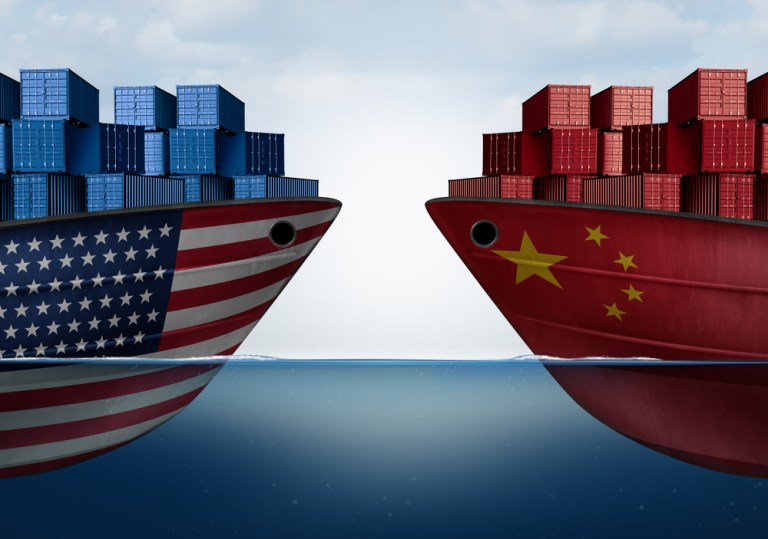
The phrase “trade war” is on the tip of everyone’s tongue as U.S. President Donald Trump redraws trade lines and revises trade agreements with the rest of the world. At stake are billions of dollars of goods traded across borders, as the fate of corporate exporters and importers hangs in the balance.
At the center of the latest commentary is the trade relationship between the U.S. and China. According to reports last week, China’s Commerce Ministry is urging Washington to nix considerations for hiked trade tariffs or risk setting up a global chain reaction of disruption. China vowed to “fight to the end” to avoid those taxes, according to the South China Morning Post.
This week’s B2B Data Digest traces the stats behind the ongoing trade war discussion, its implications for B2B traders and trade, and surprising effects on investors.
$2.19 trillion worth of goods were traded to and from the U.S. in 2016, with exports hitting $1.54 trillion and exports reaching $3.6 trillion, according to data from Statista. Trade agreement overhauls and threats of a trade war could significantly impact these figures in 2018 and beyond, however.
$375 billion: That’s the value of China’s trade surplus with the U.S., and a key statistic amid Chinese trade officials looking to trim that figure. Reports from Yahoo Finance last week said Chinese President Xi Jinping is spearheading reforms to bring greater balance to its exports and imports with the U.S. amid the trade dispute, by boosting the strength of the yuan and encouraging foreign capital inflows.
$60 billion worth of Chinese goods may face a tariff increase from the U.S. as disputes continue between the two nations over China’s relationship with foreign technology. China argues that the tariff increases are in violation of World Trade Organization rules, reports in South China Morning Post said.
Advertisement: Scroll to Continue
$3 billion worth of American goods could see higher taxes from China in response to previous tariff hikes from the U.S., the publication said. Those goods include pork and steel pipes as China explores its options to retaliate against proposed U.S. tax increases, though reports say China is open to negotiations to find an agreement more favorable for both sides.
70 percent: Chinese fund managers’ suggested equity allocations have hit an 18-month low, according to Reuters reports, as fund managers react to the implications of the U.S.-China trade disagreement. Fund managers maintained suggested bond allocations at 8.8 percent, while cash allocations were boosted to 21.3 percent. One fund manager told Reuters that investors say trade tensions are contributing to worries over the entire year ahead.
$7.6 billion worth of emerging market stocks and bonds were purchased by foreign investors in March, according to data from the Institute of International Finance (IIF). This is a near-total reversal of the $8 billion worth of funds pumped out of emerging market assets in February, reports noted. The IIF said the investment value is impressive, considering it occurred “during one of the most volatile months in global financial markets since China’s mini-devaluation,” and noted that growth in emerging markets is increasing at its fastest pace since 2011 – an encouraging sign of resilience despite the threat of a trade war. China, despite the size of its economy, is still considered an emerging market.