Cryptocurrency has always been about finance and programmability, a concept that traditional players are now beginning to grasp.
And as the financial world inches closer to embracing digital assets, longtime crypto market mainstays like bitcoin (BTC) and Ethereum (ETH) are now finding themselves as the nominal digital assets positioned at the confluence of innovation, scale and legitimacy across regulated capital markets.
But while exchange-traded funds (ETFs) can offer a foot in the door to market participants and investors, certain stakeholders are betting instead that the best way to gain exposure is through an actively managed, publicly listed company designed not just to hold these assets, but to grow them.
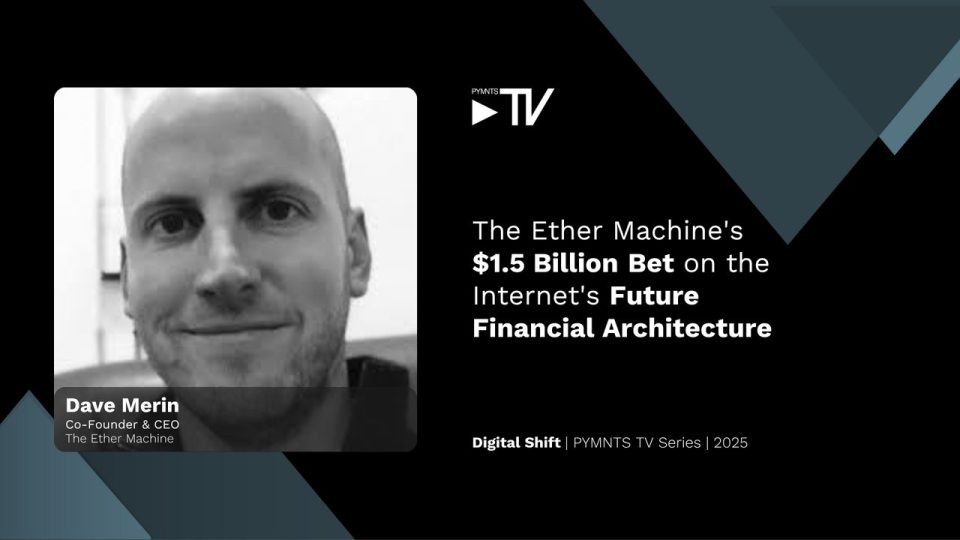
“Ethereum isn’t a static asset. It’s programmable infrastructure. Passive ETFs can’t unlock its full potential,” Dave Merin, co-founder and CEO of The Ether Machine, told PYMNTS.
In the past week alone, his firm has spent nearly $100 million acquiring more ETH, with plans to deploy a war chest potentially north of $1.5 billion.
“Everything we’re doing is built to be institutional grade from day one,” Merin said. “No legacy liabilities, no operating distractions — just exposure to the most important digital asset since bitcoin, but done in a way that’s dynamic, thoughtful, and structurally superior.”
Longtime industry observers may have seen this story before — just in a different asset class. When MicroStrategy’s Michael Saylor turned a publicly traded software company into a bitcoin holding vehicle in 2020, he helped ignite an institutional wave of BTC accumulation. Saylor issued debt, sold equity, and used the proceeds to buy bitcoin, leveraging the capital markets to amplify crypto exposure.
The Ether Machine team believes that Ethereum has the potential to be leveraged more actively than bitcoin when managed in a publicly traded treasury structure, resulting in a wide array of financial opportunities through the generation of ETH-denominated yield.
Ethereum Ecosystem Stewardship Through Capital Markets
The rise of crypto ETFs in the wake of the SEC’s long-anticipated approval of spot bitcoin ETFs has created an assumption that similar products are inevitable for Ethereum. Merin, however, views the ETF model as ill-suited for ETH, particularly due to the asset’s unique technical and economic mechanics.
We’d love to be your preferred source for news.
Please add us to your preferred sources list so our news, data and interviews show up in your feed. Thanks!
“Most ETFs can’t stake more than 50% of their ETH,” he said. “And in a crisis, that number might need to be even lower. That risk isn’t insurable — it’s structural.”
Ethereum’s proof-of-stake model allows ETH holders to earn yield by staking their tokens to secure the network. But staking comes with constraints. Unstaking ETH is subject to unpredictable delays — sometimes stretching for weeks or months — making liquidity management a challenge. That’s a major problem for ETFs, for example, which need to ensure daily redemptions and rebalancing capabilities.
In contrast, The Ether Machine is designed for active yield optimization. It stakes ETH, restakes it through protocols like EigenLayer, and participates in decentralized finance (DeFi) to amplify returns. These strategies, while potentially riskier, offer yields well above what passive ETFs can deliver.
“We think we can generate 2x the yield of an ETF, conservatively,” Merin said. “And when you layer on things like restaking or engaging in DeFi, we think we can deliver a vastly superior product. Our team knows these protocols intimately. We’re not guessing, we’re building the infrastructure that others will later follow.”
The Ethereum Infrastructure Play as Financial Architecture
The grander vision here isn’t just about buying and staking ETH. It’s about building the base layer of a new internet. Unlike bitcoin, which serves as digital gold, Ethereum is infrastructure. It’s programmable money, a settlement layer, and a platform for applications. That makes ETH more than a token — it’s the “pristine collateral” of a new financial and computing architecture.
“We’re underwriting Ethereum’s core infrastructure and using that to drive long-term value,” Merin said. “Even though stablecoins are great for usability, there will always be a special place for ETH in the ecosystem because of its purity — its lack of external dependencies.”
“Ethereum is the largest proof-of-stake network by a wide margin,” he said. “That scale means more yield opportunities, a broader security moat, and a stronger economic flywheel.”
Through its listing (currently trading under ticker DYNX and slated to become EM upon completion of its de-SPAC process), the company offers retail and institutional investors alike exposure to actively managed ETH strategies — without needing to self-custody tokens or navigate DeFi themselves.
“We’re working with convertible arbitrage funds to create a positive-sum trade,” Merin said. “They monetize volatility, we get capital, and shareholders get more ETH exposure. Everyone wins.”


 Add as Preferred Source