Speed has become essential in treasury — but many finance teams are still operating with tools built for delay.
Treasury functions, long defined by batch processing and delayed reporting, are being recast around immediacy, forcing finance teams to rethink how they manage cash, risk and decision-making.
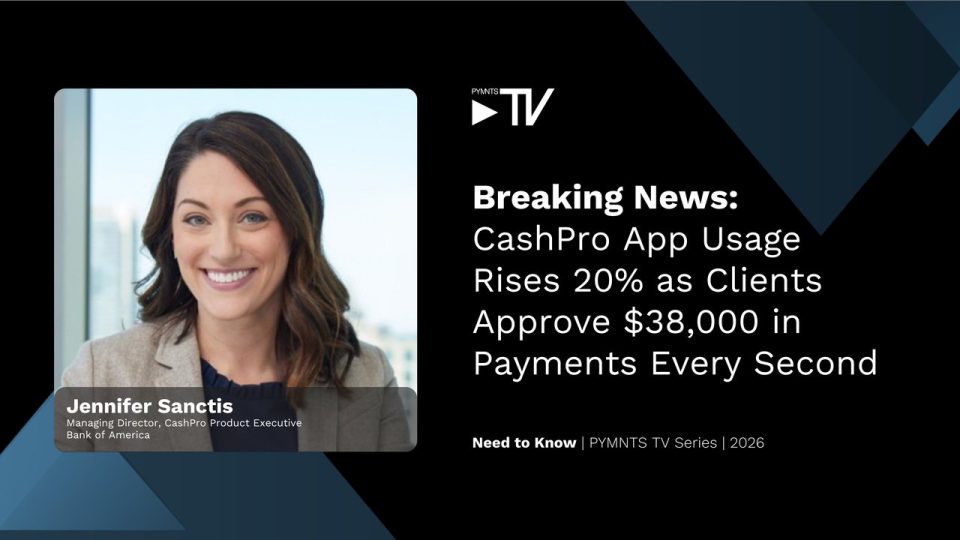
In an interview with PYMNTS, Jennifer Sanctis, managing director of CashPro at Bank of America, described the tension confronting treasury teams.
“They’re under pressure to move faster, but often their internal tools haven’t kept pace,” she said, pointing to fragmented systems and delayed insight into cash positions. “Speed without visibility creates risk and visibility without speed creates bottlenecks.”
Those competing demands are not easily reconciled, and they expose a structural problem within treasury functions that were not designed for continuous decision-making.
The latest CashPro data, announced Wednesday (April 8), provides a clear indication of how behavior is already changing. Bank of America said in a release that usage of its CashPro app has risen 20% year over year, while clients are approving an average of $38,000 in payments every second, a level of activity that would have been difficult to manage outside traditional desktop environments only a few years ago.
The growth in sign-ins reflects the jump in approvals, and also signals ongoing engagement with cash positions, authentication and operational monitoring.
Taken together, those figures suggest that treasury teams are no longer treating mobile as a secondary channel. Instead, it is becoming a primary interface for decision-making, particularly in environments where timing matters.
From Fragmentation to a Unified Layer
The response to that shift, as Sanctis framed it, centers on integration rather than incremental feature additions.
“Through a unified platform experience, CashPro connects companies to one of the largest banking networks,” she stated, describing an environment where reporting, forecasting and transaction data coalesce into single workflow.
This approach addresses a longstanding challenge within treasury operations, where systems for payments, reporting and forecasting have often operated in isolation. The result has been partial visibility and delayed reconciliation, requiring manual intervention to connect data across platforms.
Sanctis pointed to real-time reporting into enterprise resource planning (ERP) and treasury management systems, combined with search capabilities that allow users to locate transaction details on demand. These capabilities are reinforced by forecasting tools that integrate transaction data to provide forward-looking visibility into cash flows.
Mobile Moves to the Center
Mobile functionality has become central to that continuity, particularly as approvals and oversight extend beyond traditional workstations.
“Mobile first doesn’t mean lighter controls; it means smarter ones,” she told PYMNTS, adding that very action is securely authenticated, logged and auditable.
In practice, that means governance is embedded within the workflow itself rather than applied after the fact, with authentication, audit trails and user tracking operating alongside transaction execution.
She added that mobile and desktop environments provide the same level of visibility and control, allowing organizations to “gain speed without giving up governance.”
We’d love to be your preferred source for news.
Please add us to your preferred sources list so our news, data and interviews show up in your feed. Thanks!
Beyond approvals, mobile is increasingly used for identity verification, alerts, communications and administrative tasks such as user management. Sanctis described the application as functioning as a control point for treasury activity.
Security and Risk in a Real-Time Environment
As treasury operations accelerate, the requirements for security and risk management evolve alongside them. High-frequency, high-value approvals demand systems that can maintain reliability and transparency without slowing down execution.
Sanctis emphasized that security is not an overlay but a core component of the platform. Audit logs, authentication protocols and visibility into user actions are designed to operate continuously, ensuring that control is maintained even as transaction speeds increase. The expansion of biometric authentication and identity verification tools reflects that priority, providing additional layers of assurance without introducing friction.
AI as a Support Layer
Artificial intelligence (AI) is playing an increasing role in supporting treasury functions, particularly in areas that require pattern recognition and data analysis at scale. Sanctis described its strengths in practical terms.
“AI is exceptional at pattern recognition, surfacing anomalies, predicting cash needs, prioritizing what needs attention,” she noted.
At the same time, she drew a clear distinction between insight and accountability. “Humans remain essential for judgment, exceptions and strategic decisions. AI accelerates the insight, people own the accountability,” Sanctis said.
Use Cases and the Road Ahead
Current use cases extend well beyond approvals, encompassing authentication, communications, real-time alerts and administrative controls. The direction of travel suggests further expansion, particularly as treasury teams seek to consolidate more functions.
Sanctis pointed to upcoming enhancements in payment approval workflows and additional identity verification capabilities, both of which are expected to roll out later this year.
These developments are shaped in part by client feedback gathered through CashPro Boards, which bring together users from different regions and industries to inform product design and strategy. Those forums allow the platform to remain “globally consistent, but locally relevant,” she said.
Sanctis framed the changes tied to the app in terms of integration and execution.
“It’s the power of the entire platform as it comes together that really differentiates and helps our clients eliminate friction points,” she told PYMNTS.

 Add as Preferred Source