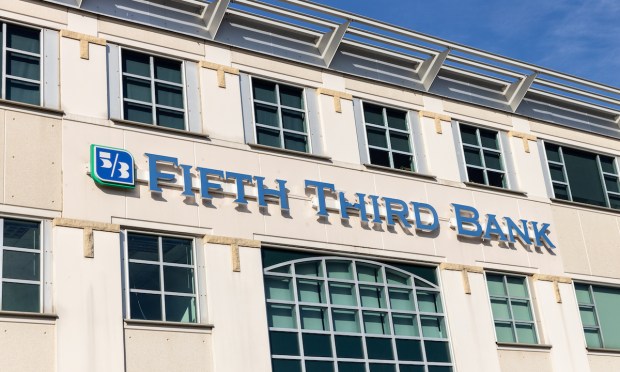
The banking industry will respond to the rise of artificial intelligence-driven cash optimization tools by using relationships with customers and offering the same services these tools offer, with the added benefit of bank-grade information security, Fifth Third Bancorp Chairman, CEO and President Tim Spence said Monday (Oct. 19).
Spence was asked about these tools and their potential impact on deposits during the bank’s third quarter earnings call. He said there is already a lot of sorting that goes on in the banking industry and history has shown that the companies that are most affected by new technology platforms that reduce friction or increase transparency are the ones whose only value proposition is price.
“Which I think in our world, in the case of deposits, would mean the online-only banks who have to lead with rate or who don’t have any distribution and therefore have to buy liquidity through aggregators, or the wealth platforms that are pricing sweep deposits at inferior yields to market rates where there are equivalents, not the folks who have either distribution or product advantages or relationship advantages, as I certainly believe that we do, because those are the things that justify incremental margins,” Spence said. “It’s the sweep deposits of the world, the online-only deposits, are going to go from being low-margin products to even lower margin products.”
Spence pointed to Fifth Third’s proprietary distribution, direct marketing capabilities, unique value embedded in products, and relationship pricing in both the consumer and commercial segments.
About $2.5 billion in deposits on the Fifth Third platform are sorted every month as they move somewhere else after coming in as a paycheck or cash from equities markets, coming off promotional pricing or coming out of a CD product. The bank retains about 80% of those deposits, with about 90% of that going back into a deposit and 10% going to a liquidity portal or an investment account, Spence said.
We’d love to be your preferred source for news.
Please add us to your preferred sources list so our news, data and interviews show up in your feed. Thanks!
“The advantage banks like us who have these branch networks and a checking-led proposition on the consumer side of the equation, and then a heavily operational commercial deposit base led by all the stuff we do in commercial payments, is that the money is operational. It needs to be here,” Spence said.
Spence also quoted a line saying that when a new platform comes along, the battle for a market comes down to whether the incumbents get the innovation faster than the insurgents get distribution.
“We’re going to take every valuable service that you can get done on Muse, whether that’s looking at subscriptions and finding opportunities to generate savings or budget or otherwise, and we’re going to build them into our apps,” Spence said. “And the benefit you’ll get then is investment-grade or bank-grade information security as a perimeter and no blending between the information that exists in your financial graph with the information that exists in your social graph, which today is monetized by basically selling you to third parties for ad purposes and otherwise.”
Meanwhile, Newline, a division of Fifth Third Bank that offers technology to help enterprise clients embed financial capabilities into their products, announced Monday at Money20/20 that it is collaborating with Visa to enable FinTechs to offer Visa corporate cards in more than 40 countries.
Powered by Visa’s Multinational Program (MNP), this offering enables the issuance of cards for local use in the cardholder’s country, with transactions authorized in local currency and processed like those on a locally issued card.
Sushil Raja, general manager of Newline by Fifth Third, said in a Monday press release: “This is what enterprise FinTech can look like when you combine the history of innovation and scale of an institution like Fifth Third with the global reach of a network like Visa.”
Chris Baker, head of commercial and money movement solutions, North America at Visa, said in the release: “Our Multinational Program was built to make paying across borders feel local. Working with Newline, we’ve made it possible for their clients to offer corporate cards in more than 40 countries, putting that experience within the reach of more businesses than ever.”
For all PYMNTS AI coverage, subscribe to the daily AI newsletter.


 Add as Preferred Source