There’s a workforce problem brewing in corporate treasury departments, and it has little to do with finding the next generation of finance executives.
It’s about the people who have spent 20 or 30 years making sure invoices get processed, receivables get reconciled, accounts get opened and payments move through the business without a hitch. They know which systems don’t talk to each other, which exceptions require a workaround, and which processes depend on someone remembering what to do next.
And they’re getting ready to retire.
For companies that have relied on these employees for decades, the question is becoming urgent. Who’s going to do the work when they’re gone?
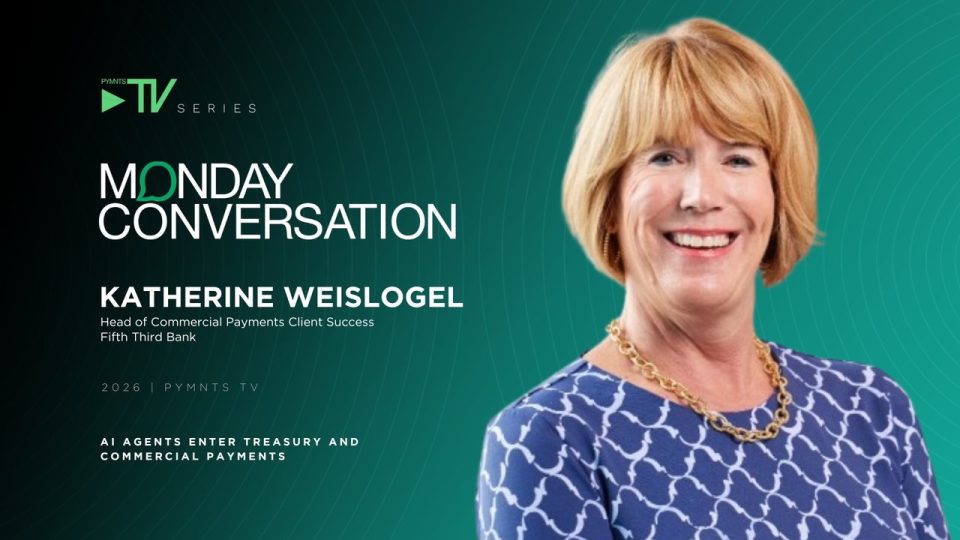
Katherine Weislogel, head of Commercial Payments Client Success at Fifth Third, told PYMNTS CEO Karen Webster that this is becoming one of the more practical reasons businesses are looking seriously at artificial intelligence (AI).
One client described a back office where employees had spent an average of 30 years in their positions. They were approaching retirement, and the company wasn’t confident it could find people willing to take their places.
The question wasn’t whether AI could make the treasury department more innovative. It was whether AI could help keep the department running.
That distinction matters. Much of the conversation about agentic AI in financial services focuses on what machines might eventually be trusted to do with money. But for businesses facing the loss of experienced employees, the immediate opportunity may be about getting the work done.
When Institutional Knowledge Walks Out the Door
Commercial payments are full of processes that look straightforward until someone tries to automate them.
An invoice arrives. Information has to be checked, matched, approved and passed through several systems before money moves. Weislogel described a payment traveling through roughly five separate steps, each potentially involving different people, technologies and decision points.
For years, experienced employees have served as the connective tissue holding those processes together.
AI agents offer the possibility of connecting those steps without requiring a person to initiate every handoff. Instead of automating one task at a time, an agent could coordinate activity across the systems involved in completing a payment.
But that requires more than installing another AI assistant.
As Weislogel explained, an agent capable of moving a process forward has to communicate with all five parts of the workflow. Otherwise, companies simply end up with faster individual tasks and the same old bottlenecks between them.
That’s also where the retirement problem becomes especially relevant. The opportunity isn’t simply to reduce the number of people performing manual tasks. It’s to redesign processes that have depended on experienced employees knowing how to navigate disconnected systems.
AI won’t automatically preserve everything those employees know. Companies still have to identify the rules, exceptions and decision points that make those processes work. But the prospect of losing that knowledge is giving them a reason to do it now.
The First Payoff May Have Nothing to Do With Moving Money
One of the more revealing examples Weislogel discussed involved commercial account onboarding.
A customer submits documents through a bank portal, only to discover that the information doesn’t necessarily follow the account through the rest of the process.
Different departments may request the same information, send separate updates or wait for another team to complete its work.
From the customer’s perspective, the bank has everything it needs. From the bank’s perspective, the process may still involve several disconnected systems and employees.
Weislogel described a different experience in which the information submitted at the beginning stays with the account as it moves toward implementation.
“The next time I should hear from the bank is when my account number is live, right and my services are live,” she said.
The difference could be measured in days versus hours.
It’s a useful illustration of where agentic AI can deliver value without taking control of a company’s money. Agents can collect information, coordinate workflows, move documents and advance processes while leaving the actual financial decisions to authorized employees.
Companies Want AI to Do the Work, Not Control the Cash
That doesn’t mean treasury departments are ready to hand AI the keys to their bank accounts.
Weislogel said companies are approaching agentic authority incrementally, evaluating permissions based on the risks involved.
An agent might be allowed to analyze cash positions, prepare forecasts or recommend an action. Giving it permission to initiate or execute a payment is a different decision, one that raises questions about fraud, liquidity, entitlements and reconciliation.
Webster compared the process to a dimmer switch rather than a traditional on-off switch. Companies can gradually increase what agents are permitted to do as their confidence grows.
Even looking 18 to 24 months ahead, Weislogel doesn’t expect businesses to simply turn over money movement to AI agents.
We’d love to be your preferred source for news.
Please add us to your preferred sources list so our news, data and interviews show up in your feed. Thanks!
Human oversight, verification and spot checks will remain part of the process. The quality of the underlying data matters, too. An agent acting on incomplete information or poorly defined parameters can create problems much faster than a manual process.
But the workforce challenge gives businesses an incentive to figure out where that line should be drawn.
They may not be ready to let AI move the money. They may have considerably less hesitation about letting it do the administrative work that gets a payment ready to move.
The Economics Are Becoming Harder to Ignore
The same argument extends beyond treasury operations.
Weislogel pointed to sales employees who can spend half their working day on administrative tasks rather than developing customer relationships.
Webster observed that recovering even a portion of that time and redirecting it toward prospecting and relationship development would produce a meaningful return.
For banks, that creates two opportunities. They can use AI to improve their own operating models while helping commercial customers address similar inefficiencies.
The pressure is coming from several directions. Some customers expect the speed and convenience they experience in consumer technology. FinTech competitors are moving quickly on digital experiences. And businesses are looking for ways to manage costs without compromising service.
Not every commercial customer wants the same experience. Some still prefer substantial human interaction, and banks have to accommodate those preferences alongside demands for faster, more automated services.
But the underlying economics are changing.
The value of automation becomes much easier to calculate when the alternative is replacing experienced employees in positions that are becoming difficult to fill.
A Different Starting Point for Agentic Treasury
The conventional discussion about agentic treasury begins with autonomy. How much authority should a company give an AI agent? When will agents be able to move money? Who is accountable when something goes wrong?
Those questions remain important, and Weislogel made clear that companies are not rushing to answer them by surrendering financial control.
But the more immediate issue may be operational continuity.
Businesses have spent decades building treasury and commercial payment processes around employees who know how to make disconnected systems work together. As those employees retire, companies have an opportunity, and increasingly a reason, to replace those manual connections with technology.
That won’t happen simply by adding AI to existing software. It requires understanding the underlying workflows, connecting the systems and deciding which decisions can safely be delegated.
The companies that do that successfully may discover that the first meaningful return on agentic AI isn’t an autonomous treasury department.
It’s a treasury department that can keep running when the people who built its processes are no longer there.


 Add as Preferred Source