A replacement card could give issuers a practical way to turn artificial intelligence (AI) investment into faster service and fewer customer calls.
That opportunity anchors the third key finding in “Why Modern Issuing Platforms Will Determine Which AI Strategies Succeed,” a PYMNTS Intelligence report in the AI-Ready Issuing Tracker® Series, produced with Thales.
We’d love to be your preferred source for news.
Please add us to your preferred sources list so our news, data and interviews show up in your feed. Thanks!
The report finds that AI’s usefulness depends on systems that share current information, coordinate tasks and enforce clear operating rules. For card issuers, connecting those systems can help AI carry out work across a card’s life, from opening an account to replacing a lost card. Institutions don’t need to start with an unfamiliar service: everyday requests already offer opportunities to improve execution.
- Card replacement gives AI a concrete job. A lost or damaged card can trigger address checks, physical card production, digital card updates and changes to the substitute credentials that protect payment details. When separate teams handle each step, customers can face delays. A connected issuing platform can coordinate those actions after validating the request, with some steps occurring together. Think of it as a relay team that no longer has to stop at every handoff. AI can help move the request through the process while the platform applies the bank’s rules.
- Better updates could reduce avoidable calls. Approximately 25% of inbound contact-center calls concern card status, according to observations from Thales’ customer discussions cited in the report. That figure identifies a practical service opportunity, although it isn’t a measure of calls that automation would eliminate. Connecting card production, delivery and customer communications allows issuers to provide timely updates and send notifications before customers seek help. Cardholders gain visibility into their requests, while service teams could spend more time resolving problems that require personal attention.
- Clear controls make broader automation possible. AI needs access to reliable customer details, transaction information and bank policies before it can act consistently. Modern issuing platforms connect that information with the systems responsible for completing tasks. The same approach can support transaction disputes and new card products, both of which require several teams and systems to work together. Building human oversight into those processes gives issuers a way to expand automation while maintaining security and customer trust.
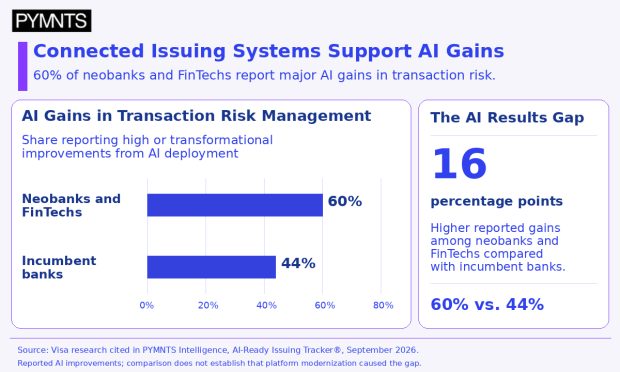
Other findings show how much room banks have to advance. EY research cited in the report finds that 52% of banks have piloted agentic AI, which can take actions across tasks, while 16% have fully deployed production use cases. Visa research finds that 60% of neobanks and FinTechs report high or transformational AI improvements in transaction risk management, versus 44% of incumbent banks.
The report recommends identifying disconnected processes and modernizing them alongside governance, giving issuers a practical starting point for wider deployment.
At PYMNTS Intelligence, we work with businesses to uncover insights that fuel intelligent, data-driven discussions on changing customer expectations, a more connected economy and the strategic shifts necessary to achieve outcomes. With rigorous research methodologies and unwavering commitment to objective quality, we offer trusted data to grow your business. As our partner, you’ll have access to our diverse team of PhDs, researchers, data analysts, number crunchers, subject matter veterans and editorial experts.


 Add as Preferred Source