At the most efficient growing companies, 80% say their primary reason for using working capital is planned growth. Among the least efficient, just 2% say the same.
That 78-percentage-point gap is a central finding in “The 24-Day Advantage: What Top-Performing CFOs Know About Working Capital,” a PYMNTS Intelligence report examining how finance leaders manage cash. Drawing on three years of research involving 3,627 chief financial officers and treasurers across 23 countries, the study finds that companies with stronger financial planning, closer supplier relationships and faster payment cycles are better positioned to fund expansion. The research covers businesses generating between $100 million and $1 billion in annual revenue.
We’d love to be your preferred source for news.
Please add us to your preferred sources list so our news, data and interviews show up in your feed. Thanks!
Three findings illustrate the differences between top and bottom performers:
- 80% prioritize growth. Among top-performing companies, 80% use working capital primarily for planned growth, compared with just 2% of bottom performers. Meanwhile, 67% of the least efficient companies use working capital primarily for unexpected emergencies. Only 3% of top performers report doing so. The findings suggest that stronger financial planning allows companies to pursue opportunities instead of responding to cash shortages.
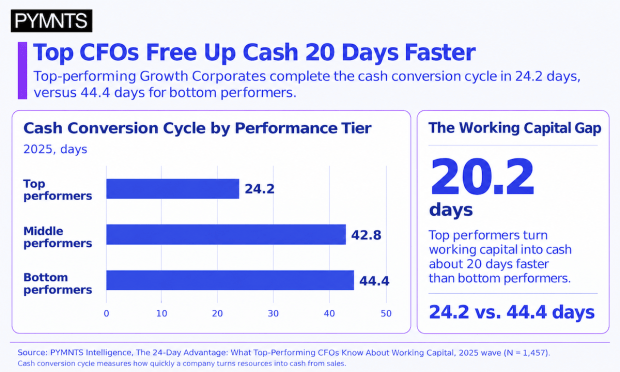
- Cash moves 20 days faster. Top performers convert their investments in inventory and other resources into cash from sales in 24.2 days, compared with 44.4 days for bottom performers. That 20.2-day advantage gives stronger companies greater flexibility to invest, pay suppliers and manage expenses.
- Supplier relationships strengthen performance. One-quarter of top performers retained all their suppliers during the year, compared with just 8% of bottom performers. Companies managing fewer than 50 suppliers reported a 23-day cash cycle, while those with more than 100 suppliers needed 49 days. The results highlight the potential benefits of simpler operations and closer coordination with suppliers.
The broader outlook is encouraging. The global Working Capital Index increased from 49.1 in 2023 to 54.6 in 2025, indicating improving efficiency.
Technology is also gaining ground, with 7 in 10 companies using artificial intelligence to improve working capital operations—although the report doesn’t establish that AI has shortened cash cycles. Challenges remain. Late payments cost companies an average of 4.1% of annual revenue, while disciplined use of external working capital solutions delivers benefits equivalent to approximately 4.5% of revenue. For CFOs, the findings point to a growing opportunity to turn more efficient cash management into business expansion.
At PYMNTS Intelligence, we work with businesses to uncover insights that fuel intelligent, data-driven discussions on changing customer expectations, a more connected economy and the strategic shifts necessary to achieve outcomes. With rigorous research methodologies and unwavering commitment to objective quality, we offer trusted data to grow your business. As our partner, you’ll have access to our diverse team of PhDs, researchers, data analysts, number crunchers, subject matter veterans and editorial experts.


 Add as Preferred Source