

Fraud attacks can now be assembled with commercially packaged software, distributed across accounts and devices, and altered faster than banks can rewrite a conventional fraud rule. “We’re seeing fraudsters leverage commoditized SaaS toolkits sold on dark web marketplaces to orchestrate scams, card testing attacks and...
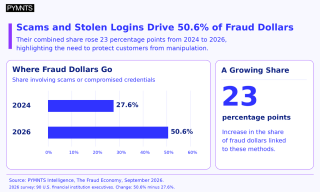
Banks have an opportunity to strengthen fraud protection by helping customers recognize when someone is persuading them to send money to a criminal. That’s a central finding of “Scams Get Personal: Why Banks Pay More to Fight Fraud,” the September 2026 edition of PYMNTS Intelligence’s “The...
Regional and community banks and credit unions surveyed by PYMNTS Intelligence now report behavioral analytics and artificial intelligence adoption approaching the levels seen with large banks, although their financial results remain uneven. The research underlying September’s “Scams Get Personal: Why Banks Pay More to Fight...
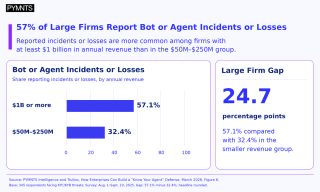
An identity check that stops a fraudster protects a business. One that blocks a legitimate customer costs it a sale. As automated agents handle more activity, enterprises have to establish who an agent represents and what it’s authorized to do, while keeping ordinary transactions moving....

Fraud losses reported by older adults increased fivefold between 2020 and 2025, leaping from $600 million to $3 billion, the Federal Trade Commission (FTC) said Monday (Oct. 19). The FTC shared this data in a press release outlining findings from its report to Congress, “Protecting...
Artificial intelligence is changing both sides of payments fraud. Fraudsters can use it to make impersonation attempts more convincing, while finance teams can use it to score transactions, verify documents and identify anomalies. PYMNTS Intelligence’s “Prevention First: Building a Smarter Defense Against Payments Fraud,” produced...
A traveler who has booked a real hotel can receive a fraudulent request containing the correct arrival date and reservation number. Criminals can use those details to demand payment information, warning that the room will otherwise be canceled. The European Commission’s Booking.com investigation, announced Wednesday...

European regulators are investigating whether Booking.com has done enough to prevent scams on its platform. The European Commission (EC) announced Wednesday (Oct. 21) that it had opened a formal inquiry into whether the travel platform had violated the Digital Services Act (DSA) by not having...
Google is bringing to the United States and Canada a Financial Services Verification program that already protects 2 billion internet users in 42 countries from financial scam ads, the company said in a Tuesday (Oct. 20) blog post emailed to PYMNTS. The program will be...