Start with the part nobody in the payments industry wants to hear. Stablecoins probably won’t win at payments.
Hundreds of billions of dollars in stablecoins circulate globally, and consumer payment adoption in developed markets is still thin. The checkout line was never the opening.
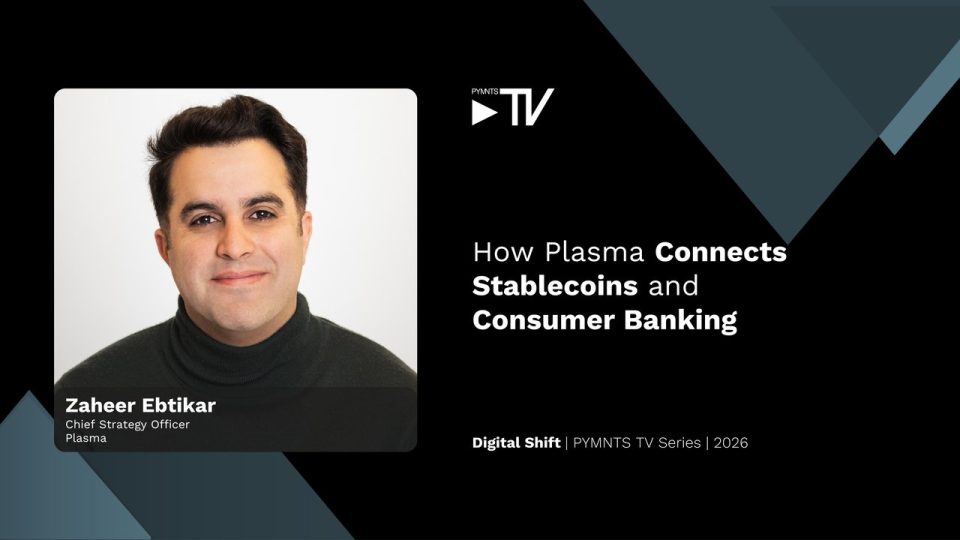
For Plasma Chief Strategy Officer Zaheer Ebtikar, that was never the point. The point was banking.
“Internationally, people don’t have access to financial services, and so they need something like a synthetic dollar,” Ebtikar told PYMNTS CEO Karen Webster in a PYMNTS exclusive.
That sentence reframes the entire stablecoin debate. The question isn’t whether a digital dollar can move faster than a card. It’s whether a digital dollar can become the account people actually live out of. Plasma is betting it can, and it has built a consumer product, Plasma One, around that bet.
The market is crowded. Exchanges, wallets and FinTech apps already hand people access to stablecoins. What Plasma is reaching for is something none of them set out to be. The bank.
Are users starting to treat Plasma as their primary banking relationship? Ebtikar pointed to the behavior, not the marketing.
“We’re seeing more top-ups, the top-up frequency increasing, and we’re also seeing more card spend in general,” he said. “More and more day-to-day spend is moving onto the platform.”
That’s what a primary account looks like in its early innings. Money comes in more often. Money goes out more often. The platform stops being a place you visit and starts being the place your money lives.
A Dollar You Can Trust in Places the Dollar Doesn’t Reach
In developed economies, stablecoins get sold as an efficiency upgrade. Shave a fee here, save a settlement day there. In much of the developing world, the pitch is different, and the stakes are higher. There, a stablecoin is an alternative to an unstable local currency, to limited banking access, to a financial institution you’re not sure will be standing next year.
Customers are people who “don’t feel super comfortable having a lot of money within their bank because there’s some amount of instability with the financial institutions, and they want to have a place to have their money and they want it to be under their own control,” Ebtikar said.
The product isn’t a faster payment. The product is custody you trust and dollars you can hold. That’s not a payments feature. That’s the founding promise of a bank.
Banks Aren’t Reimagining the Financial Experience
On paper, the incumbents should take this market. Big banks already own distribution, regulatory relationships and customer trust. As they push into tokenized deposits and blockchain payment rails, the gap looks easy for them to close.
Ebtikar said he doesn’t see it that way, and his reason is about mindset, not muscle.
“They’re still very much thinking about it from a traditional financial perspective,” he said.
The instinct is to tokenize the products that already exist rather than to reimagine the financial experience from the ground up, he said.
We’d love to be your preferred source for news.
Please add us to your preferred sources list so our news, data and interviews show up in your feed. Thanks!
So, does blockchain end up as an efficiency layer humming underneath the bank products we already have? Or does something genuinely new get built, something the incumbents can’t easily copy because it doesn’t start from their assumptions? Plasma is wagering on the second answer. Whether that wager pays off remains to be seen.
See also: British Neobank Plasma Debuts Stablecoin Banking Product
Digital-Dollar Platforms Could Leapfrog Traditional Banking
The future of money won’t be settled by technology alone, Webster said. Adoption, regulation, distribution and plain human behavior matter just as much. A better dollar that nobody can reach is just a whitepaper.
So, Plasma’s next job isn’t a better coin. It’s embedding the dollar into the places life actually happens, like cards, payroll, business banking, remittances and local payment networks.
“I think the No. 1 thing that we’re really focusing on is making stablecoins as frictionless as possible,” Ebtikar said, especially across borders, outside banking hours, around the clock. “Every form of technology has moved to a 24/7/365 basis, but the money hasn’t gotten there yet.”
The coin is only the opening move, he said.
“Stablecoins are kind of the thin first layer, but there’s so much more that needs to get built around them,” he said. “We’re global first. We’re thinking about all of the markets that traditionally have been underserved.”
Here’s the analogy that Ebitkar said makes the bet credible. Mobile phones did their most dramatic work in places that never had much landline infrastructure. People in those markets didn’t upgrade from one network to the next. They skipped the old model entirely and landed on the new one.
Plasma is betting digital dollars do the same thing for banking. In markets where the financial system was never finished, a stablecoin bank doesn’t have to be a better version of the local bank. It can be the first one people actually trust. Not an improvement on the system. The system itself.
Watch the full PYMNTS exclusive with Zaheer Ebtikar to hear more about:
Why stablecoins’ endgame may be deposits, not payments. Ebtikar said the biggest opportunity isn’t replacing the card at checkout. It’s giving consumers in underserved markets a digital-dollar alternative to local banks, currencies and savings accounts.
How stablecoins are shifting from infrastructure to consumer finance. Access to stablecoins is no longer the hard part. The new competition is over who can embed digital dollars into cards, payroll, remittances, spending accounts and everyday financial workflows.
Why the biggest stablecoin opportunity may be outside the developed world. Consumers facing currency instability and limited banking access may not adopt stablecoins as a payment method at all. They may adopt them as a primary financial relationship, letting digital-dollar platforms leapfrog traditional banking infrastructure entirely.


 Add as Preferred Source