Digital assets may be winning consumers’ attention, but a 14-percentage-point gap shows they haven’t yet won the checkout.
“From Asset to Everyday Money: Making Digital Currencies Spendable,” a Payments Innovation Tracker® from PYMNTS Intelligence and Paymentology, finds that consumers increasingly want cryptocurrencies and stablecoins to work like familiar forms of money. Demand is growing for everyday purchases, subscriptions and larger transactions. Yet limited merchant acceptance, transaction costs and uneven user experiences still separate ownership from routine use. The report points to an encouraging path forward: connect digital assets to the banking apps, cards and payment networks consumers already understand.
We’d love to be your preferred source for news.
Please add us to your preferred sources list so our news, data and interviews show up in your feed. Thanks!
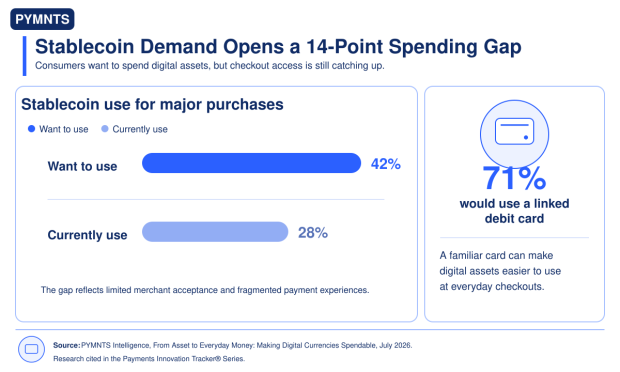
Demand has moved ahead of use. Forty-two percent of stablecoin holders say they want to use digital assets for major purchases, while 28% currently do. The 14-point gap suggests that the main constraint is no longer consumer curiosity. People need more places to pay and a simpler route from the asset in a wallet to a completed transaction.
Key Points:
- Familiar tools could close the distance. Seventy-one percent of stablecoin holders say they would use a linked debit card to spend stablecoins. Such cards can convert digital assets at the point of sale, send the payment over established card networks and pay merchants through systems they already use. Think of it as putting a new fuel through the same pump: the underlying value changes, while the customer experience stays recognizable.
- Trust may give banks and FinTechs an advantage. Seventy-seven percent of consumers say they would open a crypto or stablecoin wallet through their existing banking or FinTech app if the option were available. That finding suggests consumers don’t necessarily want another account or unfamiliar interface. Providers that already handle their money can make digital assets feel less specialized and more useful.
Other findings show why the opportunity extends beyond consumer checkout. Monthly crypto card spending grew about 15-fold from early 2023 to late 2025, reaching an annualized rate of roughly $18 billion. Stablecoins are also gaining ground in cross-border business payments, where faster settlement, lower costs and access to dollar-denominated value can solve practical problems.
Barriers remain: nearly half of surveyed consumers cite limited merchant acceptance, while 45% cite transaction costs, 43% cite volatility and 36% cite fraud concerns.
The report’s outlook is measured but positive. Linked cards, real-time conversion and modern issuer processing can make digital assets easier to spend without asking consumers or merchants to learn an entirely new payment method.


 Add as Preferred Source