Consumers who still pay their bills comfortably are losing confidence in managing debt, giving banks an opportunity to recognize financial pressure before customers fall behind.
The PYMNTS Intelligence report “Keeping Up Gets Harder: Debt Confidence Falls Among Bill Payers,” based on responses from 2,087 consumers in the United States, found in October that overall sentiment was holding steady while some household finances weakened. The PYMNTS Consumer Expectations Index edged up to 54.2 from 54.1 in September, remaining above its neutral reading of 50.
The report revealed that consumers grew more positive about economic conditions, but job worries increased. Among consumers living paycheck to paycheck without trouble paying bills, confidence in handling debt fell. This group represents about 4 in 10 consumers, making its experience particularly relevant to banks and payment providers.
Other key findings from the report:
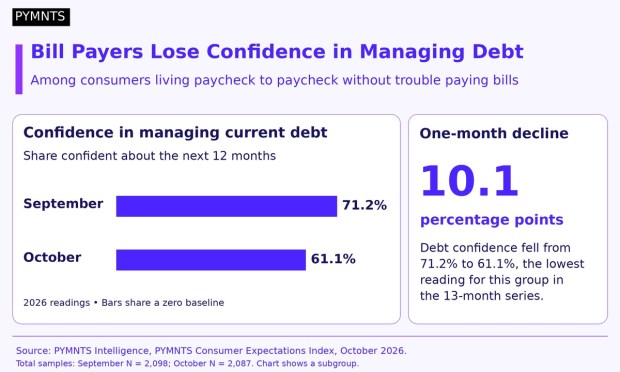
- Keeping up with bills doesn’t guarantee confidence. Among these paycheck-to-paycheck consumers without trouble paying bills, 61.1% felt confident about managing current debt over the next 12 months, down from 71.2% in September. That 10.1-percentage-point decline brought confidence to its lowest reading in the 13-month series. A majority remained confident, but the decrease suggested that payment records alone may give lenders an incomplete picture of customers’ finances. Paying on time is like passing a monthly inspection. It shows that obligations were met without establishing how much strain a household can withstand.
- Unexpected expenses became more common. In October, 32.5% of consumers in this group reported an unexpected expense of at least $1,200 during the previous 90 days, up from 27.1% in August. The 5.4-percentage-point increase exceeded the increases among both financially comfortable consumers and those struggling to pay bills. The survey didn’t establish that these expenses caused confidence to decline. Still, the findings suggested an opportunity for banks and FinTech providers to help customers plan for irregular costs and manage payment timing.
- Savings resilience improved across consumers overall. The share of consumers saying their savings would last three months or less fell to 47.5% from 51.8%, the first decline in four months. That improvement offered an encouraging counterpoint to the weaker debt confidence within the bill-paying group. Financial pressure isn’t moving in the same direction for every household.
Other findings reinforced that mixed picture. The share expecting the national economy to improve over the next year rose to 30.2% from 26.4%. Yet 20% had delayed a major purchase during the previous 90 days, up from 18.3% in August. For merchants, improving expectations offer an opening, although prices remain the leading reason shoppers hold back.
At PYMNTS Intelligence, we work with businesses to uncover insights that fuel intelligent, data-driven discussions on changing customer expectations, a more connected economy and the strategic shifts necessary to achieve outcomes. With rigorous research methodologies and unwavering commitment to objective quality, we offer trusted data to grow your business. As our partner, you’ll have access to our diverse team of PhDs, researchers, data analysts, number crunchers, subject matter veterans and editorial experts.