We explore this in “The Digital Healthcare Gap: Streamlining The Patient Journey,” a PYMNTS and Experian Health collaboration based on a survey of more than 2,300 U.S. consumers. Of the many eye-opening findings in this study is the sheer number of healthcare providers that consumers are engaging with — or trying to — making a strong case for the use of digital tools.
We’d love to be your preferred source for news.
Please add us to your preferred sources list so our news, data and interviews show up in your feed. Thanks!
Overall, the study finds that two-thirds of consumers use patient portals, with millennials and higher-income consumers the most likely to do so. Additionally, 32% of nonusers of portals express high interest in using a portal if offered by providers. Thirty-eight percent of specialist and radiologist patients who are not provided portals have the greatest interest in using them. At 29%, patients of family practice doctors who do not use patient portals are the least interested.
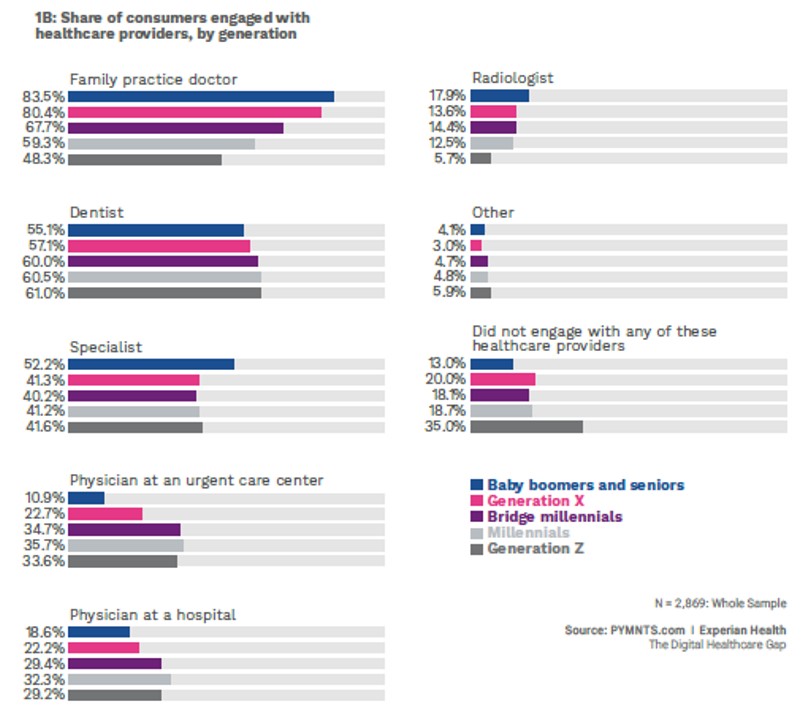
Looking at the breakdowns, 73% of patients who visited a healthcare practice in the last 12 months saw their family practice doctor, 58% of patients visited dentists and 45% saw specialists. Less than one-quarter of respondents visited a physician at a hospital (24%) or urgent care center (23%) and only 14% visited a radiologist.
The study states, “Baby boomers and seniors and Generation X patients were the most likely to use family practice doctors, at 84% and 80% respectively. Generation Z, millennial and bridge millennial patients were more likely to see urgent care or hospital physicians than older generations, with approximately one-third of each generation of consumers doing so in the last year. Just 11% of baby boomers and seniors visited an urgent care physician, while 19% saw a hospital physician. Close to two-thirds of all age groups scheduled dentist appointments. Only 8% of patients scheduled remote appointments, with family practice patients being the most likely to do so at 10%.”
We also found that 1 in 5 patients scheduled appointments via digital channels in the last 12 months, “with urgent care patients being the most likely to do so: 17% of urgent care patients scheduled via patient portals, 16% did so via the practices’ website and 5% via text message. Family practice patients tend to use patient portals to schedule appointments more than other digital channels, with 15% doing so, compared to only 5% who do so via their practices’ websites and 2% who do so via text message.”
Get your copy: The Digital Healthcare Gap: Streamlining The Patient Journey


 Add as Preferred Source