Analyzed in the PYMNTS study “How The World Does Digital: Different Paths To Digital Transformation,” we found that consumers in seven of the 11 countries we study increased their adoption of digital wallets for in-store payments. Across all countries, digital wallets were used for 4% more transactions than in the previous quarter, on average. In Japan, in-store use of digital wallets jumped a staggering 20%, leading all other nations we surveyed.
Looking at the rise of digital wallet usage in select economies studied as part of PYMNTS’ ConnectedEconomy™ Index, the study notes that “Japan — where cash-only retail is still common — saw a 20% increase in the use of digital wallets for in-store payments, indicating the release of pent-up demand post-pandemic. Japan now has the highest rate of in-store digital wallet use among the 11 countries, followed by Germany and Singapore.”
Consumers in Japan completed more than 88% of in-store mobile transactions in Q3 2022 using FinTech wallets, which tend to be local in origin.
The use of mobile wallets to pay for in-store transactions also rose in the U.S. (13%), Australia (14%), and Singapore (18%). “The difference is that global wallets dominate these markets, accounting for 47%, 74%, and 43% of in-store mobile payments, respectively.”
One place digital wallet usage fell was Brazil, where in-store digital wallet use fell 19% as of Q3 2022. The study states that “the economic windfall of Carnival festivities, which helped drive a temporary 19% rise in digital wallet use in Q2 2022, was eclipsed this quarter by high inflation and political turmoil surrounding the presidential election.”
Meanwhile, online use of mobile wallets “remained largely unchanged from Q2, experiencing a slight decrease of 0.3% across the 11 economies we study. However, online shoppers in Japan and the Netherlands ramped up their use of mobile wallets: 36% of consumers in Japan used mobile wallets to complete online transactions in Q3, as did 26% of their counterparts in the Netherlands — a 21% increase in both cases,” per the study.
Get your copy: How The World Does Digital: Different Paths To Digital Transformation


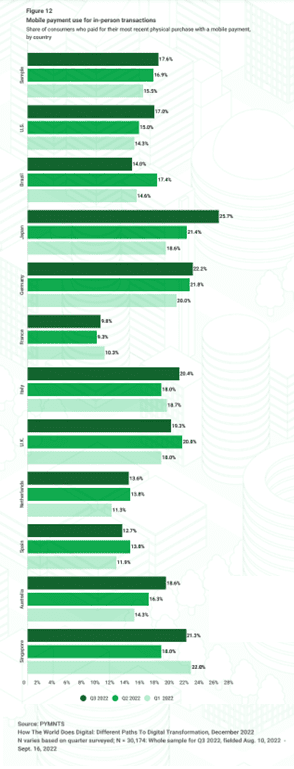 In measuring the digital transformation of some 30,000 consumers in 11 countries, collectively representing half of the global gross domestic product (GDP), PYMNTS finds that digital wallet use is rising markedly.