“Enterprises today suffer from decades of SaaS applications that define work in siloes and by departments,” the release said. “Many have dozens of separate AI solutions simply bolted onto existing systems, leaving employees juggling disconnected tools that don’t have access to the data they need to move work forward.”
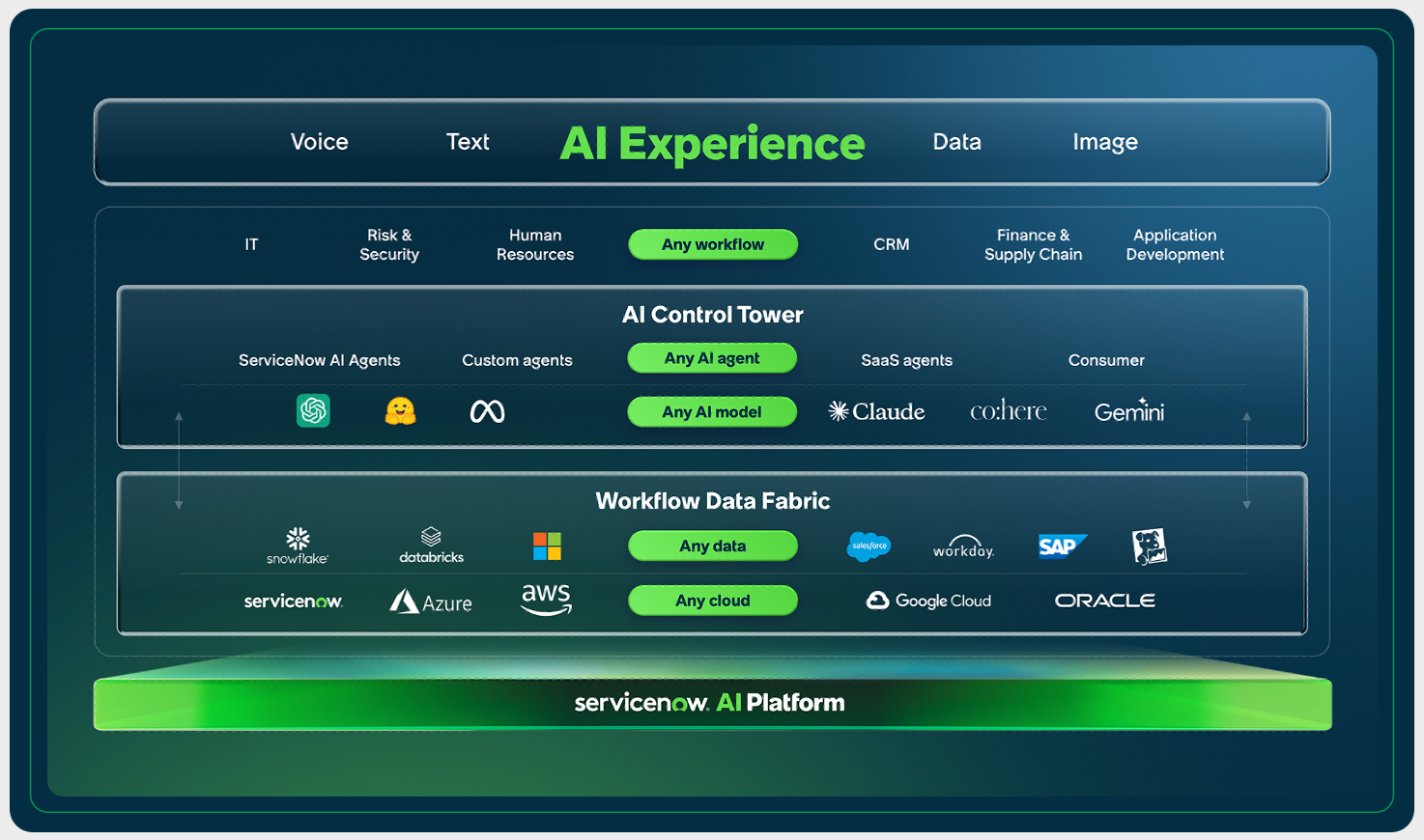 AI Experience combines data, AI models, AI modalities and workflows into one interface to help companies with adoption and access and to reduce AI learning gaps among their employees, according to the release.
Among the features of AI Experience are AI Voice Agents, which provide “hands-free support” to retrieve information, update records and troubleshoot issues with “human-like fluency,” the release said.
It also includes AI Web Agents, which can learn from humans to complete tasks across third-party apps and the web, as well as AI Lens, which takes what users see, such as screens, forms and dashboards, and turns it “into instant action, eliminating manual effort and accelerating decisions with AI-powered automation,” per the release.
Enterprises are turning to AI to automate not just repetitive tasks but also more complex processes such as compliance, fraud detection and supply chain optimization. They are employing tactics such as combining robotic process automation (RPA) with AI to streamline workflows.
Advertisement: Scroll to Continue
“With rising uncertainty, regulatory complexities and competitive pressures, companies are seeking ways to streamline operations, improve decision-making and unlock efficiencies,” PYMNTS wrote in January. The back office is ready for its glow-up, and the appropriate, effective and responsible use of AI could be the key.”
Meanwhile, the PYMNTS Intelligence report “The Agentic Trust Gap: Enterprise CFOs Push Pause on Agentic AI,” published in July, found some reluctance among enterprise chief financial officers in adopting AI agents.
While familiarity with agentic AI was nearly universal among CFOs, there was hesitation regarding its deployment. Only 15% of executives said they were even considering putting agentic AI to work, and most said they were in the early evaluation stage.
“This contrasts with the surging adoption of generative AI, which CFOs are increasingly using for tasks like content creation, customer service, coding and data analysis,” PYMNTS wrote Aug. 15.
For all PYMNTS AI and B2B coverage, subscribe to the daily AI and B2B Newsletters.