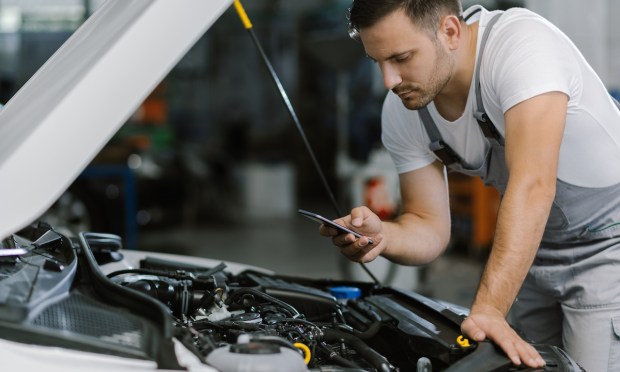
An automotive technician photographs a diagnostic error code and asks an artificial intelligence model what it means before touching a wrench.
An industrial mechanic points a phone camera at a bearing that has been running hot and gets back a probable cause before the shift ends.
Neither worker typed a paragraph describing what they saw. They just snapped a picture.
Scenes like these are becoming common across the physical trades, marking a shift in how AI shows up outside the office. Workers in predominantly physical and manual occupations, like auto technicians and industrial mechanics, are treating conversational AI as a live collaborator for real-time diagnostics, troubleshooting and on-the-job learning, Google found in its first AI & Economy ATLAS report released this month, according to a Thursday (July 23) company blog post.
The study also found that workplace AI now touches 68% of occupations, representing 90% of employment in the United States, although within any single job, workers use it for about 21% of their tasks on average, the post said.
Manual Workers Use Multimodal AI at Twice the Average Rate
“Blue-collar workers tend to be using a lot of what we call multimodal AI, which is AI with images and video,” said Scott Strand, head of strategic operations and special projects for technology and society at Google, according to a Thursday Axios report.
Workers in manual and technical trades are twice as likely as the average workplace AI user to use multimodal tools, those that create or interpret images and video, the Google blog post said.
We’d love to be your preferred source for news.
Please add us to your preferred sources list so our news, data and interviews show up in your feed. Thanks!
That is a different kind of value than the summarization and drafting work that dominates office adoption. A mechanic photographs a damaged part. An electrician holds up a wiring panel instead of describing which wire is which. The physical world produces information that resists text description, and a model built to read images can take it in directly.
That utility is showing up alongside a wage boom in the trades. Wages in construction and mechanical trades have climbed 30% to 40% since 2020, outpacing most office-based sectors, according to U.S. Bureau of Labor Statistics data cited by The Blue Collar Recruiter. Skilled trades work, such as plumbing and electrical repair, still requires human hands, human judgment and human presence that AI cannot replace. AI is making these workers faster, not obsolete.
Nationally, the wage-AI correlation still favors higher earners overall. A 1% increase in an occupation’s median earnings is associated with a more than 2.5% increase in AI usage intensity, the Google report found. The median salary of observed AI users is about $83,000, roughly $20,000 above the national employment-weighted median. The trades finding pushes that adoption curve into jobs built around a shop floor and not a screen. It’s a territory wage data alone would not have predicted.
Wholesale Firms Lead Other Sectors on AI Task Adoption
Individual adoption data shows where workers have found AI useful on their own. Enterprise data shows where companies have chosen to build it into how they operate, and on that measure, wholesale firms are setting the pace, PYMNTS Intelligence found in the July edition of its Enterprise AI Benchmark Report.
The report, based on a May survey of 60 senior technology executives at U.S. enterprises with at least $1 billion in revenue, revealed that the average wholesale firm uses AI across 35 of 75 tracked enterprise tasks, more than its counterparts in retail or construction. Three-quarters of wholesale firms have reached majority adoption in contract generation and security monitoring, and majority adoption now spans six of the report’s eight business functions.
The report showed that 65% of wholesale and retail firms are increasing AI budgets over the next year, and 70% expect returns to take five years or more. The timeline reads less like a pilot program than a line item in the infrastructure budget, the kind of spending that follows proof a technology works and not a bet that it might.
Back on the shop floor, none of that five-year math registers for the mechanic waiting on a diagnosis. The photo goes out, the answer comes back, and the wrench comes out already knowing what it’s for.
For all PYMNTS AI coverage, subscribe to the daily AI Newsletter.


 Add as Preferred Source