A company doesn’t need rising sales to lose a clear view of its cash, and that gives finance leaders a reason to improve visibility before growth returns.
That’s a central finding of “Growth and Scaling: The Corporate Finance Inflection Point,” a PYMNTS Intelligence report produced in collaboration with Fynapse. The August edition of The 2026 Certainty Project draws on a survey of 60 CFOs and senior finance executives at U.S. companies with annual revenue between $100 million and $1 billion. It finds that new products, suppliers and transactions can complicate financial operations even when revenue stays flat. Cash flow forecasting feels that pressure first. Like a windshield in heavy rain, a financial view becomes less useful when the details ahead are hard to see.
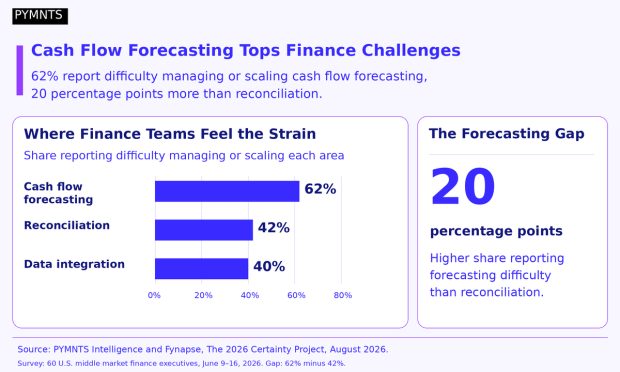
- Forecasting exposes the biggest visibility challenge. Nearly two-thirds of executives, 62%, said cash flow forecasting had been difficult to manage or scale. That’s 20 percentage points above reconciliation, the work of matching financial records, at 42%. Combining data across systems followed at 40%. More tellingly, 37% named forecasting their single hardest finance or back-office challenge. These functions depend on one another: incomplete or disconnected records make it harder to determine how much cash will be available and when. Improving the forecast therefore requires attention to the information behind it.
- Operational changes make disconnected data harder to manage. Among firms that made at least three significant business changes, 59% reported difficulty combining financial data, compared with 24% among firms with fewer changes. Reconciliation difficulties reached 59% versus 27%. The pressure wasn’t confined to expanding businesses. Among companies without revenue growth, 48% added suppliers and 40% reported higher transaction volumes. Those activities create additional records to match and payments to track, whether or not sales increase.
- Finance leaders are directing investment toward clearer cash information. Cash flow forecasting led investment priorities at 52%, followed by real-time reporting at 35%, reducing manual processes at 33% and unifying finance data at 32%. The findings suggest that CFOs recognize the connection between reliable forecasts and reliable inputs. They also point to practical improvements businesses can pursue now, from connecting financial records to reducing the manual work required to keep them current.
The report offers encouragement for those efforts. Executives rated consistent processes, finance automation and connected data among the most helpful approaches to managing complexity. Manual and spreadsheet-based processes were the only category that more respondents said hindered than helped them. Although 62% said their finance and back-office systems were at least mostly prepared for the next two years, just 12% reported complete readiness. Better cash visibility gives those investments a concrete purpose: helping finance teams plan payments and spending with greater confidence.
At PYMNTS Intelligence, we work with businesses to uncover insights that fuel intelligent, data-driven discussions on changing customer expectations, a more connected economy and the strategic shifts necessary to achieve outcomes. With rigorous research methodologies and unwavering commitment to objective quality, we offer trusted data to grow your business. As our partner, you’ll have access to our diverse team of PhDs, researchers, data analysts, number crunchers, subject matter veterans and editorial experts.