For finance teams weighing whether to use artificial intelligence to spot payment fraud, one of the biggest worries is what happens when a supplier sends a bill that’s perfectly legitimate.
That concern came through in “Prevention First: Building a Smarter Defense Against Payments Fraud,” a September PYMNTS Intelligence report produced in collaboration with Bottomline. Researchers surveyed 150 treasury and finance executives in the United States at companies with at least $100 million in annual revenue. It found that 57% of firms didn’t use AI to detect fraud in outgoing payments. Many of these firms trust employees to catch suspicious requests. They also see room for software that can help staff check a payment before money leaves the business.
Key findings from the report:
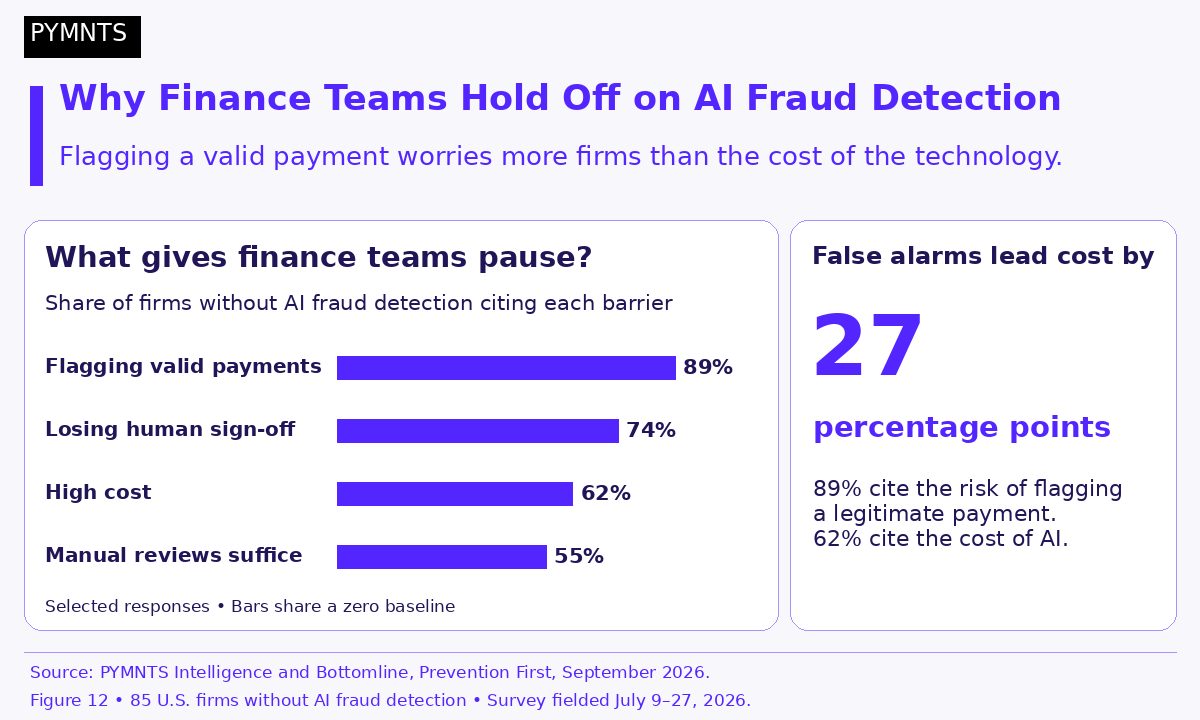
- A false alarm worries more firms than the price of AI. Among the 85 firms that didn’t use AI for fraud detection, 89% cited the risk of flagging a legitimate payment as a barrier to adoption. By comparison, 62% cited cost, a gap of 27 percentage points. For someone who pays suppliers, the distinction has a practical consequence. A system can flag a payment in seconds, but an employee still must establish that the supplier should get paid.
- Finance teams want a person to have the final say. Among firms without AI fraud tools, 74% expressed hesitation about automating without human sign-off. A smaller share, 55%, said manual reviews already handled fraud well enough. That 19-percentage-point gap suggests an opening for tools that act like a second pair of eyes. Software can flag a change in a supplier’s bank details while an employee who knows the account decides whether to release the money.
- Confidence in staff leaves room to try AI. Among firms that weren’t using AI fraud detection, 24% said they were already putting it in place. Another 9% planned to do so within six months and 25% within a year. Taken together, 58% were either implementing the technology or expected to do so within 12 months. Just 2% said they had no plans to adopt it.
Those tools would join a payment process that already involves several checks. Across the full survey, 83% of firms used bank account validation to detect fraud, 79% required approval from two or more people and 77% used staff reviews. For a finance team that knows its suppliers well, that gives AI a specific job to do. It can draw attention to the payment that deserves a closer look while leaving the decision with the people responsible for sending it.
For all PYMNTS AI coverage, subscribe to the daily AI newsletter.
At PYMNTS Intelligence, we work with businesses to uncover insights that fuel intelligent, data-driven discussions on changing customer expectations, a more connected economy and the strategic shifts necessary to achieve outcomes. With rigorous research methodologies and unwavering commitment to objective quality, we offer trusted data to grow your business. As our partner, you’ll have access to our diverse team of PhDs, researchers, data analysts, number crunchers, subject matter veterans and editorial experts.