Open finance should let a consumer’s full financial history help secure credit, personalize a financial service or inform a payment wherever that consumer chooses to do business.
To do that requires permission to move information between institutions. Consumers may welcome the service, yet still hesitate to authorize the connection, particularly when they can’t tell who will receive their information or what happens afterward.
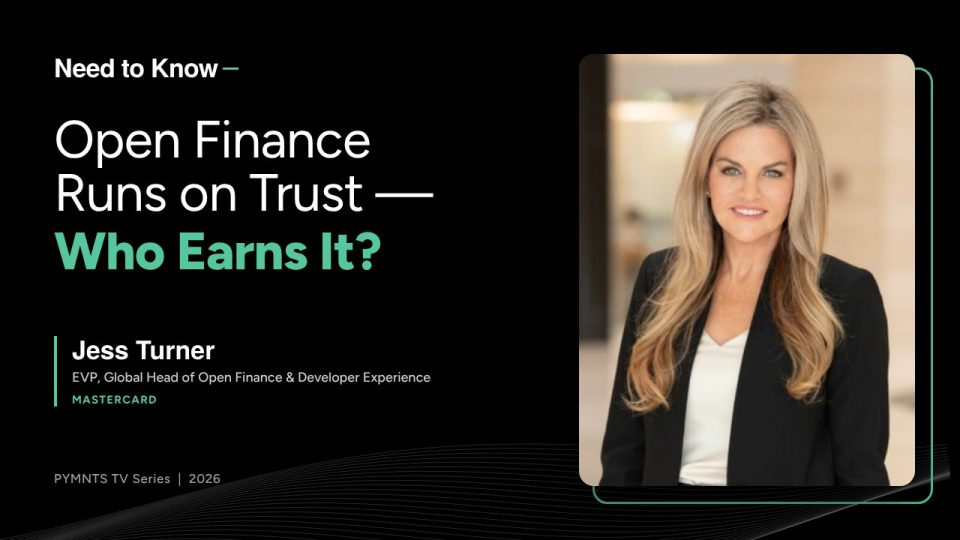
Jess Turner, executive vice president, global head of open finance and developer experience at Mastercard, said financial services providers have to address those concerns throughout their dealings with customers, not just at the point where data access is granted or denied.
Trustworthiness is something financial services providers must “prove every minute of every day,” she said.
Mastercard’s own research revealed that 89% of consumers surveyed across 11 countries would connect their financial accounts in exchange for services powered by open finance, Turner said. Nearly half of those willing to share data said it depends on understanding what the data will be used for.
To help address these concerns, transparency is critical, Turner said. Customers should know that the businesses are receiving their information, should be able to find out where it is, and understand that it’s protected and used for the agreed purpose. The account connection should be straightforward enough so that customers understand what they’re approving, which in turn means the firms must look inward at how they communicate with end users.
There’s a reason for providers to examine their own explanations. Mastercard found that 76% of consumers would switch providers for better money management features, and companies estimated that they missed out on as much as 4.6% in annual revenues due to gaps in data permissions. The data suggested that disclosure can influence provider choice.
Mastercard is positioned to close the trust gap, due in part to its role connecting the companies exchanging information, Turner said.
“We add security, we make sure we add enrichment to the data so it’s usable and can get to the outcome,” she said. “And we make sure we’re doing that with consent and in a way that is clear and transparent.”
Customers Need a Reason to Connect
Providers should begin with what consumers and small businesses want to accomplish through their bank, merchant or financial management service, Turner said. Customers and businesses need to see a benefit in sharing their financial data with third parties, such as faster onboarding, smarter lending, personalized experiences and seamless payments.
“It’s about outcomes,” Turner said.
The regional uses Turner described show why a single account-sharing proposition won’t suit every market. In Brazil, financial information can help assess borrowers with limited credit histories. In Australia, meanwhile, data enrichment can support banks in carrying out certain activities relevant to their regulatory obligations.
In the United States, Turner said, she sees market demand shaping open finance use cases in fraud, payments and personalized financial services.
For United Kingdom and European markets, there has been substantial development around payments initiation under regulation.
“What really helps things scale is when there’s commercial viability for all parties and that the user experience is very easy,” Turner said.
Artificial intelligence introduces another consideration. Turner said she expects open finance to support a move beyond providing and enriching financial data toward using that data to drive faster action.
To that end, Mastercard is applying concepts such as agent trust and verifiable intent to that development, Turner said, alongside capabilities in fraud, identity, payments and data insights.
A consent-led approach to open finance puts customer authorization at the heart of the discussion about consent management. As technology and agents gain the ability to act, providers will need to establish what customers have authorized these agents to do. Turner returned to consent when describing the safeguards required.
“We have to make sure that the intent is always captured with the right consent for data to help take action,” she told PYMNTS.
Watch the full interview with Jess Turner to learn more about:
- What consumers expect when they share financial information.
- How regional needs influence open finance services.
- How Mastercard approaches permission for AI-directed actions.