Credit card issuers have an encouraging starting point for keeping their cards first in customers’ wallets: Most cardholders haven’t seriously entertained a change.
That’s a central finding of “The Switching Trigger: How Issuers Can Stop Their Credit Cards From Losing Top-of-Wallet Status,” a PYMNTS Intelligence report produced in collaboration with Elan Credit Card. Drawing on a survey of 2,460 U.S. credit cardholders, the report examines why consumers change their primary card and why they stay. Sixty-four percent kept the same primary card over the previous two years. Among those who stayed, 75% never seriously considered switching. Trust provides an anchor for those relationships, while rewards and convenient account management give issuers practical ways to reinforce them.
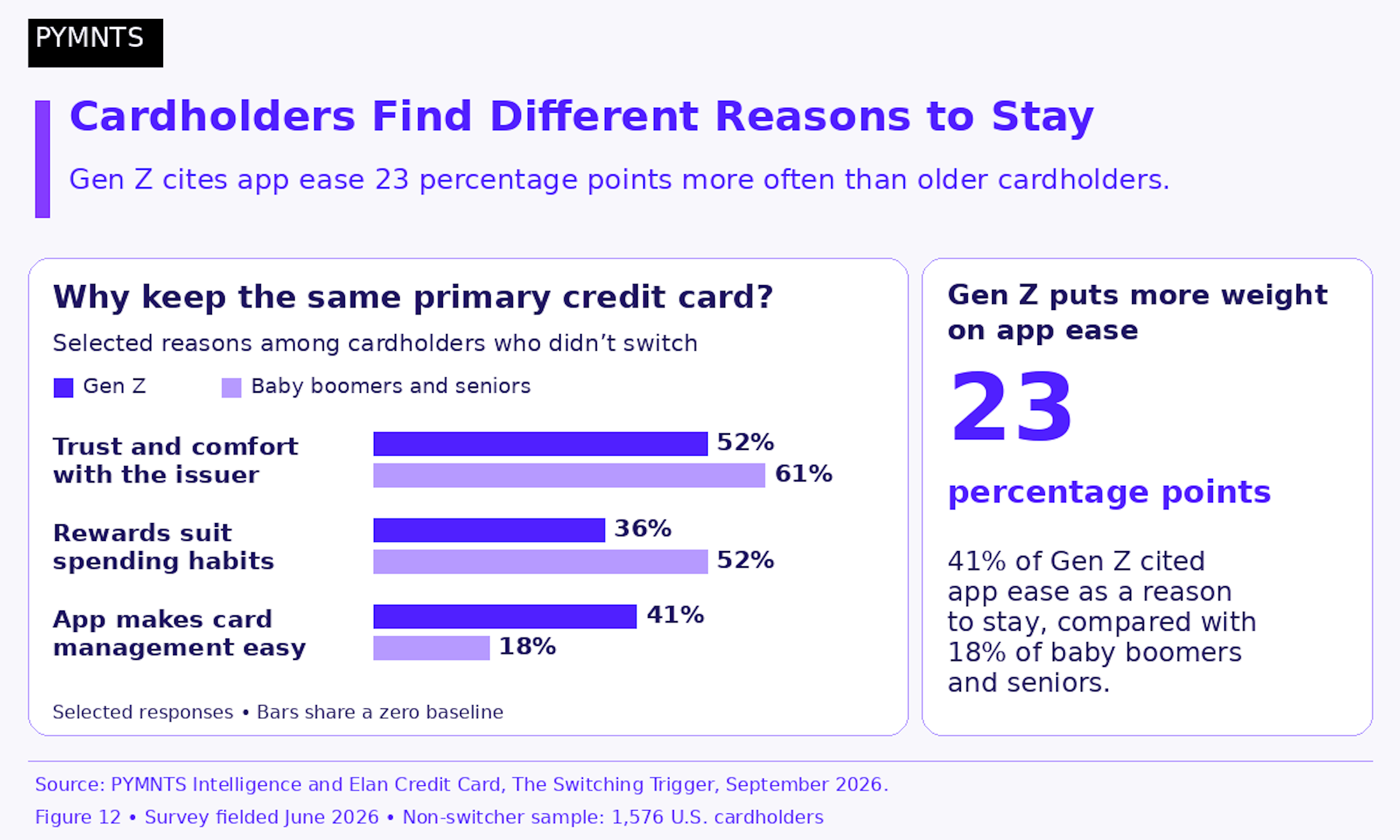
- Trust gives issuers a strong starting point. Among consumers who kept their primary card, 61% of baby boomers and seniors cited trust and comfort with the issuer as a reason, as did 52% of Gen Z. Those responses suggest that confidence in an existing provider remains valuable across generations. Issuers don’t have to persuade every customer to reconsider their choice. They can build on a relationship the customer already values, although the report cautions that trust is a basic expectation shared across providers.
- Younger customers give issuers a clear opening through their apps. Among Gen Z cardholders who stayed, 41% cited an app that makes managing their card easy, compared with 18% of baby boomers and seniors. That 23-percentage-point difference points to a practical opportunity to support loyalty through everyday convenience. Rewards also help explain why customers stay, but the generational pattern reverses: 52% of older non-switchers cited satisfaction with rewards for their spending habits, versus 36% of Gen Z.
- Loyalty leaves room for attentive service. Among cardholders who retained their primary card, 18% briefly considered switching before dismissing the idea and 7% seriously considered it but stayed. The broader generational differences are substantial: 82% of baby boomers and seniors kept the same primary card, compared with 44% of Gen Z. Those figures suggest issuers have more work to do to maintain younger customers’ preference, even when the relationship continues.
Other findings show why issuers shouldn’t take that preference for granted. More than one-third of cardholders changed their primary card during the two-year period, often choosing another card they already owned. Among switchers, 46% reported no contact with their former primary issuer about the change. Looking ahead, 14% of all cardholders said they were very or extremely likely to switch within a year. For issuers, the opportunity is to act while customers still prefer their card, using the report’s age-specific findings to guide improvements.
At PYMNTS Intelligence, we work with businesses to uncover insights that fuel intelligent, data-driven discussions on changing customer expectations, a more connected economy and the strategic shifts necessary to achieve outcomes. With rigorous research methodologies and unwavering commitment to objective quality, we offer trusted data to grow your business. As our partner, you’ll have access to our diverse team of PhDs, researchers, data analysts, number crunchers, subject matter veterans and editorial experts.