The most important question for software companies building payments used to be whether they had the engineers, budget and time to do it themselves. Agentic artificial intelligence has already made that question obsolete.
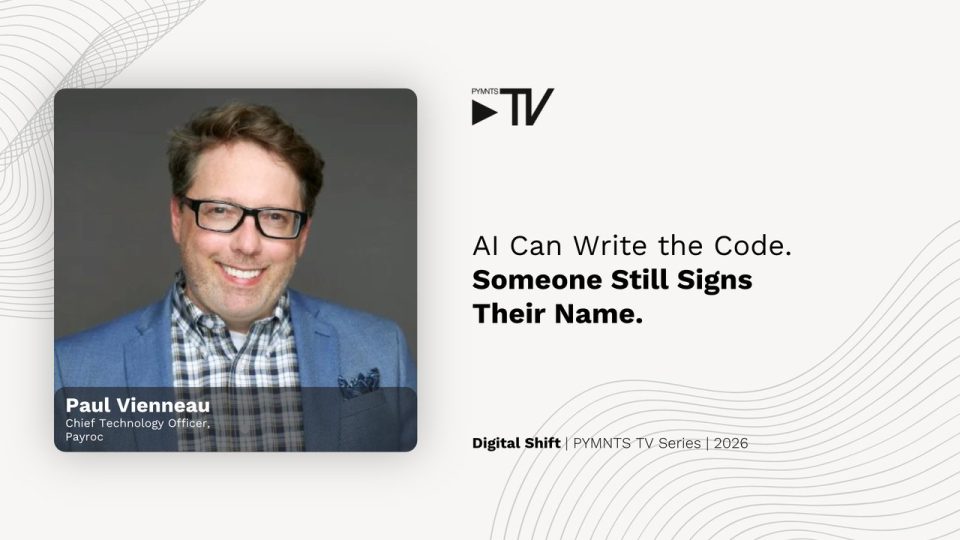
“The question has changed from can we afford to build it, to, who’s responsible for when it breaks at 2 in the morning?” Paul Vienneau, chief technology officer at Payroc, told PYMNTS.
Cheaper code does not make payments simpler. It can expose everything that was previously bundled into the price of a payments partner: compliance, fraud controls, testing, operational resilience and, ultimately, accountability.
“It’s easy to go from concept to a working demo or build,” Vienneau said. “What’s more difficult is encapsulating the expertise and know-how, that tacit knowledge that developers and the business have.
“Agents are going to write the code, but they’re not accountable for it. Someone still has to sign their name,” he added.
For software companies, that essentially flips the old build-versus-buy debate inside out.
AI Is Reframing the Build-vs-Buy Debate in Payments
Payments historically presented software companies with a relatively straightforward economic trade-off. Building internally meant absorbing development costs and assembling specialized expertise. Buying meant surrendering some control in exchange for infrastructure, compliance capabilities and operational support.
AI weakens the first half of that equation.
“Build is almost now out of the picture, in the sense that there’s a lot less friction towards that particular outcome,” Vienneau said.
“Accountability and compliance and ownership” are becoming scarcer, he added.
The implication is that companies evaluating payments partners today are buying something other than technology. They are buying institutional knowledge, fraud intelligence, reliability and someone willing to share responsibility when something goes wrong.
“Is it you that wants to get up at 3 o’clock in the morning or is it the partner?” Vienneau said. “Is it the partner that has a fraud control sophistication because they’re able to test against billions of transactions, where maybe you can’t?”
We’d love to be your preferred source for news.
Please add us to your preferred sources list so our news, data and interviews show up in your feed. Thanks!
Essentially, the paradox of artificial intelligence-assisted development is that faster prototyping can make the last mile more important. Payments are exposed to that distinction because seemingly small engineering decisions can intersect with sensitive assets such as cardholder data, compliance requirements and actual money movement.
Still, Vienneau described one domain where agents can move rapidly: interface changes, workflow adjustments and other reversible work where mistakes can be quickly undone. Better verification could eventually allow companies to give artificial intelligence greater freedom inside higher-risk environments. But for now, the key distinction may be reversibility: AI can move fastest where its mistakes are cheap.
Human Expertise Is Becoming More Valuable, Not Less, in the AI Era
That same logic helps explain why AI’s growing coding capabilities do not necessarily eliminate the need for experienced payments engineers.
“Agents can read the tutorials, agents can read the code, but people have lived the outages,” Vienneau said.
Humans, in his view, should establish rules, review exceptions and resolve ambiguous decisions while AI absorbs more of the repetitive development work.
“Let AI take over the toil and the drudgery,” he said. “But let humans bring in those guardrails, those checkpoints, those verification points.”
That may be the defining constraint on agentic payments development. AI is rapidly lowering the cost of creating software. It is not lowering the cost of being wrong when that software moves money.
Vienneau pointed to updated documentation, APIs and Model Context Protocol integration points as important because agents themselves can continuously evaluate and interact with partners’ capabilities.
“I see launch as the beginning of the relationship, because that’s now where the hard stuff takes place,” he said, emphasizing that as software itself becomes easier to generate, an API alone becomes less differentiated when compared to post-implementation durability.
Watch the full PYMNTS interview with Payroc Chief Technology Officer Paul Vienneau to hear more about:
- Why AI is killing the old build-versus-buy debate in payments.Vienneau says AI has made coding dramatically cheaper and faster, shifting the real question from whether companies can build payments themselves to who owns compliance, reliability and the 3 a.m. failure.
- Why faster AI development could require stricter payments guardrails.Vienneau says agents can move quickly on reversible workflows and UI changes, but card data and money movement demand tighter controls, verification and human oversight.
- Why payments expertise becomes more valuable as AI writes more code.Vienneau says agents can read documentation, but humans have “lived the outages” — giving experienced teams an edge in handling exceptions, setting guardrails and ultimately taking accountability when something breaks.

 Add as Preferred Source